

Published Jul 02, 2026 | 8:00 AM ⚊ Updated Jul 02, 2026 | 8:00 AM

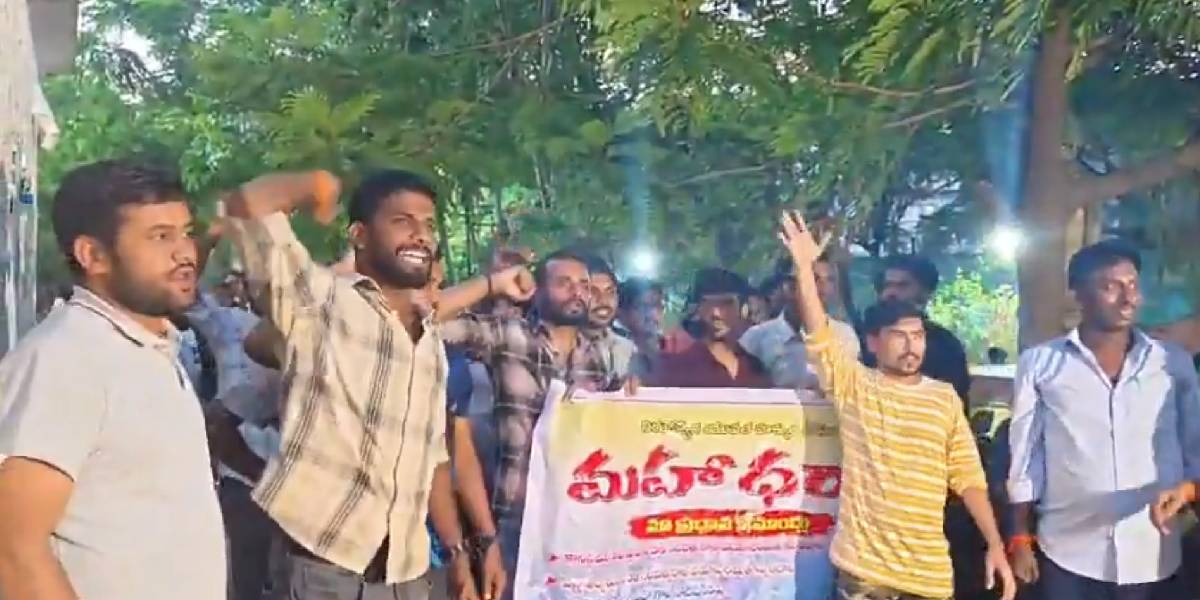
Aspirants protest at City Central Library, Ashok Nagar

Synopsis: Thousands of young people in Telangana are protesting over delays in government recruitment, saying years of cancelled examinations, court cases and unfilled vacancies have left them in limbo despite repeated promises of jobs. As the state struggles to restore confidence in its recruitment system, vacancies continue to mount across public services, particularly in education.
“How long are you going to be in Hyderabad?” “We can’t afford to send you money every month.” “How long should we wait?” These are routine questions that 26-year-old Indravati hears from her parents over the phone.
An engineering graduate from Telangana’s Nagarkurnool, she is among the thousands of aspirants in the city preparing to appear for government recruitment exams. She says she chose this path after a series of lay-offs and a hiring slowdown in the IT sector.
“It’s been three years since I started preparing for TGPSC [The Telangana State Public Service Commission] exams. I live in a rented room here in Ashok Nagar. There was only one Group I exam during this whole time, which was cancelled, and a retest was held later. We do not know when there will be another one. I don’t want to be a burden to my parents anymore,” she told South First.
Twenty-four-year-old Srikanth’s situation is even more precarious. A postgraduate in Chemistry, he has pinned his hopes on state recruitment exams while surviving on borrowed money.
“I am preparing for government recruitment exams by borrowing money from my friends. I have no support from my family. They want me to go back to my hometown and lend a hand in farming,” he told South First.
Hailing from Bhadradri Kothagudem district, Srikanth’s family are agricultural workers who own no land. He is determined not to return to farming. “I studied in Gurukuls and government colleges my whole life. I want to make something of it,” he said.
Indravati and Srikanth are not alone. A walk through the lanes of central Hyderabad’s Chikkadpally, Ashok Nagar, DD Colony, Vidyanagar and Padmarao Nagar reveals thousands of students with similar stories.
These localities have morphed into homes for innumerable coaching centres, hostels and dingy single-room flats, where young people from across Telangana and Andhra Pradesh arrive hoping to land government jobs. Many have little to no financial support from their families.
Some say that, on most days, they eat at the nearest government-run Indira Canteen.
In recent weeks, the area, along with east Hyderabad’s Dilsukhnagar, has become the site of flash protests as students, fed up with inordinate delays, have demanded the release of a job calendar and notifications to fill vacancies across various government departments.
One of the most notable protests was at the City Central Library, where police locked the library gates and arrested at least six people.
Protesters from the Telangana Unemployed Joint Action Committee, who are actively organising the flash demonstrations, told South First, “[Chief Minister] Revanth Reddy promised two lakh government jobs if the Indian National Congress came to power in Telangana. We rightfully demand that they fulfil their poll promise.”
Just a few minutes away from Chikkadpally is the historic Osmania University campus, where, according to the University College of Arts, at least 4,000 students are preparing to appear for public service recruitment exams.
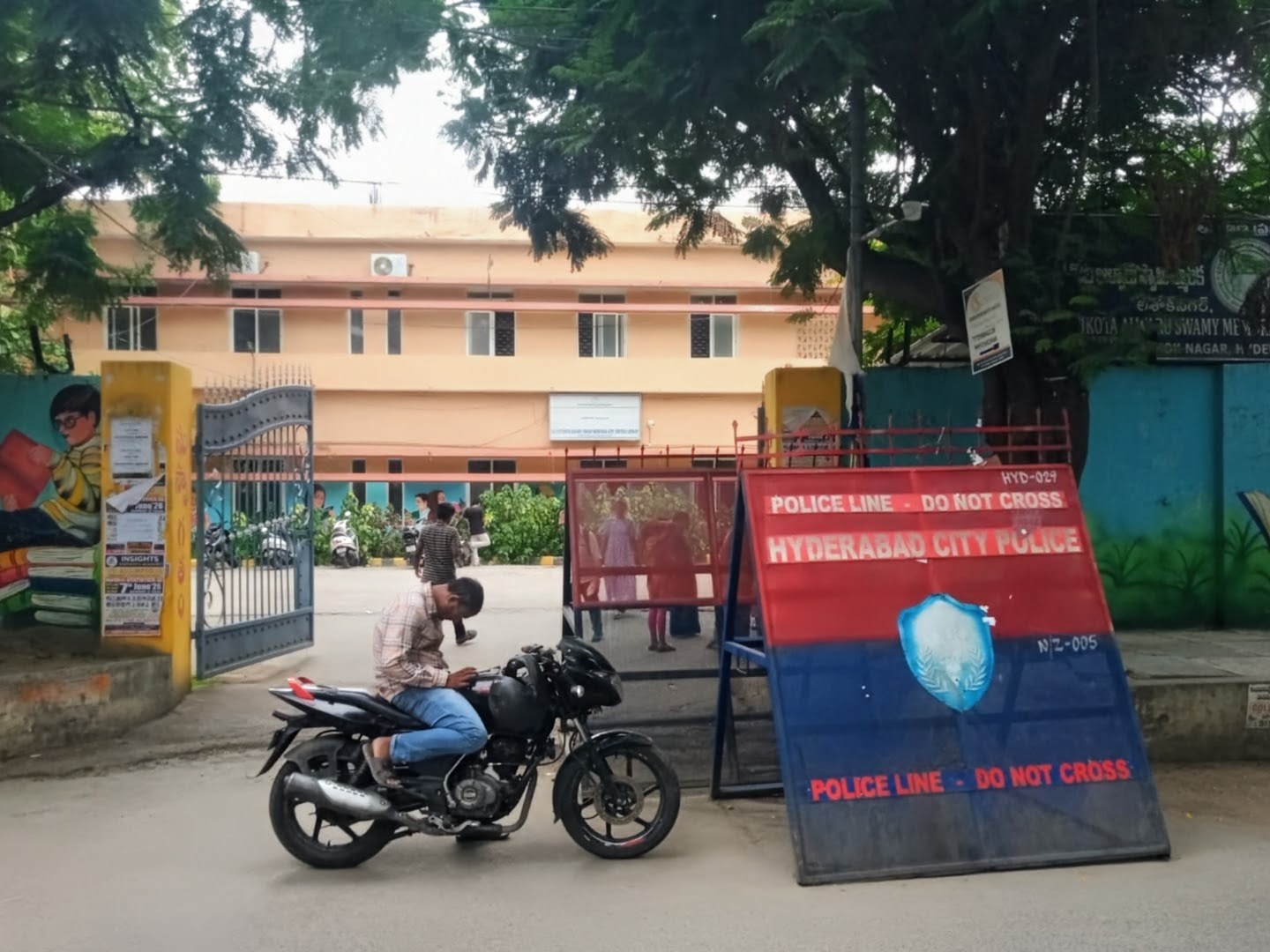
Police barricades outside City Central Library
The main university library, with a capacity of 2,000, is always full of aspirants for central and state government jobs. The campus has erupted in protests multiple times over the past year over delays in public service recruitment in Telangana.
The OU Joint Action Committee (OUJAC) has extended support to the Unemployed JAC and has conducted multiple demonstrations on campus over the last few weeks.
Also Read: Telangana overtakes Bihar to record India’s highest share of women who never attended school
The most prominent slogan of the Telangana statehood movement was Neellu, Nidhulu, Niyaamakaalu, which translates to “Water, Funds, Jobs (appointments)” — the three areas in which Telangana was seen as having been discriminated against under the united Andhra Pradesh.
Students were an important part of the movement and hoped that a separate Telangana would bring an avalanche of government job opportunities. But what followed over the next decade under the BRS government was a sustained institutional failure that sparked protests and court battles.
The problems were visible from the very first major recruitment drive. The Telangana State Public Service Commission (TGPSC) issued Notification No. 20/2015 and a supplementary notification in 2016, inviting applications for 1,032 posts across 13 categories under Group II services.
The written examinations were conducted in November 2016. The process quickly became mired in complaints of OMR sheet mismatches and tampering, with candidates filing petitions challenging the evaluation process and the final selection list published in 2019.
A government-appointed technical committee had recommended that such OMR sheets not be evaluated, but the Commission proceeded to include them in the final selection process.
In November 2025, the Telangana High Court quashed the 2016 Group II final selection list. The court held that the inclusion of tampered answer sheets was illegal and unconstitutional, and directed the TGPSC to undertake a fresh evaluation.
The recruitment process began in 2015 and remained unresolved a full decade later.
The 2023 crisis was even more explosive. The 2022 Group I notification, which covered coveted posts such as Deputy Collector, attracted 3.8 lakh applications.
This was the first Group I recruitment since 2016. When the examinations were finally held in October 2022, they were cancelled within months after a paper leak came to light in March 2023.
Two more recruitment examinations, for the posts of Assistant Executive Engineer (AEE) and Divisional Accounts Officer (DAO), were also cancelled.
An SIT investigation confirmed that insiders had copied Group I question papers onto a pen drive and sold them to candidates, raising fresh concerns about the integrity of the 2016 Group I recruitment process.
The Group I re-examination held in June 2023 was also annulled following directions from the Telangana High Court.
A three-member Pay Revision Commission, appointed by the then Bharat Rashtra Samithi (BRS) government, reported in December 2020 that 1.91 lakh posts had remained vacant across government departments since the state’s formation in 2014.
The finding was particularly damning given the promises made during the Telangana statehood movement.
It is widely speculated that massive unemployment and stalled public service recruitment were among the factors behind the anti-incumbency wave against the BRS in the 2023 Telangana Assembly elections.
Ahead of the elections, Congress leader Pawan Khera claimed that at least 40 lakh people were unemployed in Telangana. Several other party leaders repeated the figure throughout the campaign.
The Socio-Economic, Educational, Employment, Political and Caste (SEEEPC) Survey 2024 estimated that 10.2 percent of the state’s population aged 15 and above was unemployed. The estimate excludes students, retired employees, homemakers and several other social categories.
The Congress swept to power in December 2023, promising a transparent job calendar, two lakh government appointments within a year, a monthly unemployment allowance, and a judicial inquiry into the recruitment scandals that surfaced during the BRS government’s tenure.
Within days of taking office, Chief Minister Revanth Reddy ordered a review of the Commission’s functioning. The optimism, however, proved difficult to sustain. Eight months into its tenure, the Congress government released a job calendar that conspicuously omitted the number of posts to be filled.
The 2024 Group I recruitment cycle was also rocked by protests. A government order (GO) issued by the BRS government in 2022 recommended that the number of candidates allowed to write the main examination should be “fifty times the total number of vacancies” in each zone.
The TGPSC responded to the GO only in February 2024, stating that implementing it would require amendments to the examination rules.
The Commission, under the Congress government, amended the rules while relying on its interpretation of a 2009 Supreme Court judgment, which held that, in the event of a shortfall among reserved-category candidates, the remaining vacancies could be filled by general-category candidates beyond the prescribed 1:50 ratio.
Around three lakh aspirants appeared for the Group I preliminary examination held in July 2024. The amended rules triggered protests from some candidates, particularly those from reserved categories.
Also Read: Telangana Police impose Section 163 in Armoor after BJP counter-protest over Urdu row
When the Group I Mains was finally conducted in October 2024, it should have marked the end of a long ordeal. Instead, the Telangana High Court delivered a damning indictment of the TGPSC’s functioning.
A single-judge bench found that unqualified examiners had evaluated papers outside their areas of expertise and that some evaluators had assessed more than 1,400 answer scripts a day, a pace the court deemed incompatible with any meaningful assessment.
The High Court also noted that Telugu-medium candidates had fared disproportionately poorly compared with candidates from much smaller language groups, suggesting systemic bias rather than random variation. It ordered a re-evaluation.
A Division Bench overturned that order in February 2026, ultimately upholding the selection process and clearing the way for 563 appointments.
The Congress government has not issued any fresh notifications for Groups I, II, III or IV since then. Aspirants are still awaiting a detailed job calendar for 2026.
Gadusu Krishna, an active member of the Unemployed JAC who has participated in the recent flash protests, said he has watched several peers lose confidence in the TGPSC recruitment process.
Krishna, who belongs to the Scheduled Caste Madiga community, said the Congress government has betrayed people like him.
“Even after preparing and writing exams, there is no hope that the recruitment process will be completed successfully. They are discriminating against candidates appearing in the Telugu-medium stream. Who are these students? They are the ones who come from government schools. We had to study there because we couldn’t afford private schools,” said Krishna, who has been preparing for competitive examinations for more than six years.
The Leader of the Opposition in the Lok Sabha, Rahul Gandhi, visited the City Central Library in November 2023, where he interacted with students and unemployed youth at the tea stall outside.
He promised that, if elected, the Congress government would fill two lakh vacancies in government departments within a year.
Recalling Gandhi’s visit, Krishna asked, “Where is the Rajiv Vikasa Yojana? Where is the promised unemployment allowance? We were disillusioned with the BRS, so we voted for the Congress. Many Congress leaders visited us during their election campaign. They asked us to put our books aside for a month and join them in bringing Marpu (change). Now we feel cheated. We are not asking them to create new jobs. Why are they not filling the existing vacancies?”
Telangana’s public education system is also grappling with a severe staffing crisis, with thousands of teaching and administrative positions lying vacant.
The Telangana Education Commission’s Education Policy Report 2026 lays bare staff shortages across every tier of public education in the state.
Based on data collected from all 33 districts, the report found that chronic vacancies, prolonged recruitment delays, and an increasing dependence on contractual and guest faculty have severely undermined the quality of public education.
Around 36 percent of primary schools function with just one teacher, or none at all, while nearly 89 percent fall short of the minimum requirement of five teachers, forcing widespread multi-grade teaching in cramped, under-resourced classrooms.
Administrative and supervisory posts also remain largely vacant, forcing teachers to perform duties well beyond their designated roles.
During the BRS government’s tenure, only one large-scale recruitment drive was conducted in more than a decade to fill teacher vacancies in government schools. The Congress had promised a Mega DSC (District Selection Committee) drive to recruit 20,000 teachers.
However, the recruitment conducted in 2024 filled only 11,062 posts, of which around 5,000 had already been notified by the previous BRS government in 2023. Another DSC notification was scheduled for February 2025, but no further announcement has been made, leaving prospective applicants in limbo.
More recently, Chief Minister Revanth Reddy’s announcement that 23,000 residential schools in Telangana would be closed, citing low enrolment, drew criticism from education activists.
Speaking to South First, K Lakshminarayana of the Telangana Save Education Committee said, “The government does not want to investigate why enrolment has gone down. They are permitting private schools to run without any regulations. They don’t want to correct staffing shortages in government schools. Without teachers, who will go to schools?”
On the government’s failure to conduct the promised mega recruitment drive, Lakshminarayana said, “None of these governments is interested in giving jobs. They abandon their promises after coming to power. The public education system cannot survive if they don’t employ more people. They need to recruit more teachers in all schools.”
Also Read: Revanth Reddy unruffled as the Telangana Congress kettle threatens to boil over
The problem deepens further in higher education. No regular recruitment of lecturers in government degree colleges has taken place for more than a decade.
According to the Telangana Education Commission’s Education Policy Report 2026, 2,589 of the 4,115 sanctioned posts in Government Degree Colleges are vacant, a vacancy rate of 62 percent.
Across Government Degree Colleges and welfare residential degree colleges combined, the vacancy rate stands at 61 percent, leaving the system heavily dependent on nearly 2,400 guest and contract faculty.
State universities fare no better. The last recruitment of assistant professors in state technical universities took place in 2009, more than 15 years ago.
Public engineering colleges are grappling with more than 72 percent of sanctioned faculty posts remaining vacant, with 648 positions requiring urgent recruitment. Government polytechnics, which primarily serve students from low-income backgrounds, have a 25 percent vacancy rate among teaching staff and a staggering 55 percent vacancy rate among non-teaching staff. Overall, 41 percent of sanctioned posts across the polytechnic system remain unfilled.
Prof. C Kaseem, Principal of the Osmania University College of Arts & Social Sciences, told South First that the university alone has close to 1,000 vacancies.
“We are currently functioning with only 327 permanent employees against 1,268 sanctioned posts. There are 17 public universities in the state. Around 3,000 posts are vacant across these institutions. If the Telangana government is serious, it could fill all the vacancies in the public higher education system and easily account for 50,000 of its promised two lakh appointments,” he said.
Prof. Kaseem said many meritorious candidates with master’s and PhD degrees are still waiting for appointments as assistant professors and lecturers.
“Several government junior and degree colleges are also short-staffed. Even posts that were already sanctioned by the BRS government, with budgetary allocations in place, are not being filled by the current government,” he alleged.
In November 2025, then Director General of Police (DGP) Shivadhar Reddy announced at a press conference that the department had around 14,000 vacancies for constable posts. He said a proposal seeking the state government’s approval to fill these vacancies had already been submitted.
When CV Anand took charge as DGP in May 2026, he put the figure even higher, stating that there were around 19,000 vacancies across the police department and that a major recruitment drive would be held soon.
Telangana conducted three major police recruitment drives over the past 12 years, all during the BRS government’s tenure, in 2016, 2019 and 2022. Each filled between 9,000 and 16,000 posts.
No major police recruitment notification has been issued since the Congress came to power. However, speaking at The Hindu Huddle on 6 June, Chief Minister Revanth Reddy said a notification to recruit 5,000 police personnel would be issued soon.
The announcement triggered an uproar, as the earlier statements by successive police chiefs had raised expectations of a much larger recruitment drive.
Madhusudhan Goud, a postgraduate in physical education, said he quit his job at a private school after government sources hinted at a large-scale recruitment drive.
“I have been preparing for five years in the hope of getting a Group(s) job, or becoming a police sub-inspector or constable. It has been four years since the last police recruitment. After all this wait, they announced only 5,000 vacancies, even though the police chief himself said there were 19,000 vacancies,” he told South First.
“There are lakhs of aspirants waiting for these jobs. Five thousand is a very low number. Most of these posts will be filled in and around Hyderabad. What about the districts? And who is going to compensate us for the four years we lost?” he asked.
The steady erosion of public services, and, with it, public-sector employment, in the Telugu states has been underway since the 1990s, following India’s economic liberalisation.
As Chief Minister of the erstwhile united Andhra Pradesh, N Chandrababu Naidu introduced a series of governance and economic reforms broadly aligned with the World Bank-backed restructuring agenda pursued during that period.
Large-scale privatisation, fiscal restructuring and a gradual shift in government spending followed, slowing permanent recruitment across the public sector. Contract employment and outsourcing increasingly became the norm.
Prof. Kaseem argued that successive governments have, by and large, continued along the same path.
“A permanent employee must be paid a livable wage, along with annual increments and benefits. Governments get away with paying barely one-fifth of that to contractual employees. Maybe that’s why recent governments have shown little interest in filling permanent posts,” he said.
Public-sector jobs continue to attract young graduates from marginalised socio-economic backgrounds because they offer job security, a stable income and the possibility of upward social mobility.
For many, the Telangana statehood movement fostered hopes that a new state, with nearly 85 percent of its population belonging to Scheduled Castes, Scheduled Tribes and Other Backward Classes, would expand access to public employment.
“Our hopes were shattered by both governments, the BRS and the Congress. They only used unemployed youth to win elections,” said aspirant Madhusudhan Goud.
Government jobs also remain especially attractive to young people from historically marginalised communities because entry into professional private-sector employment often presents significant barriers. The Telangana government’s SEEEPC Survey 2024 notes that, for many SC and ST families, state-run Gurukulam residential schools represent their children’s best chance at upward mobility.
Yet these schools have not consistently equipped students to compete in the private job market. English-language proficiency, access to professional networks and other forms of social capital continue to play a significant role in corporate hiring, creating additional barriers for students educated in government schools.
Prof. Kaseem believes this has contributed to political indifference towards unemployed youth.
“Many young people have already moved into the private sector. After the IT boom, most middle- and upper-class families began preferring corporate jobs or opportunities abroad for higher education and employment. Those who still aspire to government jobs are mostly from marginalised communities. Since the ruling classes have largely moved away from these aspirations, governments that represent their interests no longer consider this a priority,” he said.
The simmering discontent spilled into the streets in June, as flash protests erupted across Hyderabad, drawing attention to unemployment and delays in government recruitment.
Police have repeatedly cracked down on the demonstrations, detaining activists and aspirants on multiple occasions this month.
On 10 June, a large group of police job aspirants, under the banner of the SI and Police Constable Candidates’ JAC, stormed the Dilsukhnagar Metro station to protest Chief Minister Revanth Reddy’s announcement of 5,000 police vacancies.
As the crowd swelled, police resorted to a lathi charge, drawing criticism from opposition parties.
Multiple demonstrations were also organised outside the City Central Library, demanding the release of a comprehensive job calendar. The Unemployed JAC raised concerns about the state’s recruitment process and demanded the rollback of what it called an arbitrary increase in application fees for recent recruitment notifications.
The organisation also criticised the TGPSC for issuing multiple small recruitment notifications instead of notifying all vacancies together and publishing a detailed recruitment calendar.
Gadusu Krishna of the Unemployed JAC said, “Some of our peers who couldn’t afford to live in Hyderabad have returned to their hometowns. Firstly, we do not know when a large-scale recruitment drive will take place. Secondly, the sporadic notifications are creating confusion among aspirants. They are unable to decide whether to apply for the currently advertised posts or wait for better opportunities. A detailed job calendar would help us focus on the posts we have been preparing for.”
The City Central Library is now under constant surveillance, with CCTV cameras and police barricades. Library patrons alleged that they were being directly monitored by the office of the state’s police chief.
Members of the Unemployed JAC and the Police Aspirants’ JAC also joined the Cockroach Janata Party protest at Dharna Chowk on 15 June. They highlighted the unemployment crisis in Telangana and expressed solidarity with the CJP’s campaign against irregularities in public recruitment examinations.
The latest protest was held at the office of the Telangana State Level Police Recruitment Board (TSLPRB) in Lakdikapul on 30 June. Police once again detained demonstrators and transported them to nearby police stations. The protesters resumed their demonstration in Dilsukhnagar later that evening. Telangana Rakshana Sena’s K Kavitha also met the aspirants and extended her support.
The Unemployed JAC is planning larger protests across Telangana in coordination with several student organisations if the government fails to fulfil the recruitment promises it made during the election campaign.



