
Published May 22, 2026 | 7:59 AM ⚊ Updated May 22, 2026 | 7:59 AM

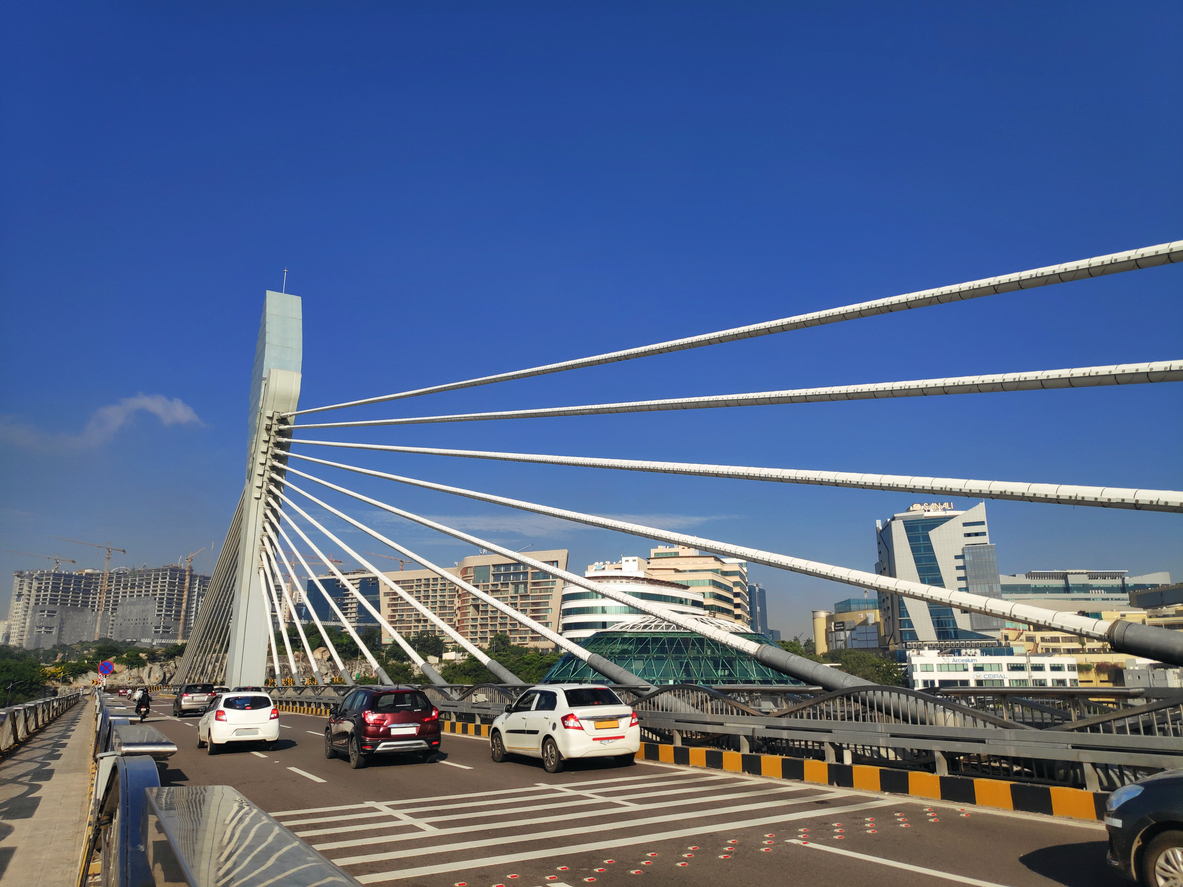
A brigde in Hyderabad. (iStock)

Synopsis: In an attempt to ease traffic congestion in Hyderabad, the government has been approving and building new flyovers across the city. However, flyovers carry a hidden cost that is rarely discussed. At every point where an elevated corridor or flyover is constructed, the road beneath it is constricted. Multiple transport systems are never discussed or reviewed. There is no integrated thinking, even though a sample of traffic on Hyderabad roads is always a mix of transit systems.
Every few years, Hyderabad’s roads get a new promise. A widened stretch here, a flyover there, a freshly coined acronym — SRDP, H-CITI — attached to a cluster of projects rendered in glossy brochures and attractive AI-generated videos. Ribbon cuttings follow. And then, within months, the same roads clog again. Commuters shrug. Planners plan again.
This cycle is not incidental. It is the system working exactly as designed.
Also Read: The minister who sat on a stove and turned up the flame
There is a peculiar feature of Hyderabad’s road network: Fixed widths are a fiction. Roads that were widened in the 1990s are candidates for re-widening today. Stretches expanded a decade ago are already earmarked for another round. What does this tell us?
It tells us that the city’s growth was never adequately anticipated. It tells us that violations — commercial encroachments, unauthorised constructions, illegal parking structures — were allowed to accumulate until they became the new baseline.
And it tells us that each expansion, rather than creating a buffer for the future, was consumed almost immediately by the very pressures it was meant to relieve.
This is not a planning failure in the conventional sense. It is a failure of will — a refusal, repeated across administrations and decades, to enforce what already exists.
When a road is widened in Hyderabad, properties that sit in its path must be partially or wholly demolished. Compensation is owed. But cash is expensive, and the Greater Hyderabad Municipal Corporation (GHMC) and allied agencies prefer an alternative: Transfer of Development Rights, or TDR.
TDR is presented as an elegant solution. Instead of cash, displaced property owners receive rights to build vertically — either on the same plot, set further back, or on another plot entirely. The government saves money. The owner is, theoretically, made whole. Urban planners have called it revolutionary.
But observe what actually happens on the ground. Take the road between RTC X Roads and Ashoknagar. The road was widened. TDR was granted. Owners built upward. More floor space meant more residents, more businesses, more vehicles.
The additional road width — the entire justification for the disruption and demolition — was absorbed almost entirely by the parking demand generated by the new vertical construction.
TDR, in this context, does not offset road expansion. It cancels it out. The city gained nothing in effective road capacity. It merely displaced the problem forward by a few years, at considerable public and private cost.
Hyderabad has an inner ring road with six lanes — a genuine piece of infrastructure designed to move traffic efficiently around the city’s older core. Today, it is a study of everything that can go wrong when infrastructure is built without governance. The Outer Ring Road (ORR) can go similarly, even though it is grade-separated. But that is another study.
The road itself is technically still six lanes. But those lanes exist in name only. On one side, shops have extended their display areas onto the footpath and then onto the road. On another, street vendors occupy what was once a service lane. Roadside parking — unregulated, temporary, haphazard, often permanent — has effectively narrowed the carriageway by two lanes in many stretches.
What moves through the remaining space is a genuinely chaotic mix: Heavy goods vehicles that operate through the night, buses competing for the same lane, two-wheelers weaving between them at speeds that bear no relationship to surrounding traffic, and pedestrians who, lacking usable footpaths, walk on the road itself. No lane discipline is observed because no lane discipline is enforced.
This is the product of three overlapping failures: Mixed land use with no separation between heavy commercial, residential, and transit corridors; road maintenance that has been chronically neglected; and traffic enforcement that, for practical purposes, absent. A series of flyovers was constructed to overcome this congestion. No investment was made for improving road maintenance.
Flyovers and elevated corridors carry a particular mystique in Indian urban planning. They are visible, photographable, and attributable — a politician can point to a flyover in a way they cannot point to bus frequency improvements or footpath repairs.
As Prashanth Kumar Bacchu points out, the argument for flyovers is positive only to cross railway lines or waterways. Crossing a crossroad by building a flyover or bridge is bad road planning. Flyovers merely shift the traffic problem from Point A to Point B. But Hyderabad city planners of various hues and colours think flyovers are the only answer to traffic congestion.
Flyovers complicate the problem of road traffic.
Further, flyovers carry a hidden cost that is rarely discussed. At every point where an elevated corridor or flyover is constructed, the road beneath it is constricted. The supporting pillars eat into the carriageway width.
In many cases, the reduced width is insufficient for full-sized buses. The result: Public transport routes are diverted or discontinued on precisely those stretches where infrastructure investment has been heaviest.
The road, having received crores of rupees in investment, becomes less useful for the buses that carry the largest number of people. More cars can pass overhead; fewer buses can pass below. This is a transfer of road capacity from high-occupancy vehicles to low-occupancy ones — the opposite of what a congested city needs.
Nobody is accountable for this outcome. No detailed project report that predicted the construction of a flyover is made public. No agency owns the problem once the contractor has been paid.
Also Read: Hyderabad firm announces cash incentives for employees switching to EV vehicles
There is a constituency that benefits from Hyderabad’s perpetual infrastructure churn, and it is not commuters. It is consultants. Private consultants are commissioned to study traffic, model future demand, and recommend interventions. Their recommendations are, with near-total consistency, more projects: more roads, more flyovers, more grade separators.
This is not necessarily because more roads are always the right answer. It is because the consultant’s income depends on new projects. A study that recommends enforcement, behavioural change, and better public transport generates no follow-on engineering contract.
Public institutions — universities with urban planning departments, IITs with civil engineering expertise, independent research bodies — are systematically excluded from this process. Their involvement would introduce scrutiny, public accountability, and the possibility of recommendations that do not generate construction contracts.
The result is a closed loop: Consultants recommend projects, projects are approved, projects generate new problems, consultants are commissioned to study the new problems, and more projects are recommended.
There is a set of questions that Hyderabad’s infrastructure discourse seldom asks. What is the opportunity cost? Every crore spent on a flyover is a crore not spent on bus fleet expansion, footpath construction, or junction redesign. These trade-offs are never made explicit. The public is not invited to consider them.
What would it cost to enforce existing rules? Encroachments on footpaths are illegal. Roadside parking on no-parking stretches is illegal. Overloaded vehicles on city roads are illegal. Enforcing these provisions requires no new infrastructure at all — only sustained will. No government has demonstrated that will.
Why are single-occupancy cars the implicit design standard? A road designed around single-passenger cars will always fail. A city the size of Hyderabad cannot move its population in private vehicles. The arithmetic is impossible. Yet every road widening, every new flyover, every traffic management intervention is calibrated to the car. Buses, bicycles, and pedestrians are afterthoughts.
Where is the comprehensive study? Piecemeal project-by-project assessments exist in abundance. A comprehensive, publicly available, independently reviewed study of Hyderabad’s transport system — its actual demand patterns, its modal distribution, its infrastructure lifespan, its maintenance backlog — does not exist in the public domain.
Multiple transport systems — from pedestrian methods and cycling to metro rail — are never discussed or reviewed. There is no integrated thinking, even though a sample of traffic on Hyderabad roads is always a mix of transit systems.
Decongestion is possible. Cities in conditions of comparable density and income have achieved it — not by building more roads, but by making existing roads work better and investing heavily in mass transit.
The tools are well understood: Dedicated bus lanes, integrated public transport with reliable frequency, pedestrianised streets in commercial cores, parking pricing that reflects real scarcity, strict enforcement of road rules, and land use planning that reduces the need to travel long distances.
None of these requires revolutionary technology. Several require no capital expenditure at all. What they require is political will that survives beyond the next election cycle and administrative continuity that outlasts the next transfer order.
That is, evidently, the harder problem.
Also Read: The fight to save Hyderabad’s last urban forest
Hyderabad’s roads are not a solved problem waiting for more funding. They are an unsolved governance problem that more funding — channelled through the same institutional arrangements — will not fix.
Every new flyover announcement, every fresh acronym attached to a package of road projects, is a decision to defer the real question: Not how to build more road space, but how to use existing space better, enforce existing rules more consistently, and move more people with fewer vehicles.
Until that question is seriously asked — in public, with transparent data, with accountability for outcomes — Hyderabad’s roads will keep being widened, and will keep being congested, and the cycle will continue.
The contractors will be paid. The consultants will file their reports. And commuters will sit in traffic, on roads that were just expanded, wondering why nothing ever changes.
(Views are personal.)



