

Published Jul 03, 2026 | 2:55 PM ⚊ Updated Jul 03, 2026 | 3:16 PM

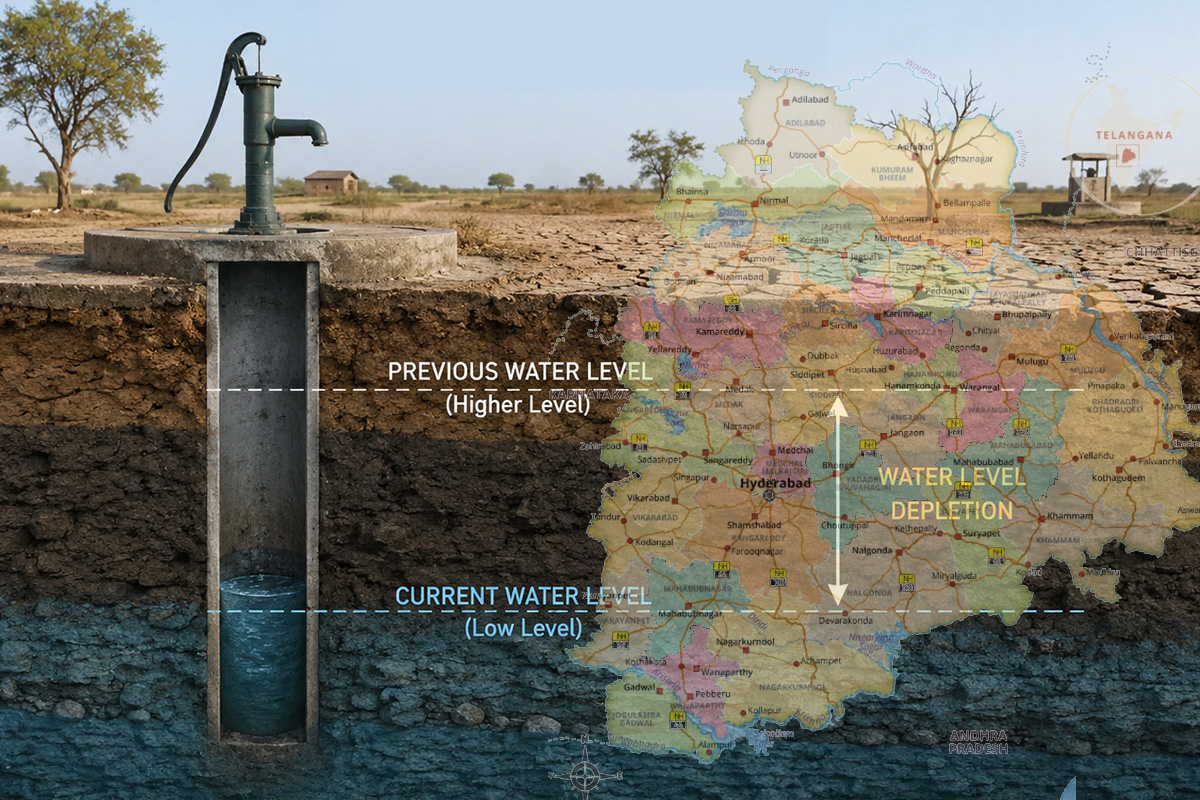
Image used for representational purpose.

Synopsis: It’s not all bleak across Telangana. But 17 districts are facing a decline in groundwater levels. For Hyderabad, there is a lot to ponder over because of the scale of its growth and the ground realities.
The steady depletion of groundwater in and around Hyderabad has emerged as one of the most pressing environmental challenges confronting Telangana. The latest data released by the Central Ground Water Board (CGWB) paints a worrying picture: groundwater levels have declined in 17 districts of the State compared with the corresponding period last year. Hyderabad, despite receiving substantial rainfall during the 2025 monsoon, has witnessed one of the sharpest falls, underscoring the growing disconnect between rainfall and groundwater recharge.
According to the CGWB’s latest assessment for June 2026, groundwater levels deteriorated in 17 districts while only 16 districts registered an improvement over June 2025. Hyderabad recorded the most significant decline, with the average groundwater depth increasing from 9.96 metres below ground level in June 2025 to 12.43 metres in June 2026. This represents a fall of nearly 2.47 metres within a year, the steepest among all districts surveyed.
The findings are particularly alarming because they come after a year in which Telangana experienced an above-normal southwest monsoon. Ordinarily, abundant rainfall is expected to replenish underground aquifers. However, rapid urbanisation, concretisation of land surfaces, shrinking lakes, encroachment of water bodies, and excessive groundwater extraction appear to have prevented effective recharge in Hyderabad and its surrounding urban areas.
Karimnagar also witnessed a marginal decline, with groundwater levels dropping from 8.82 metres to 8.93 metres below ground level. Though the reduction is relatively small at 0.11 metres, experts caution that even minor declines, if sustained over consecutive years, can lead to long-term stress on aquifers.
Also Read: Why Telangana has reasons to fear the likely “super” El Niño
The report highlights contrasting trends across Telangana.
Bhupalpally recorded one of the most significant declines, with groundwater levels falling from 10.93 metres below ground level to 12.26 metres below ground level. Similarly, Adilabad also saw a decline from 9.50 metres below ground level to 10.27 metres below ground level.
Other districts seeing a decline included Rajanna Sircilla, which recorded a 1.51 metres fall in groundwater levels, Peddapalli 1.33 metres, Nizamabad 1.12 metres, Jagityal 0.99 metres and Bhadradri Kothagudem 0.95 metres.
In all, 17 districts have seen a decline in groundwater levels.
On the other hand, Yadadri Bhuvanagiri district recorded the highest rise in groundwater levels of 2.86 metres. It was followed by Nagarkurnool (1.64 m), Rangareddy (1.51 m), Jangaon (1.46 m) and Vikarabad (1.44 m), indicating that local hydrogeological conditions, rainfall distribution and water management practices continue to influence groundwater behaviour differently across regions.
The broader State-level picture, however, calls for caution rather than celebration. Between June 2025 and June 2026, groundwater levels improved in only about half the districts, while the remaining districts either stagnated or declined. Such uneven recovery suggests that rainfall alone is insufficient to ensure sustainable groundwater resources. Scientific recharge mechanisms and prudent extraction policies are becoming increasingly indispensable.
The CGWB report also analyses groundwater availability across different depth ranges. Approximately 51 per cent of monitoring wells recorded groundwater within five metres below ground level, indicating relatively shallow aquifers in many parts of the State. Another 28 per cent fell within the 5-10 metre range, while about 9 per cent registered groundwater between 15 and 20 metres below ground. These figures reveal that although significant portions of Telangana still possess accessible groundwater, several pockets are witnessing rapid depletion, particularly urban centres experiencing intense developmental pressure.
Long-term trends offer a mixed outlook. Comparing groundwater observations over the decade from 2016 to 2025, nearly 480 monitoring locations showed improvement, while about 141 stations recorded declining groundwater levels. This indicates that while groundwater management initiatives have yielded positive outcomes in several regions, the gains remain fragile and uneven.
Also Read: For men in rural Telangana, the road to diabetes and heart disease may begin before 30, study finds
Hyderabad deserves special attention because of its unique urban challenges.
Telangana’s capital was extracting 96% of its annual available groundwater, ranking it in the “critical” category, according to a recent assessment by the Telangana Groundwater Department.
The city has expanded dramatically over the past decade, with large-scale residential layouts, commercial complexes and infrastructure projects replacing open land. Natural drainage channels have narrowed, lakes have shrunk, and rainwater that once seeped into the ground now flows rapidly into stormwater drains. Simultaneously, dependence on borewells has increased in many peripheral areas where municipal water supply remains inadequate. The combined effect has been a steady fall in groundwater despite generous seasonal rainfall.
The consequences extend beyond water scarcity. Declining groundwater raises the cost of drilling deeper borewells, increases electricity consumption for pumping water, threatens agricultural livelihoods in peri-urban regions, and heightens vulnerability during drought years. It also places additional pressure on surface water sources such as the Krishna and Godavari river projects, which are already burdened by rising urban demand.
The latest groundwater assessment should therefore serve as an urgent wake-up call for policymakers, urban planners and citizens alike. Protecting lakes, restoring feeder channels, enforcing rainwater harvesting regulations, preventing illegal groundwater extraction and expanding artificial recharge structures must become policy priorities. Equally important is promoting water conservation at the household, institutional and industrial levels.
Groundwater remains an invisible yet indispensable resource sustaining Telangana’s economy and urban life. Once depleted, aquifers require years—sometimes decades—to recover. Hyderabad’s sharp decline is therefore not merely a statistical anomaly but a warning of the environmental costs of unchecked urban growth. Unless immediate corrective measures are implemented, the city risks entering a future where water scarcity becomes a permanent feature rather than a seasonal challenge. The time to act is now, before the crisis sinks even deeper beneath the ground.
Also Read | Ground Report: Fertilizer App’s glitches are forcing us back to queues, say Telangana’s farmers
(Edited by R Rajesh Kumar.)



