

Published Sep 16, 2026 | 10:13 PM ⚊ Updated Sep 16, 2026 | 10:13 PM

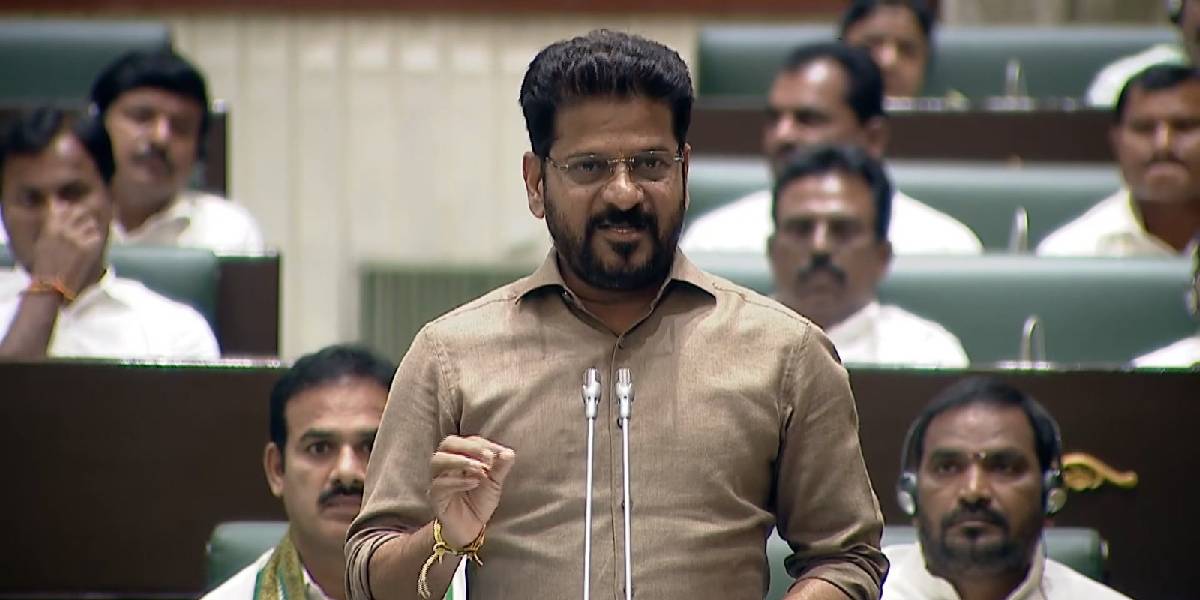
Telangana Chief Minister A Revanth Reddy addressing the Section 22A issue at the state Legislative Assembly on 16 September. (File Photo)

Synopsis: The Telangana Assembly’s discussion on Section 22A turned into a lengthy speech by Chief Minister A Revanth Reddy, who defended the suspension of BRS members and accused the previous government of land-related irregularities. Reddy outlined a process to remove genuine private properties from the prohibited list and said owners would have opportunities to submit documents and appeal against orders.
What was meant to be a short discussion on Section 22A of the Registration Act, which resumed in the Telangana Assembly on Wednesday, 16 September, turned into one of Chief Minister A Revanth Reddy’s longest speeches yet.
It touched up on a century of land records, launched an indictment of the BRS government’s Dharani portal, announced a fresh probe into K Chandrashekar Rao’s farmhouse land, and promised a fix for those affected by the prohibited list of properties.
Wednesday’s sitting followed a bitter start to the Assembly last week, when the Chair suspended BRS members for the rest of the session, citing disorderly conduct on opening day.
The Chief Minister defended the action and noted that the rules invoked were themselves framed by the previous BRS government, and that comparable restrictions exist in Parliament as well.
Reddy said the Chair had already let the suspended members back once, after they apologised, hoping they would join the debate on Section 22A, fee reimbursement, and El Niño relief, but instead, they chose to disrupt the proceedings.
Also Read: Revanth Reddy orders inquiry into alleged encroachment of government land by KCR family
The Chief Minister laid out a process to resolve the problems arising from the Section 22A prohibited list of properties. He said property owners would receive a KYC, an email notice, or a newspaper advertisement and 15 days to submit relevant documents.
Officials would then review the documents and government records, address the objections, and pass a ‘speaking order’ that clearly states the reasons for including or removing a property from the prohibited list. The government will hand over an audio copy of the proceedings to the property owners to facilitate any future appeals.
If the property included in the prohibited list is agricultural land of over 1 acre or non-agricultural land over 1000 square yards, the state government would give relevant orders. These properties would be placed in the IGRS list only after the entire review procedure concludes.
If registration or patta lands end up on the prohibited list, RDOs and sub-collectors are directed to remove them immediately. No regularised land would be placed on the prohibited list, said the CM, and that land purchased through auction would also be exempted.
Other lands to be removed from the Prohibited List are:
If property owners wish to challenge the orders passed by the RDO over the prohibited properties, they can appeal to the Joint Collector within 60 days. Further, Reddy said, a revision petition can be submitted to the State within 90 days, and hoped that the new system would help resolve the major issues identified by the government.
Also Read: Telangana police arrest nine in Hyderabad history-sheeter Nayeem murder case
The Chief Minister told the House that the state’s full prohibited-property list runs to 98,31,320 acres, built from five categories: about 24.63 lakh acres of government-assigned land, roughly 42 lakh acres of forest land, close to 29 lakh acres of state and Central government land, about 5.12 lakh acres under religious endowments and wakf boards, and a smaller share tied to court orders and attachments by agencies such as the Enforcement Directorate and CBI.
None of that, he argued, should ever be struck off. The genuine dispute concerns a far smaller slice, the 3,72,930 acres of privately held patta land that got swept in alongside government plots sharing the same survey number.
He said the number of acres was down from about 7.9 lakh acres his government inherited in 2020. His point, repeated throughout the speech, was that his government inherited the current prohibited list mess; it didn’t invent it.
CPI legislator Kunamneni Sambasiva Rao also backed roughly the same private-land figure in his own remarks, as opposed to the Opposition’s claim that a full crore acres had been wrongly listed.
For much of his address, Reddy traced Telangana’s land-record history from pre-independence to the current times. The Nizam-era split between Diwani (state) and non-Diwani (private and jagir) land, the Chessala and Kasara Pahani surveys of 1948-55 that first recorded tenant rights, and the 1908 Hyderabad Land Revenue Act.
He said one major flashpoint was the difference in land revenue systems in Telangana and Andhra Pradesh, ruled by the Nizam and the British respectively, before independence.
He credited Congress-era laws such as the Land Reforms (Ceiling on Agricultural Holdings) Act, 1973; the Assigned Lands (Prohibition of Transfers) Act, 1977; the Andhra Pradesh Rights in Land and Pattadar Pass Books Act, 1971 (Act No. 26 of 1971); and the 2006 Forest Rights Act with giving Dalit, tribal and landless families ownership of roughly 35 lakh acres.
Also Read: KTR rules out BRS-BJP alliance ahead of 2028 Telangana polls, backs proportional delimitation
The sharpest attack within the Chief Minister’s address was reserved for Dharani, the land-records portal the BRS government launched in 2020.
Reddy disputed BRS supremo and former Chief Minister K Chandrashekar Rao’s (KCR) earlier claim to have personally designed it, saying a similar system first appeared in Odisha in 2010 and was later flagged for irregularities there.
He alleged that the Telangana contract, first awarded to IL&FS, passed through Terasys Technologies and a chain of investment entities before ending up with firms in Singapore, the British Virgin Islands and the Cayman Islands.
He alleged that land, bank and Aadhaar details tied to nearly 2.5 crore acres of farmland left government hands.
Reddy accused the former BRS administration of exploiting the loopholes in the portal to transfer thousands of acres of land. He accused KCR and his family members of using similar methods to [grab 440 acres of assigned lands] and said such land parcels would be seized and distributed among the landless poor.
Citing revenue records, Reddy said close to 340 acres of government land lies within KCR’s roughly 700-acre farmhouse at Erravelli. He claimed that the assigned land KCR and his wife held had grown from 27 acres to 67 acres over the years.
He directed the Collector and Revenue Department to serve notice to Rao, verify the extent of government and assigned land under his control, and reclaim it within 30 days. He warned officials and ministers that action would follow if the deadline passed.
Referring to an earlier episode near the same farmhouse, in which turmeric water was reportedly sprinkled after a Dalit-led protest by Congress cadre, he said the reclaimed land would be handed out as pattas to roughly 800 Dalit families. The CM said the matter had been referred to a Special Investigation Team.
Also Read: SC cites over 200 days’ delay, dismisses Telangana’s plea in Lothkunta land case
Reddy alleged irregularities near the Rangnayak Sagar reservoir in Siddipet and claimed that the land first notified for acquisition by the Irrigation department was quietly de-listed once former minister T Harish Rao and relatives bought it cheaply.
He also accused Harish Rao of transferring irrigation lands to Siddipet Urban Development Authority (SUDA) to lay a road for direct access to his farmhouse.
He also claimed that a 93-acre holding in Gunded village, Balanagar Mandal, changed ownership through Dharani’s name-correction module before landing with a company tied to Harish Rao’s in-laws.
Reddy then said a land parcel at Survey 311 at Janwada, linked to a firm owned by Ramalinga Raju’s Satyam Computers, was transferred to KTR’s wife Shailima and later her family members. He questioned how land seized and attached by the Income Tax Department could be transferred.
Reddy alleged that KCR and other BRS members either skipped the Assembly or disrupted it with protests because they feared being exposed for large-scale irregularities in land registrations during the BRS administration.
The discussion on 22A went ahead regardless, with BJP, AIMIM and CPI members pushing for it to continue, the Chief Minister said.
(Edited by Dese Gowda)



