

Published Jul 22, 2026 | 8:19 PM ⚊ Updated Jul 22, 2026 | 9:59 PM

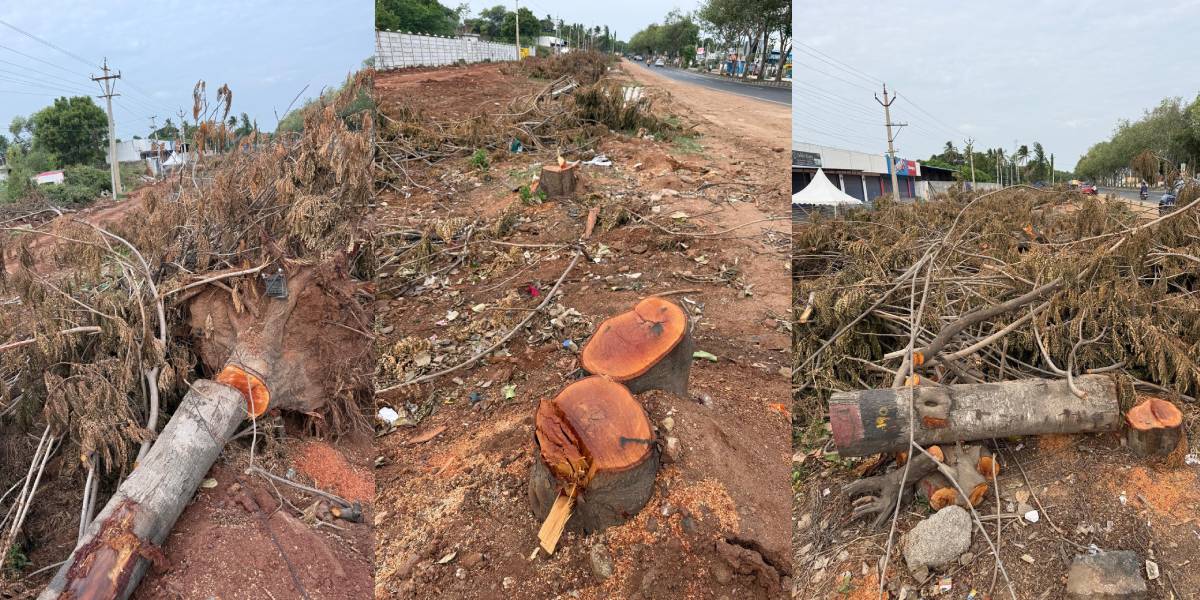
Trees cut down along NH 163 in Aziz Nagar (Credit: Vata Foundation)

Synopsis: Citizens in Hyderabad have come forward to adopt and relocate trees marked for felling in Aziz Nagar as the National Highways Authority of India continues the widening of NH 163. More than 300 people have contacted the Vata Foundation after public pressure halted the latest felling drive, with the NHAI agreeing to allow time for the remaining trees to be translocated instead of being cut down.
Citizens across Hyderabad have stepped forward to adopt trees marked for felling in Aziz Nagar, as the National Highways Authority of India (NHAI) presses ahead with the four-lane expansion of National Highway 163 (NH 163).
P Uday Krishna, founder of the Hyderabad-based environmental non-profit Vata Foundation, told South First that he had received more than 300 requests from concerned citizens willing to adopt and translocate the trees.
The felling drive is part of the larger NH 163 expansion, which has led to the axing of more than 9,000 trees along the Moinabad–Manneguda stretch over the years. In the latest round, authorities felled more than 100 Peltophorum trees at Aziz Nagar before halting the drive in the face of public pressure.
Also Read: ‘Hyderabad demands PM Modi’s resignation’: CJP-sparked agitation goes beyond NEET, Pradhan
NH 163 runs from Bhopalpatnam in Chhattisgarh to Ravulapalli on the Telangana–Karnataka border, passing through Warangal, Hyderabad, Moinabad, Chevella, Manneguda and Kodangal. The stretch now being widened between the ORR Appa Junction in Hyderabad and Manneguda in Vikarabad district has a design length of 46.405 km.
The NHAI signed a concession agreement for the project in 2022 with Hyderabad-based Megha Engineering and Infrastructures Limited (MEIL) on a Hybrid Annuity Mode.
According to the agreement, the NHAI must secure the permits needed to cut down any tree that materially hinders construction, and the cost of felling is to be borne by the NHAI. The felled trees are deemed to belong to the NHAI, which alone decides how they are disposed of. This clause left little formal say for citizens or civic groups in what happens to the trees once they are marked for felling.
The four-laning has been one of Telangana’s most contested road projects. Though the NHAI issued its tender notification in September 2021, the plan ran into resistance from environmentalists and residents.
The citizen group formed the ‘Save Banyans of Chevella’ collective over fears that the widening would claim thousands of trees, including more than a thousand banyan trees, along the Moinabad–Manneguda stretch.
The group moved the National Green Tribunal (NGT), seeking a halt to the project and a study of alternate alignments, keeping the widening in limbo for years.
The matter came to a head on 3 November 2025 when the NGT delivered its order clearing the widening project. The tribunal’s go-ahead followed a compromise worked out between the petitioners and the NHAI.
Under the revised design, the NHAI agreed to retain 765 banyan trees in place and translocate about 130 more to the highway’s shoulder rather than fell them outright. The petitioners also sought civil society representation on the committee set up to monitor the widening work.
Also Read: Telangana’s youth caught between fee reimbursement failure and the unemployment crisis
P Uday Krishna learned about the latest felling from a concerned citizen and visited the site in Aziz Nagar.
He made a video request last week urging the NHAI and Union Minister Nitin Gadkari to halt the felling and appealed to them to grant a few days for the translocation process. More than 300 people from in and around the city have since reached out to Uday and Vata Foundation expressing interest in adopting the trees.
After the video gained traction online, Uday heard from NHAI officials who were willing to open a dialogue.
“The officials reached out to me via X and Instagram. I explained to them that it was unnecessary to axe the trees when they could be adopted instead,” said Uday, speaking to South First.
He alleged that wood dealers usually lobby to obtain felled trees, without giving them a chance to be translocated.
“There is no need to cut down such a huge numbers of trees when there are so many willing to take care of them. We have successfully translocated thousands of trees. We have volunteers willing to help us. We maintain a list of people from different regions who have expressed interest in tree adoption. This costs the government nothing,” he added.
The NHAI has responded positively to Vata Foundation’s suggestion, allowing time for the trees to be translocated.
Also Read: Alcohol intoxication, not attempted suicide: Doctors treating IPS trainee accused of sexual assault
The translocation approach helps in moving full-grown trees to new sites, such as parks, campuses or private plots, rather than felling them.
The process begins with an on-ground assessment of a tree’s health, root depth and soil conditions, followed by careful root conditioning to prepare it for the move. Specialised cranes and trolleys are used to lift and transport the tree, minimising stress, before it is replanted at a protected site.
Private adopters and givers usually share the expenses of lifting, transportation and replantation, while the foundation pitches in with the help of volunteers to translocate trees cut down on public properties.
“We usually favour adopters who are willing to care for over 20 trees. The process becomes easier and manageable,” said Uday.
The trees must be monitored and nurtured for their long-term survival. The Vata Foundation says that more than 75 percent of the trees have survived for over a year after replanting. But for the Peltophorum trees in Aziz Nagar, they guarantee a 100 percent survival rate.
They have so far saved more than 5,000 trees, spanning over 30 species, from felling.
However, administrative hurdles hinder the process significantly.
“We need to get permission from the municipal authorities, But it is often very easy to get permits to cut down a tree rather than shift it to another location,” said Uday.
Translocation is costlier and slower than felling, and survival is not always guaranteed, but citizen groups argue it is the only way to save trees old enough to predate the highway itself.
(Edited by Dese Gowda)



