

Published Jul 17, 2026 | 9:47 AM ⚊ Updated Jul 17, 2026 | 1:11 PM

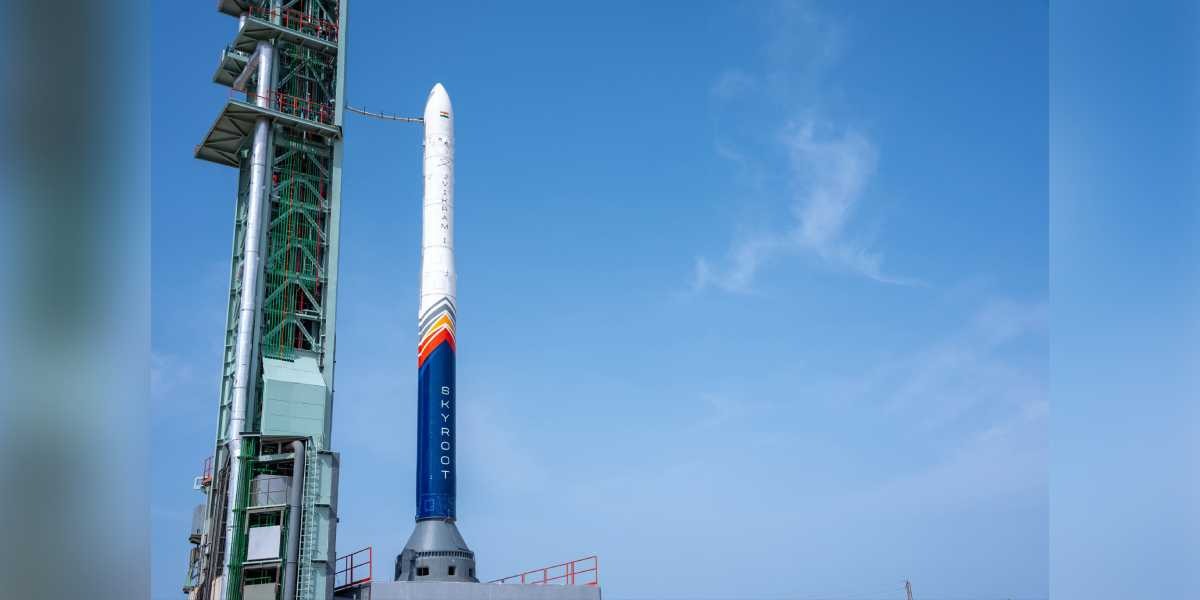
The launch will provide crucial data to validate the vehicle under actual flight conditions.

Synopsis: The mission, named “Aagaman”, represents space startup Skyroot’s next milestone after the successful suborbital flight of Vikram-S in 2022. The company said in a statement that all vehicle integration, testing and launch preparations have been completed ahead of liftoff.
Hyderabad-based space startup Skyroot Aerospace is set to attempt the maiden test flight of its orbital launch vehicle, Vikram-1, from the Satish Dhawan Space Centre (SDSC-SHAR), at Sriharikota in Andhra Pradesh on Saturday, 18 July.
The launch vehicle will blast off from the Indian Space Research Organisation’s facility at 11.30 am.
If successful, the mission will mark India’s first attempt to place a privately developed rocket into orbit.
The mission, named “Aagaman”, represents Skyroot’s next milestone after the successful suborbital flight of Vikram-S in 2022. The company said in a statement that all vehicle integration, testing and launch preparations have been completed ahead of liftoff.
Airspace and maritime authorities have also issued Notices to Airmen (NOTAM) and maritime advisories, restricting movement along the rocket’s planned flight path.
Also Read: Hyderabad puts India on aerospace map as Skyroot becomes sector’s first unicorn
Unlike Vikram-S, which demonstrated suborbital capabilities, Vikram-1 is designed to reach Low Earth Orbit. The maiden mission aims to place its payloads into a 450 km orbit at a 60-degree inclination.
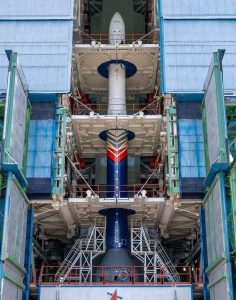
The launch vehicle, Vikram 1, can carry satellites weighing up to 350 kg to Low Earth Orbit.
The multi-stage launch vehicle is capable of carrying satellites weighing up to 350 kg to Low Earth Orbit.
Skyroot said the rocket has been built with an all-carbon composite structure and is powered by indigenously developed propulsion systems, including 3D-printed engines and high-thrust solid-rocket motors.
The company said all rocket stages have been assembled and stacked on the launch pad, while telemetry interface tests, tracking radar validation and integrated vehicle checks have been completed.
Mission Aagaman will carry multiple technology demonstration payloads from Grahaa Space, Cosmoserve, DCubed, and Skyroot’s own SCOPE payload. The flight will also carry “Cosmic Bloom”, an artwork created by Cosmos Diamonds, along with a micro-art payload.
Also Read: Prarambh Mission’s Vikram-S soars into space
Skyroot co-founder and Chief Executive Officer Pawan Kumar Chandana said the launch would provide crucial data to validate the vehicle under actual flight conditions.
“We are eager to see how Vikram-1 performs in its first real-world flight. This is our first test flight, and the data generated will be invaluable. It will lay the foundation for establishing a regular launch cadence,” Chandana said.
He added that the global market for launching small satellites continues to face supply shortages despite rising demand for satellite-enabled services, creating opportunities for private launch providers.
Also Read: India’s first privately developed rocket lifts off
Skyroot co-founder and Chief Operating Officer Naga Bharath Daka said the mission reflects years of engineering and manufacturing efforts.
“This mission represents the efforts of nearly 1,000 people, over 400 suppliers and almost 3,000 days of development. The in-flight data from this mission will help us validate every technology developed over the years and enable us to build a reliable, on-demand launch company from India,” Daka said.



