

Published May 09, 2026 | 5:01 PM ⚊ Updated May 09, 2026 | 5:01 PM

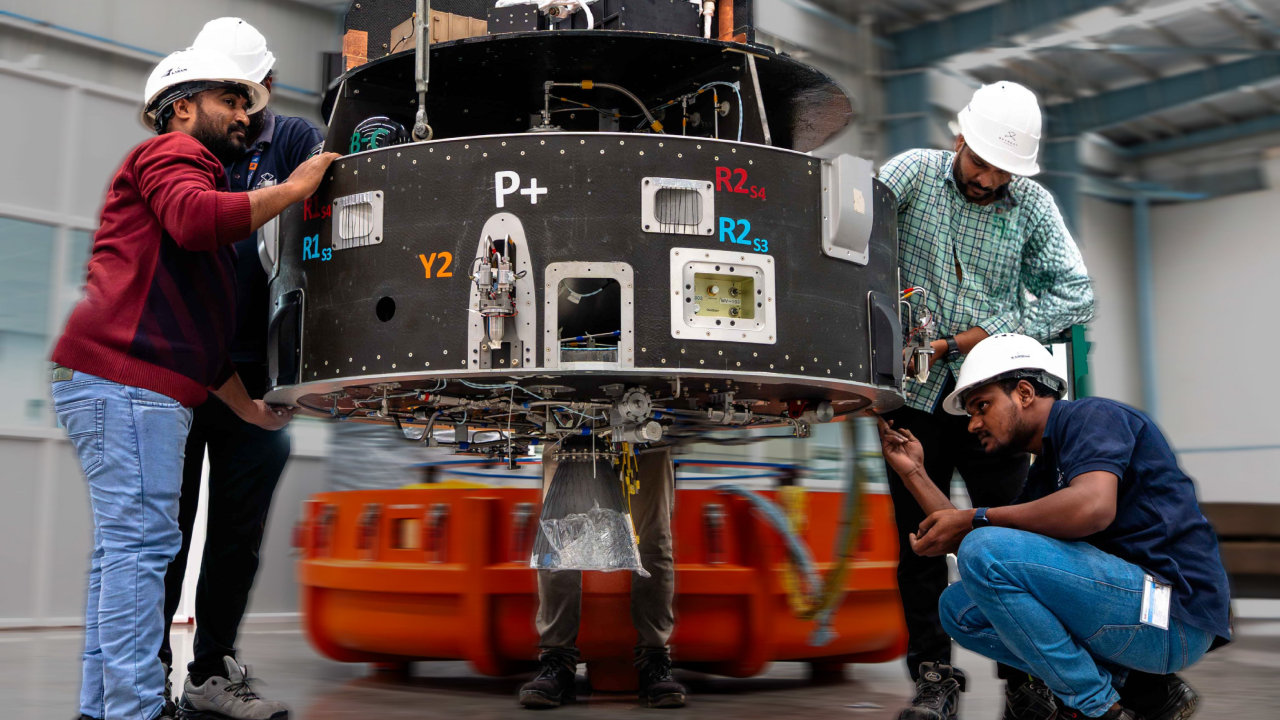
Hyderabad's role in Skyroot's rise runs deeper than real estate and office space. Credit: x.com/SkyrootA

Synopsis: Skyroot Aerospace, founded in 2018 by ex-ISRO engineers in Hyderabad, has become India’s first aerospace unicorn with a $1 billion valuation after raising $60 million led by GIC and Ram Shriram’s Sherpalo Ventures. Backed by BlackRock and others, Skyroot readies Vikram-1’s orbital launch, expanding Hyderabad’s role in deep-tech and positioning India in the global small satellite launch market.
A rocket company that started at a Hyderabad co-working space has done what no aerospace firm in India has managed before.
Skyroot Aerospace crossed a $1 billion valuation this week, becoming the first aerospace company in the country to enter the unicorn club. The milestone arrived on the back of a $60 million funding round, taking its total capital raised to $160 million.
No Indian aerospace startup had achieved this before. Not in the seven decades since independence. Not through the years of policy reform. Skyroot, founded in 2018, got there in seven years.
The round was co-led by Singapore’s sovereign wealth fund GIC and Sherpalo Ventures, the Silicon Valley firm run by Ram Shriram, the investor who put money into Google before most people had heard of it. Shriram now joins Skyroot’s board.
Funds managed by BlackRock, one of the world’s largest asset managers, also participated. So did Playbook Partners, Shanghvi Family Office, the founders of Greenko Group, and existing investor Arkam Ventures.
These are not speculative bets from venture funds chasing themes. GIC manages Singapore’s foreign reserves. BlackRock manages money for pension funds and sovereign institutions across the world. Their presence in this round signals that Skyroot has cleared a threshold of credibility that most Indian deep-tech startups never reach.
Also Read: Kalam 250: Skyroot Aerospace successfully test fires stage-2 of Vikram-1 launch vehicle
Pawan Kumar Chandana and Naga Bharath Daka both worked at ISRO before leaving to start Skyroot in 2018. They understood rockets not from textbooks but from years of building systems inside India’s national space programme.
Skyroot Aerospace has raised $60 million at a valuation of $1.1 billion.
Vikram-1, India’s first privately developed orbital rocket, is weeks from its maiden flight. This capital will go toward scaling launch cadence for Vikram-1, expanding manufacturing, and developing Vikram-2… pic.twitter.com/NSkXM6OktN
— Skyroot Aerospace (@SkyrootA) May 7, 2026
They chose Hyderabad as their base, a decision that proved consequential. The city gave them proximity to ISRO’s facilities, access to a defence and aerospace manufacturing supply chain that had quietly built up over decades, and a pool of engineers trained in hardware-intensive disciplines.
They incubated the company at T-Hub, the government-backed innovation platform on the IIIT campus in Gachibowli. T-Hub gave them early infrastructure, connections, and a launchpad of a different kind before they ever got close to a real one.
Hyderabad’s role in Skyroot’s rise runs deeper than real estate and office space.
The city houses ISRO’s National Remote Sensing Centre and has long supported a cluster of aerospace and defence suppliers. Companies like DRDO, Bharat Dynamics, and a network of precision engineering firms operate out of the city, creating a manufacturing ecosystem that Skyroot could draw on as it scaled.
Telangana’s state government also moved early to support the company. BRS Working President K T Rama Rao pointed to T-Hub’s incubation of Skyroot as evidence of what government-backed innovation platforms can achieve when they back the right bets early.
He described the unicorn milestone as a validation of Telangana’s decade-long push to position Hyderabad as a hub not just for software services but for frontier technologies and hardware startups.
“This success belongs to the entire ecosystem cultivated in Telangana,” he said.
Hyderabad has spent years attracting global technology and defence companies. Skyroot’s rise now signals something more significant: the city can produce companies that do not just serve the aerospace industry but lead it.
Also Read: Space-tech firm Skyroot raises $27.5 million in pre-Series C funding led by Temasek
In November 2022, Skyroot flew Vikram-S, a suborbital rocket developed entirely by a private Indian company. The flight worked. It reached space.
That made Skyroot the first Indian private company to launch a rocket beyond the atmosphere, a moment that rewrote what was considered possible in the country’s space sector.
The flight also came at a significant policy moment. The Indian government had opened the space sector to private companies in 2020, allowing startups to access ISRO’s launch and test facilities for the first time.
Skyroot was the first private firm to sign such an agreement with ISRO. The Vikram-S flight demonstrated that the policy reform had teeth.
Vikram-1, India’s first privately developed orbital-class rocket, now sits weeks away from its maiden flight.
The mission will attempt to place satellites into orbit. That capability separates a handful of countries and companies from the rest of the world. If Vikram-1 succeeds, Skyroot joins that group.
The new capital will fund higher launch frequency for Vikram-1, expand Skyroot’s Hyderabad manufacturing base, and accelerate development of Vikram-2, a one-tonne-class vehicle powered by an advanced cryogenic upper stage. Vikram-2 targets heavier payloads and positions Skyroot to compete for a broader range of commercial contracts.
Chandana, speaking after the funding announcement, said the ability to launch rockets independently sits at the centre of everything. “This will promote more and more investments in India,” he said.
Shriram, who backed the company from its early days, framed it in larger terms. “Access to space is one of the key challenges of our time. Skyroot is building the foundational infrastructure for that future.”
The global small satellite launch market is expanding fast. Hundreds of satellites now need to reach low Earth orbit every year, serving communications, earth observation, navigation, and defence applications. Demand for dedicated, affordable, on-demand launches has never been higher.
The market today is dominated by US and European players. SpaceX’s Falcon 9 and Rocket Lab’s Electron have carved out significant shares. India has ISRO’s PSLV, which carries a strong track record but operates on a government schedule that commercial operators cannot always align with.
Skyroot aims to fill that gap. A private Indian launch provider operating on commercial timelines, at competitive prices, with a rocket built and flown out of Hyderabad.



