
Published Oct 27, 2026 | 1:03 PM ⚊ Updated Oct 27, 2026 | 1:03 PM

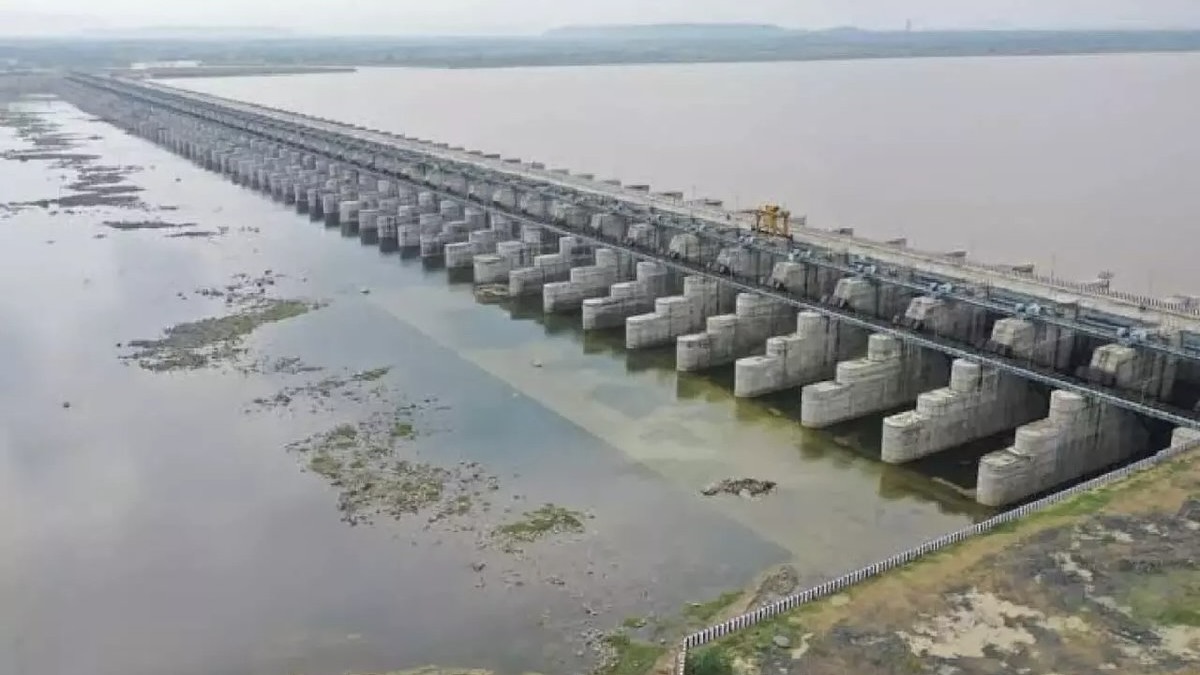
Tummidihatti barrage (X).

Synopsis: The project was designed to harness around 160 TMC of floodwater from the Pranahita, a major tributary of the Godavari, to provide irrigation to approximately 16.4 lakh acres across Adilabad, Nizamabad, Karimnagar, Medak, Rangareddy and Nalgonda districts, besides supplying drinking water to Hyderabad. The Pranahita flows along the border between Maharashtra and Telangana. Tummidihatti, in Koutala mandal of Komaram Bheem Asifabad district, was selected because of its geographical elevation.
Maharashtra’s position in the decades-old inter-state water dispute appears to have remained unchanged. At the latest meeting in Mumbai between Telangana Chief Minister A Revanth Reddy and Maharashtra Chief Minister Devendra Fadnavis, the Maharashtra government made it clear that it continues to adhere to its longstanding position on the proposed increase in the height of the Tummidihatti barrage.
While Fadnavis adopted a diplomatic tone, saying that Telangana’s proposal to raise the barrage height to 152 metres would be examined and that a joint committee would be constituted, his remarks indicated that Maharashtra remained firm on its earlier condition: the project must not cause any damage or additional submergence affecting the state’s people and land.
The Dr BR Ambedkar Pranahita-Chevella Sujala Sravanthi project was launched in undivided Andhra Pradesh in 2008–09, during the tenure of then Chief Minister YS Rajasekhara Reddy.
The project was designed to harness around 160 TMC of floodwater from the Pranahita, a major tributary of the Godavari, to provide irrigation to approximately 16.4 lakh acres across Adilabad, Nizamabad, Karimnagar, Medak, Rangareddy and Nalgonda districts, besides supplying drinking water to Hyderabad.
The Pranahita flows along the border between Maharashtra and Telangana. Tummidihatti, in Koutala mandal of Komaram Bheem Asifabad district, was selected because of its geographical elevation.
The government at the time maintained that constructing a barrage with a Full Reservoir Level (FRL) of 152 metres above mean sea level would enable water to flow through a gravity canal directly to Ellampalli, approximately 150 kilometres away, without requiring any lifting.
Lower electricity consumption and the possibility of supplying water to a larger command area through gravity were among the reasons cited for selecting Tummidihatti as the project’s headworks.
The present Revanth Reddy government has maintained a similar position, asserting that water can be conveyed by gravity from Tummidihatti.
Also Read: Rice and paddy crisis in Telangana: Artificial scarcity before the real shortage
South First spoke to irrigation expert and retired engineer Sridhar Deshpande on this issue. Deshpande said it was impossible to convey water from Tummidihatti to Ellampalli through gravity.
He recalled that the canal works had been stopped after 73 kilometres had been excavated during the undivided Andhra Pradesh era, as the authorities were aware of this limitation.
However, Deshpande criticised the Revanth Reddy government for preparing Preliminary Feasibility Reports (PFRs) to bring water to Sundilla through gravity, even though it could not be conveyed to Ellampalli by the same method.
According to him, the government should focus on the previously formulated Wardha Barrage project, which was sent to the Centre, to find a lasting solution to the Tummidihatti dispute without further delays.
After Telangana was formed, then Chief Minister K Chandrashekar Rao wanted to expedite the project. However, it became clear that the project could not move forward without addressing Maharashtra’s objections.
Maharashtra refused to accept a barrage height of 152 metres and insisted that it would agree only to 148 metres. The state made it clear that it would not agree to anything beyond that height.
Believing that an agreement with Maharashtra was essential to prevent the project from coming to a complete standstill, the BRS government entered into an inter-state agreement in Mumbai on 23 August 2016, to construct the Tummidihatti barrage with an FRL of 148 metres.
Also Read: Congress MLC candidates use private enrolment channels; Telangana election officials unaware
It was subsequently found that constructing the barrage at 148 metres would not permit gravity-based water diversion and that its storage capacity would be limited to just 1.85 TMC.
Consequently, of the original project designed to utilise 160 TMC, the Tummidihatti component was restricted to supplying 20 TMC to irrigate two lakh acres in Adilabad district.
The remaining 140 TMC component was shifted to Medigadda (the Lakshmi Barrage), downstream of the confluence of the Pranahita and the main Godavari river. By incorporating the additional water available at that location, the project was redesigned as the Kaleshwaram Lift Irrigation Scheme.
The additional four metres sought by Telangana have become a major concern for Maharashtra. The potential consequences of the increase are as follows.
Also Read: The Owaisi paradox: From Hyderabad to Uttar Pradesh
Irrigation expert and retired engineer Sridhar Deshpande reacted sharply to the Mumbai meeting.
He recalled that Maharashtra’s statement that it would consider the proposal only if there were no adverse effects was merely a repetition of its longstanding position. “Wasn’t the reason Maharashtra refused to agree to 152 metres in the first place that there would be adverse impacts?” he asked.
Deshpande said the meeting would achieve little beyond further delays in the name of studies and committees.
Water availability at Tummidihatti and Medigadda, along with the technical assessments, were among the principal factors behind the redesign of the project.
According to the hydrological assessments of the Central Water Commission (CWC) from 2015–16, the net water availability in the Pranahita at Tummidihatti was only 165 TMC at 75 percent dependability.
The CWC warned that water flows reaching Tummidihatti could decline further in the future as Maharashtra and Madhya Pradesh were developing projects on the Penganga, Wardha and Wainganga rivers upstream.
The assessment indicated that Telangana could not feasibly divert 160 TMC as net water, after accounting for Maharashtra’s share and the river’s flow requirements.
Medigadda is located downstream of the confluence of the Pranahita and the main Godavari river.
According to CWC assessments, annual water availability at Medigadda exceeds 280–300 TMC at 75% dependability. During periods of heavy rainfall and floods, the flow is said to exceed 400 TMC.
The greater water availability at this location was a major technical reason for shifting the Kaleshwaram project there.
The CWC assessments indicated that water availability at Tummidihatti was limited and that raising the barrage height to 152 metres would cause significant submergence in Maharashtra. The reports stated that securing inter-state clearances was possible only at a height of 148 metres.
Also Read: Beyond welfare: Telangana must prepare for the El Niño threat
Former minister Harish Rao recalled that the Centre had stated on three occasions in 2015 that Tummidihatti did not have sufficient water to meet the state’s requirements and that an alternative should be considered.
He said the CWC had stated on 18 February 2015 that 160 TMC was not available at Tummidihatti.
He further argued that, of the 165 TMC available at Medigadda, 63 TMC would go to the upstream states, leaving only 102 TMC. He questioned how much of this remaining water could actually be diverted and said the CWC had advised the state to explore alternatives.
More importantly, Harish Rao said that in a letter dated 13 March 2015, the then Union Water Resources Minister, Uma Bharti, had made it clear that the state should pursue an alternative because sufficient water was not available.
He questioned where the water for lifting would come from if even 102 TMC was not available. He also pointed out that if 50 TMC were required for drinking water for Hyderabad and other districts alone, little would remain for irrigation.
Harish Rao asserted that Medigadda, as part of the Kaleshwaram project, which he said had received clearances for the full 240 TMC, was therefore the real boon for Telangana.
Retired engineer and Professor Ramana Naik said Maharashtra was unlikely to agree to a 152-metre barrage because of the serious submergence concerns on its side of the border.
As a possible solution to the deadlock, he proposed constructing the barrage approximately nine kilometres downstream of Tummidihatti.
According to him, building the barrage at this alternative location would eliminate the threat of submergence on the Maharashtra side and allow the project to proceed without inter-state disputes.
He urged Chief Minister Revanth Reddy to consider the alternative rather than continuing with the existing approach.
The developments following the meeting once again highlighted the complexity of the Tummidihatti dispute.
Immediately after the Mumbai talks, Revanth Reddy posted on X that he had held fruitful discussions with Maharashtra Chief Minister Devendra Fadnavis on raising the height of the Tummidihatti barrage. He thanked Fadnavis for considering Telangana’s proposal positively and with an open mind.
Meanwhile, Congress circles in Telangana claimed that Maharashtra had given in-principle approval for constructing the Tummidihatti barrage at a height of 152 metres. They portrayed it as a major achievement for Revanth Reddy.
Concluded very productive talks with Maharashtra Chief Minister Shri Devendra Fadnavis ji @Dev_Fadnavis regarding increasing the FRL height of #Tummidihatti barrage.
I am grateful to my friend Shri Fadnavis ji for considering our proposal positively and with a big heart.
Both sides have agreed to set up a Committee of Officials to look into various technical issues, including issue of extent of submerged lands.
Shri Fadnavis has assured us that even while looking after the interests of his own state and people, in larger national interest, he would do his best to help us positively transform the lives of people, especially tribal communities in erstwhile #Adilabad district.
Irrigation minister Shri @UttamINC made a detailed presentation explaining our case. Senior officials from both states attended the meeting.
— Revanth Reddy (@revanth_anumula) October 26, 2026
However, these claims triggered a political storm in Maharashtra’s border districts. Local opposition intensified, with residents objecting to their areas being submerged for a project in Telangana. The Fadnavis government consequently came under pressure to clarify its position.
Later that evening, a post by Devendra Fadnavis made Maharashtra’s stand clearer.
He stated that Maharashtra had not agreed to the proposal and emphasised that the state’s interests remained paramount. He also asserted that the actual extent of submergence was significantly greater than previously estimated, bringing issues such as a change in the project site, the severity of submergence and the presence of a wildlife sanctuary into the discussion.
Thummidihetti Project: Detailed Assessment, Maharashtra’s Interests First
Chaired a meeting with the delegation of Telangana CM Revanth Reddy regarding the Tummidihatti Barrage in Mumbai today.
At the request of Telangana CM Revanth Reddy, Maharashtra will independently examine the issues related to increasing the height of the Tummidihatti irrigation project. A joint committee comprising the Chief Secretaries and Secretaries of the Water Resources Departments of both States will study the technical aspects and the potential submergence of areas in Maharashtra. The approach will remain constructive and cooperative, extending support to Telangana while safeguarding the interests of the people of Maharashtra.
Maharashtra has always favoured resolving issues with neighbouring States through mutual cooperation. The State remains open to supporting Telangana, provided Maharashtra’s interests are safeguarded. However, since the actual submergence area was found to exceed earlier estimates following the previous approval, a thorough assessment of the new proposal is essential.
The study will examine the impact of the proposed site change on submergence, the concerned wildlife sanctuary and additional land requirements. Any concerns raised by Telangana will be discussed jointly, with expert opinions sought if necessary. Matters concerning water allocation and statutory clearances fall under the Central Water Commission. Maharashtra will present its fact-based assessment when sought, and further decisions will follow an independent study and detailed technical discussions.
Telangana Minister Uttam Kumar Reddy and other dignitaries were present.
@TelanganaCMO @UttamINC
#Maharashtra #Mumbai— Devendra Fadnavis (@Dev_Fadnavis) October 26, 2026
Fadnavis’s response highlighted the difficulty of securing Maharashtra’s consent for a 152-metre barrage amid local political opposition and environmental constraints. It also raised questions about whether the proposed committees would lead to a substantive resolution or merely prolong the dispute.
Although the Revanth Reddy government has proposed compensation and other benefits for Maharashtra, the ground realities remain challenging. Unless the concerns over submergence, the CWC’s water-availability assessments and Maharashtra’s local political dynamics are addressed, turning Telangana’s ambition of a 152-metre Tummidihatti barrage into reality will be far from easy.
(Edited by Dese Gowda)



