

Published Jun 19, 2026 | 2:05 PM ⚊ Updated Jun 19, 2026 | 2:05 PM

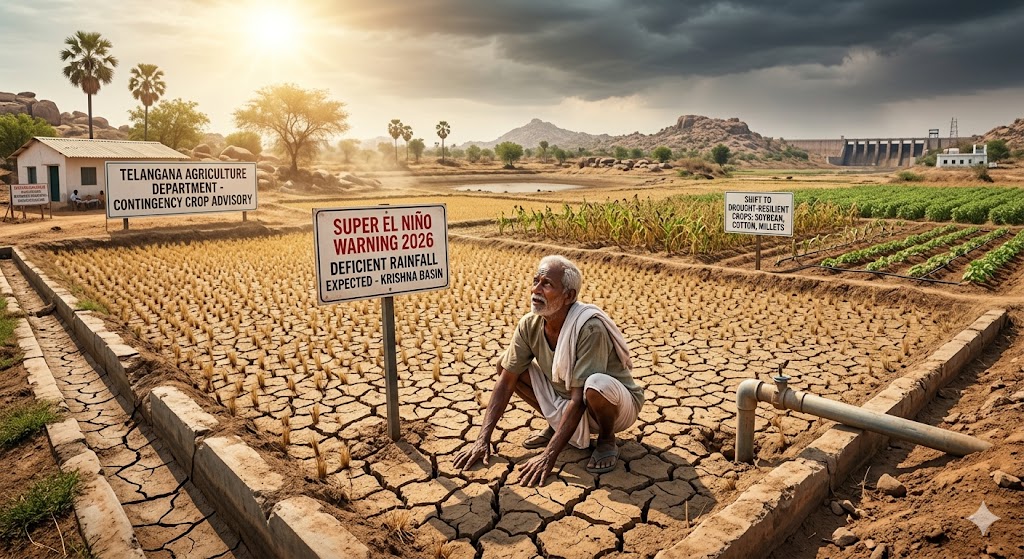
AI-generated image.

Synopsis: Telangana might be better prepared this year. But small farmers rely on heavy rains. For them and for paddy growers, in particular, “super” El Niño isn’t good news.
As the southwest monsoon of 2026 unfolds under the shadow of a developing strong El Niño, Telangana finds itself navigating one of the more challenging agricultural seasons in recent memory.
The Pacific warming phenomenon, officially declared by the US-based National Oceanic and Atmospheric Administration (NOAA) in mid-June 2026, is strengthening and carries a significant risk of disrupting rainfall patterns across India. For a state like Telangana, where agriculture remains a cornerstone of the economy and livelihoods, the implications are profound—ranging from potential water stress and crop shifts to broader economic ripples.
El Niño, the warm phase of the El Niño-Southern Oscillation (ENSO), occurs when sea surface temperatures in the central and eastern equatorial Pacific rise notably above average. This alters global atmospheric circulation, often weakening the Indian summer monsoon by suppressing the trade winds and shifting rainfall patterns.
Historically, strong El Niño events have correlated with below-normal monsoon rainfall in India, with probabilities of deficient seasons rising substantially.
In 2026, forecasts point to a potentially “super” El Niño, with Niño 3.4 anomalies possibly exceeding +2.0°C later in the year. The India Meteorological Department (IMD) has projected national monsoon rainfall at around 90-92% of the Long Period Average (LPA), with a heightened chance of deficient conditions.
Also Read | Tenant farmers in Telangana struggle amid soaring lease costs, policy gaps: Survey
For Telangana, the outlook is nuanced but concerning.
While some forecasts suggest parts of central Telangana, including Hyderabad, might see near-normal or even excess rainfall in pockets, northern and southern districts face deficits of 25-30%. The monsoon arrived in the state around June 8, but early progress has been uneven. Reservoir inflows from the Krishna and Godavari river basins—critical for irrigation—are threatened by below-normal catchment rainfall. This directly imperils the kharif season, which accounts for a major share of the state’s agricultural output.
Agriculture dominates Telangana’s rural economy, with paddy (rice) as a dominant kharif crop, alongside cotton, maize, pulses, and oilseeds. Paddy, being highly water-intensive, is particularly vulnerable. In past El Niño years, Telangana has seen notable declines in average paddy production and yields.
Rainfed areas, which constitute a large portion of farmland, are hit hardest by delayed sowing, prolonged dry spells, and moisture stress during critical growth stages like flowering and grain filling. Higher temperatures compound the issue, increasing evapotranspiration and heat stress on crops.
Recognising these risks, the Telangana Agriculture Department has proactively launched contingency measures. Farmers are being strongly advised to curtail large-scale paddy cultivation unless assured canal irrigation is available. Instead, the focus is shifting to short-duration, drought-resilient alternatives such as pulses, oilseeds (e.g., soybean), cotton, and certain millets.
Contingency plans outline crop strategies for varying deficit scenarios—no rain till mid-July, end-July, or mid-August. Promotion of drought-tolerant seed varieties, efficient irrigation techniques like drip and sprinkler systems, and organic farming initiatives are underway. Awareness campaigns in districts like Adilabad, known for cotton and soybean, emphasise these adaptations.
The human and economic toll could be substantial.
Telangana’s farmers, many of whom operate small holdings, rely heavily on monsoon rains. Reduced yields threaten incomes, food security, and rural demand. Lower reservoir levels could strain drinking water supplies and hydropower, while groundwater over-extraction during such deficit seasons risks long-term depletion. At the state level, this may necessitate increased relief spending, potential imports of pulses or oilseeds, and upward pressure on food inflation—already a national concern amid El Niño. Nationally, kharif output dips in similar years have historically affected millions, with ripple effects on supply chains.
Also Read | Unfulfilled dreams in rural Telangana: Reflections from the ground
Yet, Telangana and India are better equipped today than in past decades.
Improved forecasting, resilient crop varieties, expanded irrigation coverage, and policy focus on diversification provide buffers. A positive Indian Ocean Dipole (IOD), if it materialises strongly, could partially mitigate El Niño’s drying effect. Government coordination—through the Indian Council for Agricultural Research, state departments, and district-level task forces—aims for “preparedness, not panic,” with revised contingency plans tailored to this year’s dynamics.
This El Niño episode underscores the urgency of long-term climate adaptation. Telangana must accelerate investments in water conservation, micro-irrigation, crop diversification away from water-guzzlers, and climate-smart agriculture. Farmers need timely advisories, affordable credit, and crop insurance support. On a broader scale, India’s push toward sustainable farming and renewable energy can reduce vulnerability to such oscillations, which are increasingly influenced by global warming.
As June 2026 progresses and the monsoon evolves, vigilance is key.
El Niño reminds us that while nature’s cycles are inevitable, proactive governance and community resilience can blunt their sharpest edges. For Telangana’s farmers and its agrarian heartland, the coming months will test this preparedness. Success hinges not just on rainfall but on how effectively the state turns forecasts into actionable resilience. With coordinated efforts, what seems like an impending ordeal could become a catalyst for stronger, more sustainable agriculture in the years ahead.
Also Read: The Hyderabad Metro takeover is a bailout—Telangana should call it one
(Edited by R Rajesh Kumar.)



