

Published Aug 17, 2026 | 9:00 AM ⚊ Updated Aug 17, 2026 | 10:32 AM

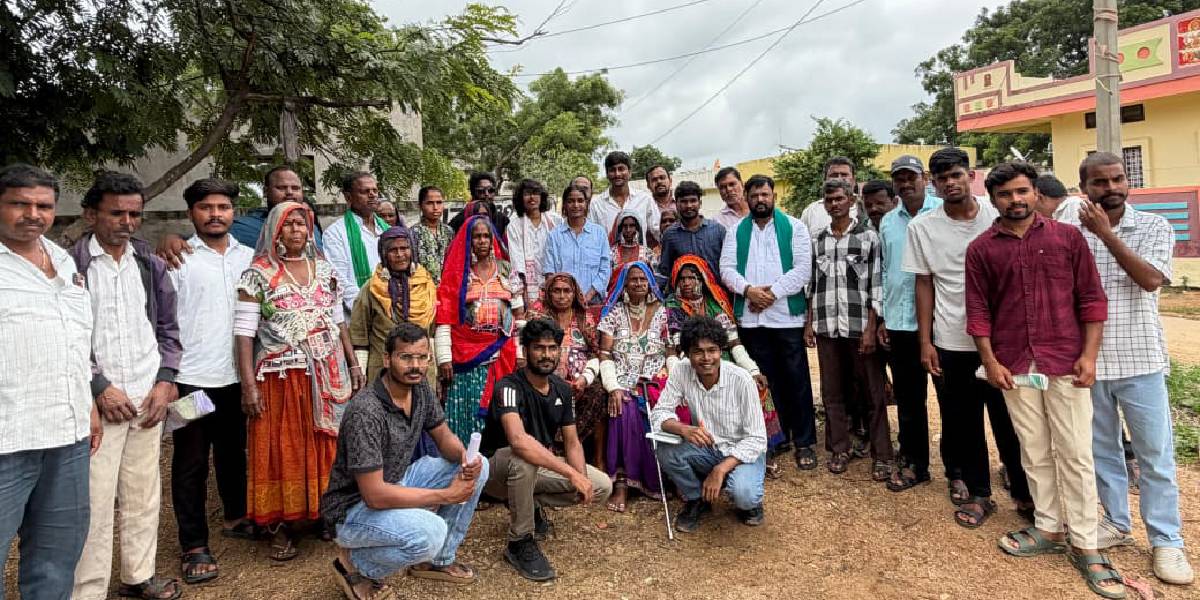
Residents of Siddapur and neighbouring villages with activists from Climate Front Telangana

Synopsis: Residents of Siddapur, the site for the Telangana government’s newly announced ‘Eco Town’ project, are pushing back on the proposal. Originally promised an industrial park, residents allege that the latest developments blindsided them. They have since rejected the project and demanded that the official proceedings be made public.
On 26 May, residents of Siddapur, a village in Ranga Reddy district’s Kothur mandal, woke up to news that Deputy Chief Minister Mallu Bhatti Vikramarka had announced plans to build the Eco-Town project, a Solid Waste Management (SWM) facility modelled on Japan’s Kitakyushu city, at their village border.
The announcement was made a week earlier, on 19 May, at the Swachh Bharat Mission Urban 2.0 review meeting in New Delhi. Vikramarka had then talked about Telangana’s push toward decentralised waste processing systems, in line with the Solid Waste Management Rules, 2026, notified by the Centre.
Siddapur came to know of the plan only through media reports. When residents went to the Ranga Reddy Collector’s office seeking details, officials there said they had no information about any such land allocation.
What followed was months of protests, RTI applications, and visits to government offices—largely met with silence. Only after the government issued GO Rt No. 641 on 2 July did the village receive an official confirmation of what was actually planned for its fields.
“We just want to know if our village will be fit to live in after they construct that facility,” Sricharan Chary, a resident of Siddapur, told South First.
Also Read: The symbols have changed in Telangana, but the character has not!
According to the Municipal Administration and Urban Development (MA&UD) Department’s GO Rt No. 641, 86 acres in Survey Numbers 252, 278 and 361 of Siddapur were transferred from the Telangana Industrial Infrastructure Corporation (TGIIC) to the Greater Hyderabad Municipal Corporation (GHMC) earlier this year.

Residents of Siddapur took out a protest march to the Collectorate in June.
GHMC’s Commissioner had originally asked TGIIC for 150 acres in August 2025, but only 86 acres were cleared free of cost in January 2026. The advance possession was handed over on 11 February.
The state government then ratified the decision to allow Hyderabad Integrated Municipal Solid Waste Management Limited (HiMSW) to establish an SWM facility under an existing Integrated Municipal Solid Waste Management (IMSWM) concession agreement. HiMSW is the private company behind the Jawahar Nagar SWM plant, and is operated by Re Sustainability.
An official with GHMC’s SWM department said that the aim was to decentralise the city’s waste processing. “Earlier we only had Jawahar Nagar; now at least half of the waste may come to Siddapur. So instead of taking waste from Shamshabad to Jawahar Nagar, which releases more emissions due to transportation, we want to reduce the emissions,” the official said.
The plant is designed to include an organic waste processing unit for wet waste, and recycling and Waste-to-Energy (WTE) units for dry waste. The proposed capacity is up to 4,000 tonnes per day, to be built in phases. It is currently awaiting Consent for Establishment from the Telangana State Pollution Control Board (TSPCB).
The project takes both its name and its template from Kitakyushu, the Japanese city with which Telangana signed a Friendship and Cooperation Agreement. The stated aim is to promote a circular economy and help the state work toward its net-zero goals.
The story of how the state got this land goes back nearly two decades.
Land records accessed by South First showed that TGIIC (then APIIC) first identified roughly 233 acres of assigned lands in Survey Numbers 252, 278, and 361 in 2008 for an industrial park. Many land owners are from the Lambada Scheduled Tribe (ST) community.
The proposal was revived a decade later in 2018. TGIIC’s Shamshabad zone initiated proceedings to acquire 377 acres under the same survey numbers, under the Telangana State Land Acquisition (Consent Award, Voluntary Acquisition and Lump-sum Payment towards Rehabilitation and Resettlement) Rules, 2017, to establish an industrial park.
Residents said they opposed the acquisition and demanded that no polluting industry be built near the village. The acquisition finally went through in 2021, with compensation of ₹10 lakh per acre paid to the landowners.
“People here only agreed after we were assured that polluting industries would not be constructed here. We asked them for facilities such as a food processing unit or IT offices,” Chary said.
Of this land, only 86 acres, all within the same three survey numbers, were eventually handed over to GHMC in 2026 for the waste management facility. Residents said they were never informed of the change in purpose.
GHMC officials maintained that no fresh consultation with the villagers was needed because the land had already undergone the industrial park’s acquisition process years earlier. They said the change of use did not require a fresh notice or public hearing.
Also Read: Grassroots fury that will haunt Telangana’s political giants
Chary said the villagers felt betrayed upon learning of the news.
“We did not give up lands to pollute our own village. We were promised an IT park and jobs for the youth here. Our primary concern is the project’s proposed location. Siddapur and the surrounding villages depend largely on agriculture and groundwater. We are worried about long-term impacts on air quality, water resources, soil, public health, and local livelihoods,” Chary added.
In May, months before GO Rt No. 641 was issued, residents filed a Right to Information application with TGIIC’s Shamshabad zone office, asking 10 specific questions about the proposed waste-processing unit.
The RTI sought information on the proposal, allocated land, public consultations, environmental clearances, Detailed Project Report, impact assessment, public objections, and internal correspondence between departments.
TGIIC’s written response, dated 17 July and signed by the Shamshabad Zonal Manager, marked “ledu” – Telugu for “no” or “none” – against all but one question.
“Our RTIs to CURE, MA&UD, Department of Revenue, GHMC, HMWSSB, and TGPCB but did not receive any response. We want to proceed legally, but we do not have the necessary documents,” Chary said.
Residents said that local leaders from the ruling party initially misled them about the proposed project.
At a public meeting on 10 June at Kothur, a leader proclaimed, “This is false news being spread by the opposition parties. So what if there is a proposal? It will be there; nothing more will happen. Do you think we will let such a facility come to Kothur?”
Residents said this pattern pushed them to organise under the banner ‘Save Siddapur’. They formed the Siddapur Dumping Yard Vyathireka Poratam Joint Action Committee (SDVP-JAC), working alongside a youth collective, Siddapur Youth Unity, to coordinate opposition to the plant.
Sarpanches of 11 gram panchayats around the village have also passed resolutions formally rejecting the project.
Also Read: Why Telangana’s heatwave death count differs from NCRB data
South First posed a detailed set of questions to the GHMC Commissioner’s office and the SWM Department. Their answers offer the clearest official account so far of how Siddapur was chosen and why the department felt it did not owe the village a fresh consultation.
On site selection, an official in the GHMC Commissioner’s office said the corporation had been scouting for a second location for an SWM facility, apart from the existing Jawahar Nagar dumping yard site.
“We identified 10-15 locations, including Banda Raviriyal and Siddapur. Sending the city’s entire waste to the Jawahar Nagar plant is causing severe operational issues and higher costs. So we identified a new location,” he said.
The SWM department said something similar, and added, “We have been looking for sites since 2017, in line with the National Green Tribunal directions for decentralisation. Jawahar Nagar is on the northeast side; we need land on the other side of the city/ corporation. Siddhapur falls on the Southern side. That is one of the criteria for selecting Siddapur.”
Another site under consideration, Pyaranagar in Sangareddy district, remains tied up in a pending court case after stiff local opposition to the SWM facility.
Officials said they will draw up a Detailed Project Report only after the Pollution Control Board sets its conditions through the pending Consent for Establishment.
On why the village wasn’t consulted afresh, the department said the land had already gone through the acquisition process for the industrial park, and the change of end-use did not require a new Gram Sabha or public hearing.
“It was not an agricultural land acquisition. TGIIC gave us the land,” an official said of GHMC’s own role in the transaction.
On environmental clearance, officials pointed to a 2017 Ministry of Environment, Forest and Climate Change memorandum that exempted municipal solid waste facilities without a landfill component from environmental clearance and public hearings.
Another policy change came into force in 2025 that completely exempted these facilities from clearances, with or without landfill. The Central Pollution Control Board (CPCB) assigned a new ‘blue category’ classification to SWM and WTE units, replacing the environmental clearance criteria with only a Consent to Establish (CTE) or Consent to Operate (CTO) from the board. WTE was earlier classified under the red category assigned to highly polluting industries.
On water usage, the officials said the plant would draw from a municipal or Mission Bhagiratha connection, and that a leachate treatment system modelled on the one at Jawahar Nagar would eventually cut the facility’s fresh-water demand.
However, they confirmed that before leachate treatment is fully operational, a large amount of water will be used for the WTE incineration process.
“It won’t affect the village. Even if it were any other industry, the government will have to supply water; same for the Eco-Town,” they said.
Officials said they would make all statutory approvals visible on the Pollution Control Board’s website once granted, and place other project documents in the public domain. However, multiple RTIs filed with GHMC by the Siddapur residents remain unanswered.
Residents and activists contested GHMC’s claims, saying that even though the proposed project is not on agricultural land, at least 20 farming villages and tribal thandas lie within its 5 km radius.
“We are worried about our land, water, and air being polluted. Several important institutions and landmarks are nearby, like the Telangana Tribal Welfare School and JP Dargah. What about those?” Chary asked.
Also Read: Government land auction in Hyderabad raises serious questions
On 4 August, a six-member delegation from Climate Front Telangana (CFT) travelled to Siddapur and the neighbouring tribal villages. They met villagers, JAC activists, sarpanches, farmers and tribal residents.
In a statement issued three days later, the group said that no environmental disclosure had ever reached the village. It reiterated that sarpanches of 11 gram panchayats had formally rejected the project.
It also flagged health concerns tied to incineration, including exposure to dioxins, furans, heavy metals and fine particulate matter. They questioned the CPCB’s move to reclassify WTE plants from red to blue, saying the reclassification has diluted monitoring requirements.
They said the technology is losing favour elsewhere and pointed to the European Union’s exclusion of waste incineration from its green finance taxonomy. They also highlighted the International Finance Corporation’s withdrawal of a proposed $40 million loan for four WTE plants in Gujarat after public opposition.
CFT’s central objection is to the Waste-to-Energy component. The group argued that Indian municipal solid waste has high moisture content and typically falls short of the calorific value necessary for efficient incineration under the Central Solid Waste Management Rules.
Ruchith Asha Kamal, National Committee member of Climate Front, told South First that WTEs are unsustainable and financially unviable on their own.
“The fundamental problem with this model is that it encourages waste generation. Instead of cutting down on waste, governments and corporate companies are running an economy on generating waste,” Kamal said.
Pointing to the viability gap funding model, he added that private companies receive subsidies, loans, and grants from the government to build SWM plants that cannot generate income on their own. He called it a way for corporates to make a profit from waste.
Kamal placed WTE facilities in the same category as riverfront beautification, carbon credits, and ethanol blending, that is, projects designed to ‘greenwash’ environmental damage being done by major industries.
CFT’s charter of demands includes revoking the WTE plant in accordance with the resolution passed by the villages, halting the project pending a public consultation, shifting toward decentralised waste management, and rejecting unscientific greenwashing efforts.
“Telangana cannot solve its urban waste crisis by continuously setting up toxic incinerators in peripheral rural villages and tribal tandas. Setting up more WTE plants is an unsustainable loop. Telangana urgently needs a comprehensive, self-sustaining State Zero-Waste Policy centred on cutting waste generation at the source,” CFT’s statement read.
The group said it will keep pressing alongside the JAC and Siddapur Youth Unity until the government withdraws the order for the Eco-Town waste facility.
Also Read: An acre of land sold for Rs 177 crore in Hyderabad!
Since the opposition to the Eco Town project began, police have closely monitored activities in the village.
“They are not allowing us to protest. We are conducting meetings, but whenever we organise a demonstration, police come in to stop us,” Chary said.
The CFT’s 4 August visit was also not without friction. According to the CFT’s account, police tried to stop the delegation from entering the village and warned Kamal of arrest if the visit went ahead.
The group said it declined to turn back and told the police that expressing solidarity with a democratic movement was a constitutional right. They were eventually denied permission for a protest and held a meeting instead.
Chary said the police were present throughout the day in the village and even attended the meeting with the CFT delegation.
Also Read: Hyderabad’s Kokapet emerges as realty goldmine
The SDVP-JAC submitted multiple representations to leaders from all major political parties.
Notably, a delegation of residents from Siddapur and neighbouring villages met BRS MLA T Harish Rao and BJP MP DK Aruna.
Harish Rao demanded the government immediately withdraw GO Rt No. 641. He warned that the project would contaminate water bodies such as Gutta Cheruvu and damage farmland across some 20 villages. He also confirmed that the former BRS government acquired the land for an IT park, and pledged the party’s backing for the villagers’ agitation.
BJP MP from Mahabubnagar, Aruna, visited the village in July. On 4 August, she submitted a memorandum to the Union Environment Minister Bhupender Yadav seeking relocation of the project. She argued that it ran counter to the erstwhile GO Ms No. 111, framed to protect the catchment areas of the Osman Sagar and Himayat Sagar reservoirs that supply drinking water to Hyderabad. She also called for a joint inspection involving the Central Pollution Control Board before granting any further clearances.
On the ground, the JAC has kept up a steady rhythm of protests, including a “Chalo Collectorate” march, a protest at the MRO office, and a recent all-party meeting on 11 August.
Their core demand remains the same: transparency. They want all project-related documents, including environmental studies, technical reports, approvals, and clearances, made available to the public. As the affected community, they believe that they should be informed and consulted before implementation.
“We are not against development or scientific waste management. But a project of this scale should undergo a transparent process. It should comply with environmental laws and take our health, agriculture, and natural resources into consideration,” Chary said.
(Edited by Majnu Babu).



