

Published Jun 18, 2026 | 11:23 AM ⚊ Updated Jun 18, 2026 | 11:33 AM

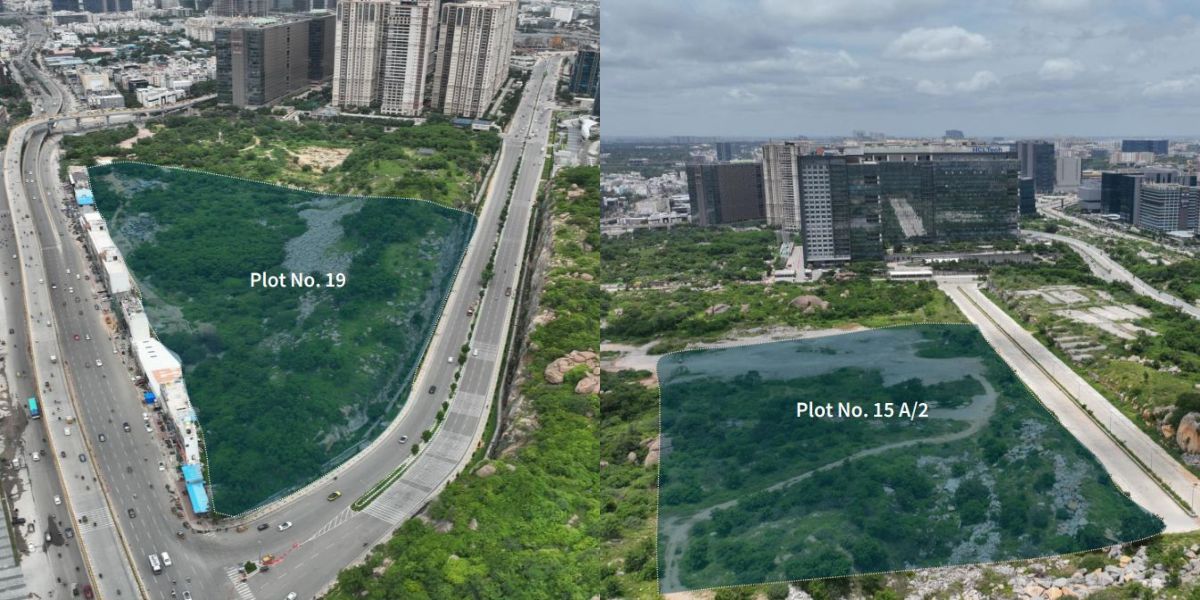
The prices these land parcels in Hyderabad have been fetching rival and even surpass bids placed in Mumbai and Delhi.

Synopsis: A land auction that fetched Rs 2529 crore while underscoring Hyderabad’s attractiveness as an investment destination has also thrown up questions about the Telangana government’s right to conduct it.
The Telangana government’s successful auction of prime land parcels in Raidurg Panmaktha and Serilingampally Mandal for a staggering Rs 2,529 crore via the Telangana Industrial Infrastructure Corporation (TGIIC) has sent shockwaves through Hyderabad’s real-estate circles. Yet, within days, the State Bank of India (SBI) approached the Telangana High Court claiming that nearly 5 acres of the 6.29-acre Plot 1A & 1F (Survey No. 83/1) sold to Gowra Ventures rightfully belong to the bank. This immediately raises a fundamental question: Did the Telangana government have the legal locus standi to auction and sell land that SBI asserts it had acquired years earlier through a formal government allotment? The High Court is hearing the petition on Thursday, casting a shadow over the entire high-profile transaction.
According to the TGIIC e-Auction Notification (No. 2024-4/TGIIC/LANDS/E-Auction/2025 dated 06-05-2026), two multi-use plots in the Knowledge City layout were offered on an “as is where is basis” with claims of being encumbrance-free.
Plot 1 (approx. 6.29 acres) fetched a record Rs 237 crore per acre, while Plot 2 (P4, approx. 5.09 acres) went for Rs 204 crore per acre. Gowra Ventures bagged the larger parcel for roughly Rs 1,490 crore. These bids far exceeded the upset price of Rs 139 crore per acre, reflecting strong market appetite for land in Hyderabad’s Financial District.
SBI’s petition, however, alleges that approximately 5 acres of this land were allotted to its predecessor, the State Bank of Hyderabad, in 2010 by the then-undivided Andhra Pradesh government for an office complex. The bank reportedly paid Rs 13.33 crore and received an official allotment letter from APIIC (predecessor to TGIIC). If proven, this suggests the land was never available for fresh auction, exposing potential gaps in revenue records, title verification, and inter-departmental coordination post-Telangana’s formation.
The notification itself carries caveats: land extents are “provisional and indicative,” with final measurement to be done via joint survey after the auction. It also directs bidders to detailed e-brochures on official portals. Nevertheless, marketing the parcels as prime, clear-title government land at premium prices has now triggered a high-stakes legal battle.
Also Read: An acre of land sold for Rs 177 crore in Hyderabad! Raidurg plot sets new record
On the positive side, the auctions underscore Hyderabad’s attractiveness as an investment destination.
Record-breaking bids boost state coffers for infrastructure development and signal confidence in Telangana’s growth story, particularly around Knowledge City, T-Hub, and the IT corridor. The transparent e-auction mechanism through MSTC, with pre-bid meetings and public notifications, reflects procedural improvements over past practices.
Yet the SBI dispute highlights serious systemic vulnerabilities.
The questions about the government’s locus standi strike at the heart of property law: once land is validly allotted and paid for, can the same government entity (or its successor) re-auction it without resolving prior claims? This episode points to lingering issues with legacy land records from the Andhra Pradesh era, incomplete digitisation, and possible administrative oversights. Similar disputes have surfaced in Raidurg previously, suggesting deeper problems in maintaining accurate, updated title databases.
For the successful bidder, Gowra Ventures, the uncertainty is damaging. Development plans could face delays, litigation costs, and potential reversal of the sale. For SBI, it is a fight to protect assets meant for public banking infrastructure. For the Telangana government, prolonged controversy risks eroding investor trust and inviting accusations of hasty monetisation at the expense of due process.
This case serves as a cautionary tale for India’s land markets, where opaque records often undermine large transactions. It underscores the urgent need for comprehensive land record digitisation, mandatory title insurance mechanisms, and stricter pre-auction due diligence involving all stakeholders.
The Telangana High Court’s verdict will be crucial.
It may uphold SBI’s claim, direct a joint verification, or uphold the auction while ordering compensation. Regardless, the government must act swiftly—through transparent communication, record rectification, and policy reforms—to restore confidence.
In conclusion, while the Raidurg auctions celebrate Telangana’s economic momentum, the SBI ownership dispute questions the very foundation of the transaction. Clean titles and undisputed locus standi are non-negotiable for sustainable real-estate growth. Resolving this transparently will determine whether this episode becomes a blemish or a catalyst for better governance in land management.
(Edited by R Rajesh Kumar.)



