

Published Jun 03, 2026 | 9:00 AM ⚊ Updated Jun 03, 2026 | 3:57 PM

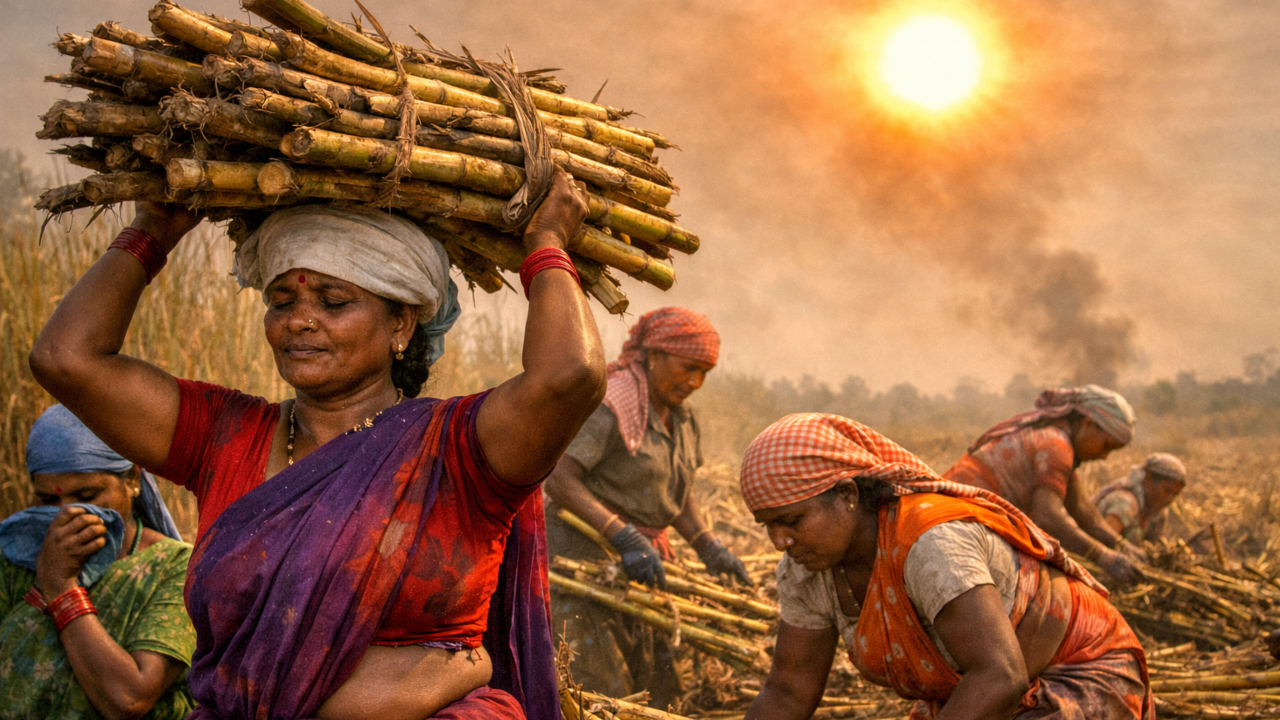
AI-generated representational image

Synopsis: A new study across 11 districts in Tamil Nadu has found that rising heat stress is severely affecting the health, productivity, and livelihoods of outdoor workers, especially women employed in informal sectors such as agriculture, salt pans, and construction. The research warns that without urgent climate adaptation measures, extreme heat could deepen poverty, wage loss, and long-term health complications for millions of labourers in the state.
Rajalakshmi, a 37-year-old woman from Cuddalore, suffers from kidney-related ailments and several other health complications. Yet, every day from 8 am until the scorching afternoon heat at around 2 pm, she has to lift and load more than a hundred kilograms of sugarcane bundles onto vehicles, balancing them on her head.
In the sugarcane fields where she works, Rajalakshmi cannot take a break to urinate whenever she needs to. She cannot freely drink water even when she is thirsty. Under the intensifying heat of the sun, dehydration can overwhelm her within hours.
Rajalakshmi’s story is not an isolated one.
Between 2021 and 2023, researchers from the Sri Ramachandra Institute of Higher Education and Research in Chennai conducted a large-scale study involving more than 1,500 outdoor workers across 11 districts in Tamil Nadu, including labourers employed in brick kilns, salt pans and sugarcane fields.
The study, carried out by Vidya Venugopal, PK Latha and Rekha Shanmugam from the institution’s Department of Environmental Health Engineering, has now been published in the journal Scientific Reports.
As Tamil Nadu experiences increasingly intense summers, this study has found that climate change is no longer just an environmental concern, it is becoming a daily survival challenge for lakhs of outdoor workers.
For women workers employed in informal outdoor labour, the findings expose how extreme heat is worsening already precarious working conditions. While discussions on climate change often focus on floods, cyclones, or rising temperatures, the study highlights how extreme heat is quietly eroding the health, earnings, and working capacity of women from some of Tamil Nadu’s poorest communities.
Also Read: Telangana heatwave claims 16 lives; govt announces Rs 4 lakh relief
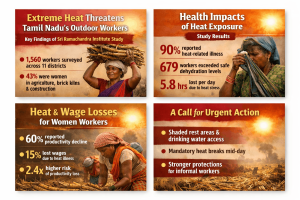
Of the 1,560 workers surveyed, 43 percent were women working in physically demanding sectors such as agriculture, brick manufacturing, salt pans, and construction. Many of these occupations involve long hours under direct sunlight with little access to shade, drinking water, or rest facilities.
Researchers found that temperatures at many workplaces routinely crossed safe occupational exposure limits. During summer, Wet Bulb Globe Temperature (WBGT) levels, a measure that accounts for temperature, humidity, sunlight, and wind, reached as high as 35°C, while the average stood at nearly 30°C.
Nearly 88 percent of workers surveyed during summer were exposed to unsafe heat conditions. Even in winter, 42.5 percent remained exposed to dangerous heat levels.
For women labourers paid on a daily-wage basis, slowing down work is often not an option.
The study found that workers exposed to high heat had a 1.45 times greater risk of productivity loss compared to those working under safer conditions. Heavy manual work further increased risks, with workers in physically demanding jobs facing 2.4 times higher odds of productivity loss.
More than 60 percent of workers surveyed during summer reported that heat affected their productivity. Many said they could not complete daily targets, required longer hours to finish tasks, or suffered exhaustion and fatigue during shifts.
For women in agriculture and construction, this often translates directly into reduced earnings.
Unlike salaried employees, informal women workers frequently earn based on daily output. If heat slows work, income falls immediately. If illness forces them to stay home, wages disappear entirely.
The study found that around 15 percent of workers reported losing wages because of heat-related absenteeism during summer months.
Researchers noted widespread symptoms of heat stress among workers, including excessive sweating, dehydration, headaches, muscle cramps, nausea, dizziness, and fainting.
An alarming 90.3 percent of workers reported experiencing at least one heat-related illness symptom.
Among 1,403 workers medically tested for heat strain, 679 exceeded safe physiological limits linked to dehydration and heat stress. Researchers recorded abnormal core body temperatures in 16.7 percent of workers, excessive sweat loss in 24.9 percent, and signs of dehydration in 32.9 percent.
Researchers found that workers suffering heat-related symptoms were over three times more likely to experience productivity loss.
Among workers surveyed across seasons, average work hours lost due to heat rose from 3.8 hours during winter to 5.8 hours during summer.
For women, the impact extends beyond the workplace.
Many female agricultural labourers and construction workers return home after long shifts to unpaid domestic responsibilities including cooking, water collection, childcare, and elder care. Extreme heat therefore increases not only workplace stress but also household burdens.
While the study did not directly measure unpaid domestic labour, the findings suggest that the health impacts of heat exposure are likely to continue long after working hours end.
Also Read: How Chennai is racing to build heatstroke wards as temperature soars
The research covered districts including Ariyalur, Chennai, Salem, Tiruchirappalli, Tiruvannamalai, Villupuram, Cuddalore, Nagapattinam, Kancheepuram, Chengalpattu, and Tiruvallur.
Some of the highest heat exposure levels were recorded in Ariyalur, Chennai, and Salem. Coastal districts such as Cuddalore and Nagapattinam, where salt-pan work is a major source of livelihood, also recorded dangerous heat conditions during summer.
These are districts where thousands of women are employed in labour-intensive occupations that offer little protection from heat.
The district-level maps included in the study show a clear pattern: areas with higher WBGT readings also reported greater productivity losses.
The study places Tamil Nadu at the centre of a larger global concern.
Researchers note that nearly 92 percent of Tamil Nadu’s workforce is employed in the unorganised sector, while around 9.6 million agricultural workers are directly exposed to outdoor heat.
Unlike formal sector employees, most of these workers lack insurance, social security, paid sick leave, or legal workplace protections.
The paper warns that rising temperatures and more frequent heatwaves could further reduce labour capacity, increase healthcare costs, and deepen poverty among vulnerable communities.
Researchers argue that climate change is effectively becoming a workplace and livelihood crisis, especially for workers already living on the margins.
“Most of these workers are already poor, and climate change will exacerbate their economic hardship,” the study notes.
Also Read: 10 deaths or 116? Why Telangana’s heatwave death count differs from NCRB data
One of the study’s starkest findings is the seasonal difference. Workers exposed to unsafe heat were nearly 10 times more likely to face excessive heat exposure during summer than winter.
Among workers who were interviewed across both seasons, 95 percent reported heat-related health impacts during summer compared to 84 percent during winter. Productivity losses nearly doubled, rising from 17 percent during winter to 32 percent during summer. Average working hours lost due to heat also increased sharply.
Researchers found that workers surveyed during summer had more than twice the risk of productivity loss compared to winter.
Speaking to South First, one of the researchers, Rekha Shanmugam, said, “Compared to the period during which the research was conducted, temperatures have now risen by 1–2°C. This has made it even more difficult for labourers to cope with the heat. Prolonged exposure to extreme heat can also lead to long-term health complications such as acute kidney damage.”
The researchers warn that current labour standards are failing to account for the realities of a warming climate.
Rekha recommends shaded rest shelters, access to cool drinking water, mandatory breaks during peak heat hours, lighter protective clothing, workplace heat awareness programmes, and revised labour regulations adapted to extreme temperatures.
She also calls for stronger government intervention to protect informal workers who currently shoulder most of the climate burden without any meaningful safety net.
She added, “Without urgent climate adaptation measures, extreme heat will increasingly translate into lost wages, declining health, and deepening inequality for millions of workers — especially women who stand under the sun every day to earn a living.”
(Edited by Amit Vasudev)



