

Published Aug 03, 2026 | 8:00 PM ⚊ Updated Aug 03, 2026 | 8:03 PM

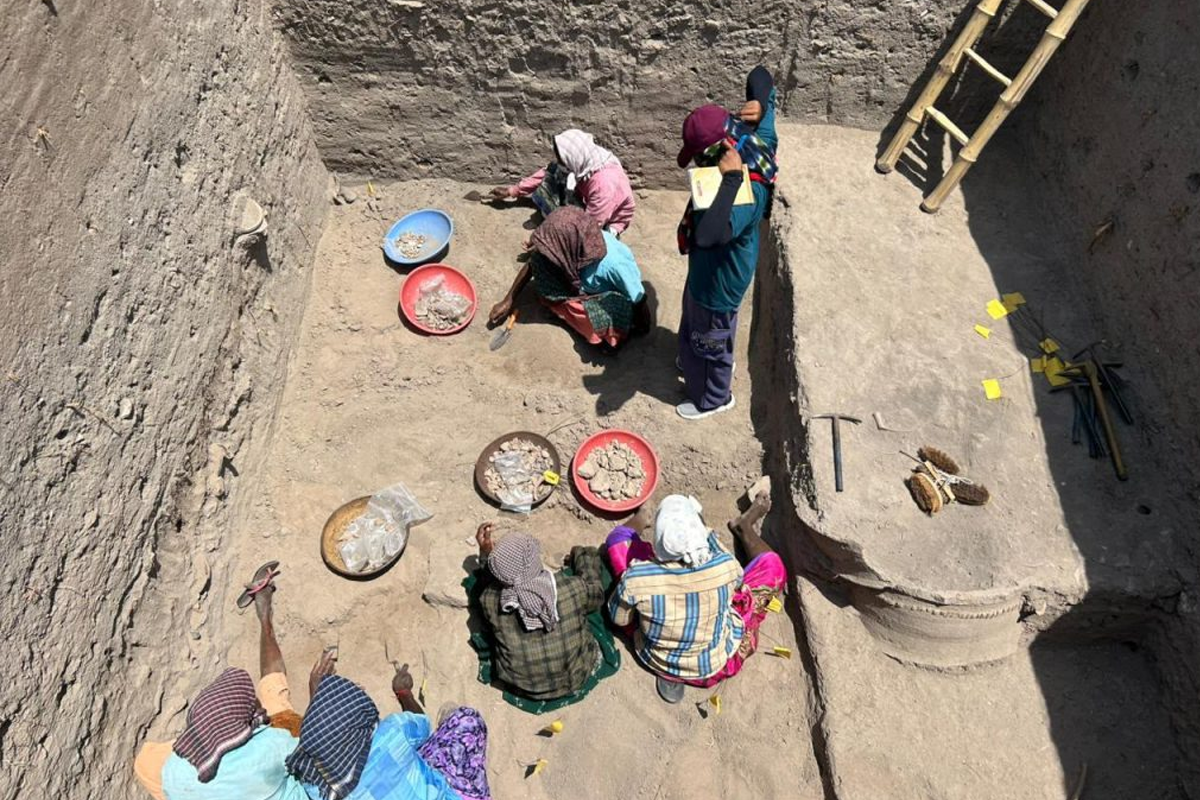
The discovery demonstrates that Pattanamarudur was not merely a habitation site but a specialised industrial centre.

Synopsis: Two significant discoveries have been made regarding the ancient Tamil civilisation: a large shell industrial site and a 16th-century inscription belonging to the Vanathirayar rulers. The shell-ornaments making centre was discovered during excavations at Pattanamarudur in Thoothukudi district, while the stone inscription was found near Sivaganga.
Tamil Nadu has recorded two significant archaeological discoveries that provide fresh insights into the state’s ancient industrial economy and medieval political history.
While excavations at Pattanamarudur in Thoothukudi district have revealed evidence of what archaeologists describe as the largest ancient shell-working industrial site discovered in Tamil Nadu so far, researchers in Sivaganga district have documented a rare 16th-century inscription belonging to the Vanathirayar rulers, adding a new record to the history of the regional chieftains who served under the Pandya, Vijayanagara and Nayak kingdoms.
In July 2026, the Tamil Nadu Department of Archaeology announced that ongoing excavations at Pattanamarudur, located in Thoothukudi district along the Gulf of Mannar, had established that an ancient shell-processing industry once functioned across nearly 200 acres, making it the largest ancient shell industrial site identified in the state to date.
According to the department, excavations have yielded large quantities of shell-related artefacts, including ornaments, bangles, beads, bracelet fragments, along with Chinese celadon pottery, Pandya coins, Vijayanagara coins, and other archaeological materials.
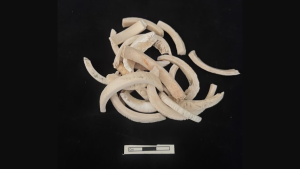
Officials say the discovery demonstrates that Pattanamarudur was not merely a habitation site but a specialised industrial centre dedicated to the manufacture of shell ornaments.
The Archaeological Survey of India (ASI) had granted permission to the Tamil Nadu Department of Archaeology in March this year to undertake excavations at eight sites across Tamil Nadu, including Pattanamarudur.
Following the commencement of excavations, the department had announced in May that around 1,500 artefacts had already been recovered from the site, including the shell ornament fragments, coins, porcelain sherds, ceramic fragments, miniature figurines and several other cultural materials.
Also Read: Prehistoric cave, 3,000-year-old rock art and Iron Age smelting remains found near Madurai
According to the excavation team, the archaeological mound is presently surrounded by the sea and extensive salt pans. Researchers noted that the excavation area itself had functioned as a salt pan until a few years ago.
The discoveries indicate a systematic shell-manufacturing industry.
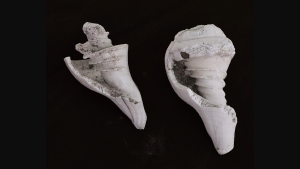
Archaeologists explained that they have also recovered complete shells and those that were partially cut during different stages of ornament production.
So far, excavations have been carried out in ten trenches, and every trench has yielded evidence connected to shell manufacturing, strengthening the conclusion that the site functioned as a large industrial production centre rather than an isolated workshop.
The department therefore considers Pattanamarudur to be the largest ancient shell industry site discovered anywhere in Tamil Nadu.
Apart from shell artefacts, excavators have recovered Chinese celadon ware, indicating overseas trade contacts.
The presence of Pandya and Vijayanagara coins suggests that the settlement remained active across different historical periods and participated in regional and maritime trade networks.
Researchers believe these discoveries reinforce the importance of the Gulf of Mannar coast as a major centre of commerce and craft production.
The Tamil Nadu Department of Archaeology clarified that the exact age of the artefacts has not yet been scientifically established through Carbon Dating.
However, the materials can presently be assessed through Relative Dating, comparing them with artefacts previously excavated at Korkai.
Pattanamarudur is situated approximately 20 kilometres from Korkai, one of the most important ancient settlements in southern India.
The department pointed out that Korkai lies around three kilometres north of the Tamiraparani River, and geological evidence indicates that the river flowed through this region during ancient times.
Korkai served as the maritime port city of the Pandya kingdom during the Sangam Age, and the similarities between artefacts recovered from Korkai and Pattanamarudur suggest that the newly excavated site may have formed part of the same wider economic landscape centred around shell ornament production and maritime trade.
Also Read: Keeladi excavation unearths rare furnace, reinforcing evidence of early Tamil iron production
In another important archaeological discovery, researchers have identified a rare stone inscription belonging to the Vanathirayar rulers at Enapuram Pudhupatti Kanmai, near Sivaganga.
The inscription came to light after Muralikrishnan, a college student from the village, informed archaeologists about the presence of an inscribed stone in the area.
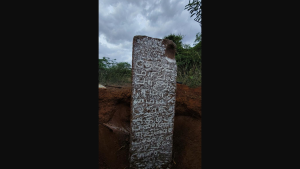
Based on this information, a field investigation was conducted by Pulavar K. Kaalirasa, founder of the Sivaganga Heritage Walk Group, and Dr. Velayudharaja, Associate Professor, Department of History, Alagappa Government Arts College, Karaikudi.
After examining the inscription, the researchers deciphered its contents and announced that it belongs to the 16th century.
The inscription is carved on a stone measuring approximately four feet in length and one foot in width.
It contains a total of 19 lines of Tamil inscription carved across its two faces.
The reverse side also bears engraved symbolic figures depicting a Kamandalam (water vessel), whip, and Tridanda (three-pronged ascetic staff). These symbolic engravings are considered significant in understanding the religious context associated with the inscription.
Researchers said the inscription records a land grant made by Deiva Maavali Vanathirayar.
The inscription also contains a customary protective clause warning against violating the charitable endowment.
It states that anyone who interferes with or damages the charity would incur the sin equivalent to killing a sacred cow on the banks of the River Ganga.
Such warning clauses, commonly known in Tamil inscriptions as Ombadai Kilavi, were frequently included in medieval land grant inscriptions to protect religious donations.
Researchers observed that a stone engraved with a trident (Soolam) is located near the inscription.
Based on this evidence, they believe the donated land was most likely endowed to a Shiva temple that once existed in the locality.
Although no temple structure survives today, the trident stone provides an important clue regarding the religious institution associated with the land grant.
Based on the style of the script and palaeographic features, researchers believe the inscription may belong to Irandhakaalam Edutha Sundara Tholudaiyan Maavali Vanathirayan, who ruled between AD 1515 and 1533.
Alternatively, they suggest that the inscription may have been issued later by one of his descendants to reaffirm and protect the charitable grant established during his reign.
One of the most significant aspects of the discovery is that this is the only inscription so far discovered that specifically mentions “Deiva Maavali Vanathirayar.”
Also Read: Tamil Nadu’s consent not needed for Mekadatu reservoir project, Centre informs RS
According to the researchers, the Vanathirayars traced their lineage to the legendary emperor Mahabali (Mabali Chakravarthi) and identified themselves as his descendants.
They adopted the title Maavali Vanathirayar and served as regional chieftains and administrative officials under the Pandya kings, and later under the Vijayanagara Empire and the Nayak rulers.
Among the prominent rulers of this lineage were, Thirumaliruncholai Ninran Maavali Vanathirayan, Sundara Tholudaiyan Maavali Vanathirayan, Irandhakaalam Edutha Sundara Tholudaiyan Maavali Vanathirayan.
These rulers governed parts of the present-day regions around Madurai’s Azhagar Kovil, Kalaiyarkovil and Manamadurai during the 15th and 16th centuries.
Their inscriptions documenting temple renovations, charitable endowments and public works have previously been recorded from Azhagar Kovil, Kalaiyarkovil, Tiruppullani, Manamadurai and Brahmanakurichi.
The newly discovered inscription at Enapuram Pudhupatti therefore adds another important record to the history of the Vanathirayar administration and expands the known epigraphic evidence relating to this influential regional dynasty.
(Edited by Fayisa CA)



