

Published Sep 08, 2026 | 8:00 AM ⚊ Updated Sep 08, 2026 | 7:36 PM



Synopsis: Across Megamalai, Karaiyar, and Kanniyakumari, families say they have lived on these hills for generations. But Government records now classify thousands of people and families as encroachers on protected forest land. With the Supreme Court directing the removal of encroachments, rehabilitation, and forest restoration, a deeper question remains: how did these communities come to live on these hills, and does the official count get it right and also capture the full human impact?
Shadows shortened as the blazing sun beat down on Thummakundu village in Tamil Nadu’s Theni district a little past 11 am. A crowd of more than 30 people braved the merciless heat as they gathered at the village square.
A mixed sense of anger, despair and uncertainty was palpable as some in the crowd spoke agitatedly. An older man in the group couldn’t contain his emotions.
“Over my body,” the frail man thundered in Tamil. “If they want to evict us, they will have to shoot me first.”
A young man who heard the older man’s declaration chipped in, trying to defuse the situation. His forced smile did not hide his inner turbulence. “Don’t talk like this,” he told the older man, who had volunteered to give up his life. “We will fight together.”
Not all were visibly agitated, though they all faced the same threat. A few kilometres away at Thandiyakulam village, 95-year-old A Karuppayi tossed twigs — dayakkattai sticks — as she played thayyam, a dice game, with friends.
She was scared, but willing to face whatever comes her way. Karuppayi has never had a life outside the village and fears her house will be gone.
The village, including Karuppayi’s home, now appears in a government list identifying people occupying forest land.
Across nine panchayats and nearly a hundred villages around the picturesque Megamalai landscape, thousands of people now live with a similar uncertainty about whether they will be allowed to remain.
The same concern extends beyond Theni.
In Karaiyar in Tirunelveli district, families said their ancestors came to the hills for British-era estate work and later for dam construction.
In Kanniyakumari, residents of areas around Kodayar and Pechiparai said their families have lived there since the erstwhile Travancore administration.
Their histories are different. But they all now face a common question: Will they be allowed to remain in the places they call home?
The dispute raised in A. John Kennedy and Others vs State of Tamil Nadu and Others, Civil Appeal Nos. 6395–6397 of 2025 before the Supreme Court was part of a larger case concerning the protection of reserve forests, wildlife sanctuaries and tiger reserves in Tamil Nadu, along with the rehabilitation of workers displaced from the former Bombay Burmah Trading Corporation Limited tea estate in Singampatti, Tirunelveli.
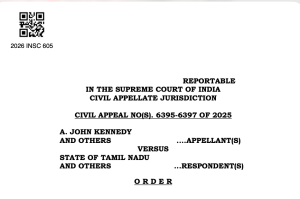
Supreme Court order in the case concerning forest land and alleged encroachments in Tamil Nadu.
The Supreme Court’s intervention on the wider Agasthyamalai landscape came on 24 March 2025, when it directed the Central Empowered Committee, or CEC. The committee was tasked with conducting a comprehensive survey of the landscape, identifying non-forestry activities in violation of forest and wildlife laws, comparing past and present forest cover, and recommending measures to restore reserve forests, tiger habitats, elephant corridors, and wildlife sanctuaries.
The CEC conducted field visits between 23 and 26 June 2025 and submitted an interim report on 10 July 2025.
It examined major protected areas including the Kanniyakumari Wildlife Sanctuary, Kalakad-Mundanthurai Tiger Reserve and Srivilliputhur-Megamalai Tiger Reserve.
The CEC described the Megamalai landscape as ecologically vulnerable and an important upper catchment of the Vaigai River. At the same time, it raised concerns about the quality of the available information, saying that data on encroachment and land use was scarce and that official records were incomplete or inconsistent.
On 16 January 2026, the CEC submitted a second report. It again pointed to gaps in verified land-ownership and encroachment records in Megamalai and adjoining forest divisions, as well as incomplete geospatial and forest-cover data.
The Supreme Court considered these reports along with the Tamil Nadu government’s reply affidavit.
In its 29 May 2026 order, the court treated the issue as extending beyond individual occupants to the larger protection of ecologically sensitive forests and wildlife habitats. It directed the state to proceed with removing encroachments and restoring affected forest areas, while also requiring rehabilitation wherever applicable.
But before looking at what the order means for the people living in Agasthyamalai, there is a more basic question: Who are the people being counted as encroachers?
Karuppayi doesn’t know the details of the case. She wants to ensure that her family lives where they have been living. Life, she knows, is not a game of dice.
According to the reports placed before the Supreme Court, thousands of people and families are living on land that the government has identified as forest encroachments across the Agasthyamalai landscape.
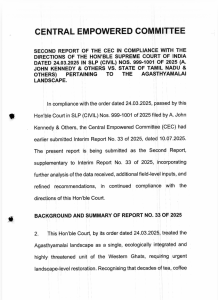
The Central Empowered Committee’s second report examines the Agasthyamalai landscape and its forest-dwelling communities.
In Theni’s Megamalai, the government identified 4,601 alleged encroachers occupying 5,072.653 hectares within the Srivilliputhur-Megamalai Tiger Reserve.
The occupants have been placed in different categories, including families living in permanent and temporary houses and people cultivating forest land.
In Kanniyakumari Wildlife Sanctuary, the government identified 553 encroachers occupying 427.404 hectares. The CEC also pointed to difficulties in establishing the exact extent of encroachment because of gaps and inconsistencies in historical forest records and boundaries.
In Papanasam of Tirunelveli district, the CEC recorded 99 families occupying 10.16 hectares. According to the report, these families include people who originally came to the area as workers during the construction of the Papanasam Upper and Lower Dams and later settled there.
These are the official figures around which the present process is being discussed. But there is an important qualification.
The figures of 4,601, 553 and 99 represent people or families identified as occupying forest land. They do not represent the total population living in these areas.
Overnight rain has brought a pleasant freshness to the morning of 21 August in the Kulasekaram area of Kanniyakumari district.
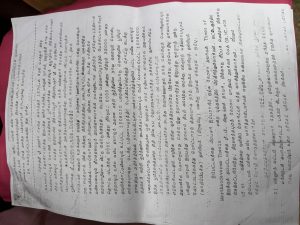
An archival document cited in connection with the history and land claims of Valaiyela.
When the sun briefly appeared, residents continued their Onam celebrations. They spoke a mix of Malayalam and Tamil.
The 10-day festival was being observed through games, food, prayers and gatherings.
Although these villages are in Tamil Nadu, the language and customs of many residents retain a strong connection with the region’s historical links to the capital of erstwhile Travancore (Thiruvananthapuram in Keralam).
About 20 kilometres from Kulasekaram lies Valaiyela. A red-earth road runs from the asphalted road through the rubber plantations to hundreds of houses beyond. The houses have tiled or sheet roofs and seem caught in the past.
Along the mud road, electric poles stood still alongside the rubber trees. But residents said that many houses had remained without electricity for decades because the area was considered forest land and the Forest Department had objected to providing connections.
It was on 23 June that residents received notices from the Kaliyal Forest Range asking why they should not be evicted from the area.
For the residents, the notice was more than a government communication. It raised the possibility that they could lose the place in which their families had built their lives.
SR Sekar, former chairman of Kadayal Town Panchayat, said the settlement has a much older history.
During a period of drought before Independence, the Travancore administration identified the area for agricultural development and gave land to around 20 families. Sekar said those families have since grown into a much larger community.
Resident C Boopathy, 60, said his family has lived in Valaiyela for five generations. His great-grandfather, grandfather, father, himself and now his son have all lived in the same area.
Boopathy also said that his ancestors received the land from the Travancore royals around 300 years ago.
The residents showed a copper-plate document supporting the history of the land—and their life.
They identified the document as one of several copper-plate grants associated with the Travancore kingdom and said it referred to lands around Valaiyela and Pechiparai.
The residents cite the document as evidence of their ancestors’ historical connection to the land.
South First has not independently cross-checked the document.
Karaiyar on the western hills of Tirunelveli looked markedly different from the rain-soaked rubber plantations of Kanniyakumari.
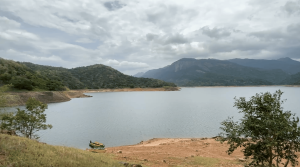
The Karaiyar landscape in the Agasthiyamalai hills.
The area is isolated, and residents described a life that has become increasingly disconnected from the outside world.
Until around 2013, tourism was an important source of income for the people. Agriculture, milk sales and small-scale farming were among the other livelihoods.
Today, residents said those opportunities have diminished considerably.
Across Karaiyar, Seralaar and Lower Camp, residents said more than 150 people and families live in the wider settlement.
The official CEC record, however, referred specifically to 99 families occupying 10.16 hectares in Papanasam.
The difference is significant because the wider population described by residents should not automatically be treated as identical to the 99 families mentioned in the official records.
R Stephen, a resident of Karaiyar, said his ancestors were brought to the hills to work in British-era estates before the 1920s.

A historical electricity receipt issued by the Papanasam Electricity System, Madurai.
He said his family lived near the present dam site and that when the Papanasam dam was constructed, residents were moved to areas including Karaiyar, Seralaar and Lower Camp.
The CEC’s records provide part of that history. It stated that around 99 families in Papanasam had originally come as workers during the construction of the Upper and Lower Dams and subsequently settled there.
Residents showed documents they claimed supported their account, including government Gazette references to the Kattalai Malai Estate, electricity-board receipts from the 1940s, and old photographs with vicars who served the local Roman Catholic Church.
These documents do not automatically establish ownership. But they provide evidence that people lived and worked in the area decades ago.
Government records showed that the issue is not new. According to the CEC, eviction notices were issued in Papanasam as early as 1996, while alternative sites were offered at different points, including in 2004, 2021 and 2025.
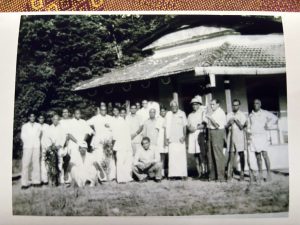
A photograph believed to have been taken in Karaiyar before the construction of the Karaiyar Dam in 1938.
The CEC also records that Kani tribal residents who were eligible received rights under the Forest Rights Act, while other occupants were dealt with separately.
The largest concentration of people affected by the present encroachment issue is in the Megamalai region of Theni district.
Around 50 kilometres from Theni town, the Varusanadu hills open into a vast rural landscape.
Kadamalaikundu-Myladumparai block contains numerous revenue panchayats, including Megamalai.
Where the road passes through land identified by residents as patta or government land, it is often tarred. Where it enters forest land, it frequently becomes a rough mud road.
Residents said this distinction has become part of their daily lives.
A Forest Department action plan cited by the CEC described these encroachments as having developed over roughly 40 to 50 years, placing the expansion broadly in the 1970s and 1980s.
The CEC linked the situation to several factors, including delays in forest settlement, unclear or damaged forest boundaries, past administrative arrangements and local circumstances.
But the history does not always fit neatly into that timeline. Many of the people are elderly.
Among them, Perumayi of Thandiyakulam is 90.
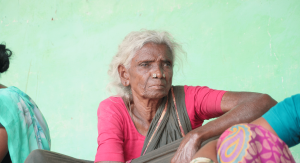
Perumayi is a resident of Thandiyakulam.
She was born here, and so was her husband. Her family has lived here for more than five generations.
Perumayi said she would give up her life if the authorities ask her to leave.
Another resident, Lingam, said his ancestors received land from the Singampatti Zamin for agriculture and other purposes and that his family has continued cultivating it.
He said his family grows crops including silk cotton, cashew and other crop varieties.
The question of pattas is particularly complicated in this region.
Residents showed areas where several houses stand together, but only some have patta documents.
Lingam said that when Ryotwari pattas were issued in the 1970s, some residents could not afford the required ₹5 fee.
People who did not obtain the pattas were later left vulnerable when the land was recorded or treated as forest land.
They also claimed that some people with pattas have appeared in the encroachment list, while some people without pattas were excluded.
These claims need to be verified against the original revenue and forest records.
But the CEC has acknowledged that complete and duly verified land-ownership and encroachment records for Megamalai were still not available. That creates a difficult question.
If the underlying land and ownership records are incomplete or disputed, how can the government accurately determine who must be removed?
But there is another side to that question.
Even where a person has a patta, the legal status of that land within a protected forest cannot be determined by the patta alone.
So the real issue is not simply “patta or no patta.” It is the complete history and legal status of each parcel of land.
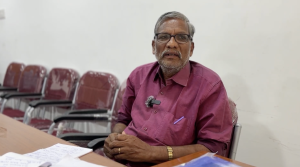
Dilli Babu of the Tamil Nadu Tribal Association (TNTA)
Residents across the three locations do not describe themselves as people who entered the forest illegally. They describe themselves as descendants of people who were already living, farming or working on the land.
Pandian of Thummakundu put it succinctly: “We are not encroachers.”
He said they inherited the land from their ancestors and that the people living there have depended on it for generations.
According to P Dilli Babu, president of the Tamil Nadu Tribals Association, the history of these lands goes back to the Gandamanur (also Kandamanur) Zamin. He said that when the ryotwari system was introduced, the land was handed directly to the people who were already tilling and living on it.
“They retained that land, farmed it, and sustained themselves across one, two, or three generations,” he said, adding that families living here could not be described as recent encroachers.
Babu said the Forest Department entered the area only in 1972 and that the declaration of these lands as forest was unknown to the people already living there. He said the area was later declared a Protected Forest in 2002 and subsequently brought under a Wildlife Sanctuary or Tiger Reserve.
“No opinions or views were sought from the people living there,” he added.
If the residents had known about these proceedings, they would have questioned how villages where people had lived for three generations could be brought under such classifications.
Most locals became aware of the seriousness of the issue only after the Supreme Court’s 29 May order.
Babu described the Supreme Court order as a “massive shockwave” that has now spread across the district, leaving families who have lived on these lands for generations facing an uncertain future.
Estates and plantations form a significant part of the landscape in all three locations.
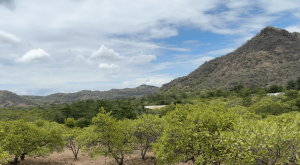
Cashew plantations spread across the hills of the Megamalai region.
In Kanniyakumari, rubber plantations extend through areas around Pechiparai and Kodayar. Residents said some of these plantations belong to large private or corporate interests and that the land carries patta.
In Karaiyar, residents pointed to the Kattalai Malai Estate, which they said has operated for decades.
In Megamalai, tea, coffee, cotton and other plantations form part of the landscape.
Residents questioned why communities facing eviction are being targeted while these estates do not appear in the same encroachment exercise.
“If forest protection is the reason communities must leave, should the same principle be applied consistently to every non-forest activity inside protected areas?” they asked.
S Ravindran, an office-bearer of the Tamil Nadu Tribal Association from the Papanasam area, said, “Above the Karaiyar Dam, there is a private estate called Kattalaimalai Estate. What are you going to do about them? You vacated the Manjolai Estate and evicted the workers from there, but the government has not taken any steps to protect their interests. Kattalaimalai Estate, too, has been operating for more than 100 years, and its produce is still being taken out of the area. If a private estate can continue to operate there, why are you evicting people by saying they cannot live there? If this is a tiger reserve, shouldn’t the same rules apply to everyone?”
The government’s count for Megamalai is 4,601. That is the number around which the current eviction and rehabilitation effort is being planned.
But it is important to understand what that number represents. It is a count of people identified as encroachers. It is not a count of everyone living in the settlements that could be affected by the wider forest-restoration process.
South First checked the 2026 electoral rolls to understand the population beyond the encroachment list from areas including Nariyoothu, Thangammalpuram, Megamalai, Thummakundu, Murukodai, Varusanadu, Ponnampadugai, Muthalamparai, Singarajapuram and Kandamanur.
Across the panchayats examined, the electoral rolls contained around 20,000 registered voters. This revealed a significant difference between the number of people officially classified as encroachers and the much larger population living across the settlements.
And even the electoral-roll figure is not a population census. It counts registered voters, not children, non-voters or every resident. So it cannot establish the total population that may ultimately be affected.
Babu argued that the population across the wider affected area could be far higher.
Another contradiction runs through the story.
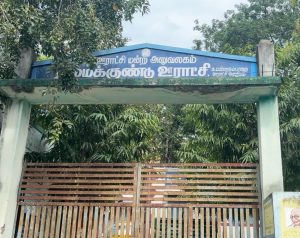
The Thummakundu Village Panchayat office in the Megamalai region.
Over the years, government institutions have administered these settlements. There are roads, electricity, water infrastructure and public facilities.
Government records placed before the court also identified 116 government or public utility structures inside forest land without prior approval.
The issue, therefore, extends beyond individual houses.
The Supreme Court has directed that government and public infrastructure located in forest areas be dealt with in accordance with law, including discontinuation, relocation, dismantling or removal where required.
It has also restricted the extension of welfare schemes, public utilities, transport, electricity, and infrastructure in encroached forest areas. This creates an unusual situation.
The state has spent years providing or permitting public services in these settlements. Now another part of the same state is being asked to remove people from them.
“You built the road here. You gave us electricity. You provided water connections, gas and bus services. We trusted you and lived here believing that the government would stand by us. Now, if you are asking us to leave, where are we supposed to go?” asked the 90-year-old Perumayi. It’s a question that cannot be easily dismissed.
With thousands of people potentially affected, the question of legal forest rights becomes unavoidable.
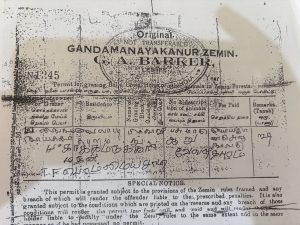
A permit issued by the Gandamanayakanur Zamin for grazing animals in Zamin forests.
Many residents said they have lived in and depended on these forests for generations and therefore seek recognition as Other Traditional Forest Dwellers, or OTFDs, under the Forest Rights Act, 2006.
But the law does not automatically recognise everyone who has lived in a forest for a long period.
Advocate I Robert Chandrakumar explained that an Other Traditional Forest Dweller must have resided in forest land for at least three generations before 13 December 2005, with the law treating one generation as spanning 25 years.
It means the required period extends back roughly 75 years, to around 1930, and the claimant must also primarily reside in and depend on the forest or forest land for livelihood.
In other words, simply saying that a family has lived there for generations is not enough. There must be evidence, and the statutory recognition process must be completed.
Here is where the documents the residents presented become relevant.
Kanniyakumari residents showed the copper-plate document. Karaiyar residents showed old photographs, electricity board receipts, and other records from earlier decades. Megamalai residents showed old pattas and documents.
Babu said the process of recognising forest rights has been delayed for years. Forest Rights Committees were supposed to be formed after the Forest Rights Act came into force, but committees were only recently formed across 12 villages. He said the committee leaders met Tamil Nadu Chief Minister C Joseph Vijay and raised the issue of pending applications.
He alleged that applications remained pending for years because of delays involving the District Collector, Revenue Divisional Officers and local forest officials. Even after the court proceedings began, he said, applications remained stalled for nearly two years, with no pattas issued. The District Collector started taking action only recently.
Babu argued that the government should first recognise the rights of eligible residents under the Forest Rights Act. He pointed out that the Act provides not only for individual forest rights but also for Community Forest Rights, which can cover community needs such as schools, temples, waste management, playgrounds, burial grounds and spaces used for festivals. He said both individual and community rights must be recognised.
The situation changed after Reserve Forests were declared in these areas and Tiger Reserves were subsequently notified, Babu said. He alleged that these decisions were taken without properly informing the people living there. Families who had grazed cattle or cultivated land along the forest edges for decades are now being told that they have no right to remain.
He argued that if eligible forest farmers and tribal communities had been granted pattas under the Forest Rights Act earlier, the present crisis could have been avoided. He blamed successive governments for failing to address the issue and added that the Supreme Court, apparently, did not benefit from a comprehensive ground-level inquiry. In his view, the Central Empowered Committee’s field visit was too brief, and its report did not fully reflect the reality on the ground.
Babu demanded a judicial inquiry by a sitting Supreme Court or High Court judge. He said public hearings should be held in every village to establish how many generations have lived there, where their ancestors are buried and how these communities have traditionally lived. Only such an inquiry, he argued, can establish the full facts and determine the rights of the people under the law.
He pointed to the government’s role in developing these settlements, saying that schools, creches, electricity poles, streetlights, roads and water pipelines were provided to the communities. People may have cleared parts of the forest in the past because they had no other means of survival, he said, but their families have lived there ever since. He said these communities have nowhere else to go and will not leave their villages.
For these families, the place where they live is not simply where they happen to reside; it is the place they consider their ancestral home. Even today, many from these communities have studied, moved to other towns and built careers elsewhere. But they continue to return home for festivals and family occasions, both celebrations and times of grief.
Now, with eviction looming, the question is: will they be able to do that anymore?
Also Read:
Village of widows: Women pay the price for Puducherry’s alcohol-dependent economy
(Edited by Majnu Babu and R Rajesh Kumar.)
Also See:



