

Published Aug 27, 2026 | 9:00 AM ⚊ Updated Sep 15, 2026 | 11:40 AM

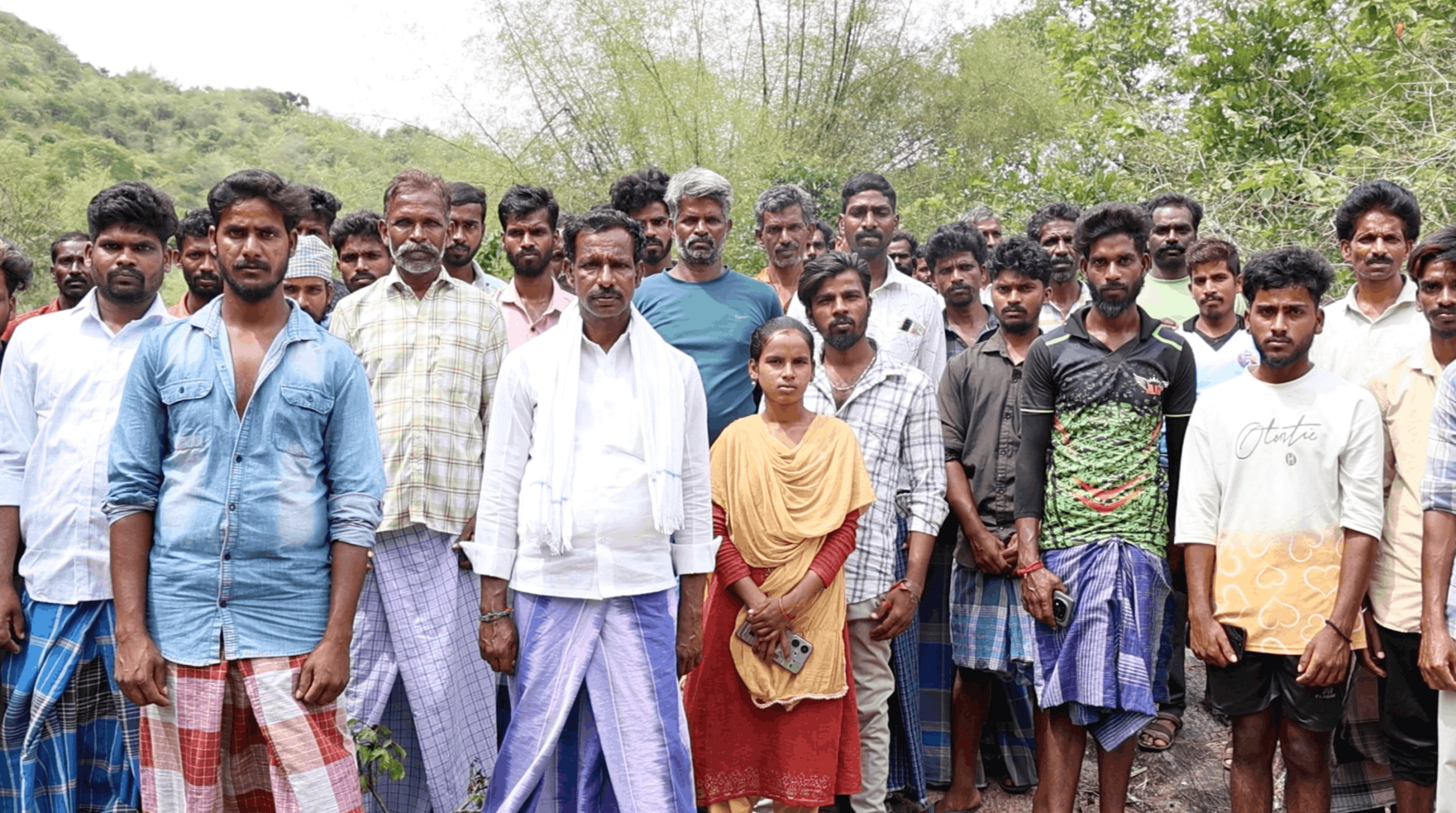
Residents of Alleri and nearby tribal villages oppose the proposed 1,800-MW pumped-storage project.

Synopsis: A proposed 1,800-MW pumped-storage project in the Jawadhu Hills has triggered fears among tribal residents over water, forests, biodiversity and displacement. The project is still in the early stages of environmental appraisal, but opposition is already growing.
The scant monsoon has made the heat mighty oppressive. The wind stood almost still, as if too lazy to ruffle the vegetation even as a faint, dusty smell filled the nostrils.
India was then two days shy of entering its 80th year of Independence. Elsewhere, preparations were on for the celebrations. Gen Z were upbeat and hopeful, a feeling that had rubbed off on the preceding generations. Debates raged over whether to sing the national song’s full six stanzas, as the central government wants.
None of them affected Alleri, located on a remote stretch of the Jawadhu Hills in Tamil Nadu’s Vellore district.
Instead, the village looked a world apart from the nearest town, Odugathur, some 16 km away. Independence, and the development that modern-day India boasts about, mean little to the tribal people living in the village. They have other concerns to attend to.
For instance, inadequacies have been a part of their lives for generations. The village lacks a proper road or a regular bus service. When someone falls ill or goes into labour, villagers make a makeshift stretcher and take turns carrying the patient in hurried silence.
Often, many pairs of dusty feet scurry toward the nearest point where a vehicle can be arranged. But the stretcher is placed on the ground with disbelief, even before the nearest motorable road. Their efforts have often gone in vain. On such occasions, whispers grow louder, sometimes into a bawl. A cloth is spread over the unlucky patient.
Another set of four men pick up the stretcher. The return journey is slower. No haste. The inevitable has happened. It will repeat, they know.
Life in Alleri, quite often, is like the road to the village: it stops abruptly, as if it had forgotten something, even as the hamlet of the Malai Gounder tribe still spreads before it.
Also Read: Women pay the price for Puducherry’s alcohol-dependent economy
Malai Gounders have been living in the forgotten subaltern shadows of Jawadhu Hills for long.
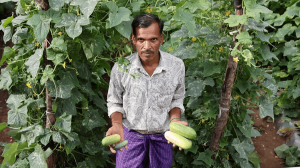
The main occupation, agriculture, depends on scant rainfall.
The Jawadhu Hills form one of the largest continuous stretches of the Eastern Ghats in Tamil Nadu, spreading across Vellore, Tirupattur and Tiruvannamalai districts.
Once known for its sandalwood trees, the region also has much scientific and geographical significance.
The Vellore section is relatively less endowed with natural resources than other parts of the range. Yet it remains home to tribal communities spread across 32 villages, many of whom depend on rainfall and groundwater to survive.
Alleri, under Peenjamandhai panchayat in Anaicut taluk, is one of them. Twelve other tribal villages surround Alleri. Together, all 13 have a population of 2,000 to 2,500 people.
The communities depend largely on agriculture and daily-wage labour. Cucumbers are cultivated almost throughout the year, while little millet and foxtail millet are grown during the rainy seasons.
When agricultural work is unavailable, residents take up other daily-wage jobs.
Sometimes, however, there is not enough work and the migration begins. Entire families travel to neighbouring Karnataka and stay there for months before returning home. Those migrating now worry whether they can even return.
They have a reason.
Also Read: Village of wilted dreams
Adani Green Energy Limited has proposed setting up a 1,800-MW Alleri Pumped Storage Project (PSP), involving two reservoirs, dams, tunnels and an underground powerhouse in the hills.
The project is expected to cost ₹10,094.03 crore and would require diverting more than 228 hectares of forest land.
It is still in the early stages of the environmental-clearance process. But residents of Alleri and environmental activists have already begun opposing it.
Their concerns range from the project’s impact on water and forests to the possibility of displacement and the larger question of who will benefit from the electricity generated from their land.
For a community that has lived in these hills for generations, the question is simple: What will development mean for the people who already call these hills home?
Also Read: How Sphoorthi girls are preventing child marriages
Adani Hydro Energy Fourteen Limited (AHE14L), a wholly owned subsidiary of Adani Green Energy Limited, is developing the Alleri Pumped Storage Project. Adani Green Energy’s FY-26 annual report lists AHE14L as a 100% subsidiary.
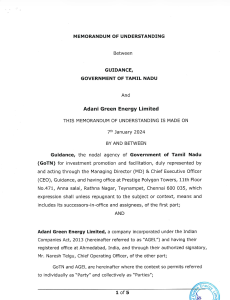
The first page of the Memorandum of Understanding signed on 7 January 2024 between the Government of Tamil Nadu and Adani Group
The project was initially conceived as a 1,500-MW facility before being expanded to 1,800 MW, comprising six 300-MW units.
The proposal involves two new reservoirs, an upper reservoir near Nellimarathukollai and a lower reservoir near Sivanathapuram.
During periods of low electricity demand, water would be pumped from the lower reservoir to the upper reservoir. During peak-demand hours, it would be released through turbines to generate electricity.
The project is estimated to generate around 3,840 million units of electricity annually, with generation planned for about 6.15 hours a day.
Its current estimated cost is ₹10,094.03 crore.
The project’s origins go back to the Tamil Nadu Global Investors Meet held in January 2024, when the Tamil Nadu government and Adani Green Energy signed an MoU for a ₹24,500-crore investment covering three pumped-storage projects, Alleri, Thenmalai and Aliyar.
Together, the three projects were proposed to have a capacity of 4,900 MW, with the investment planned over five to seven years.
The Alleri project was subsequently taken forward as an 1,800-MW project.
The distinction is important: ₹24,500 crore was the investment commitment for all three projects under the 2024 MoU. The current estimated cost of the Alleri project alone is ₹10,094.03 crore.
According to the project’s April 2026 Pre-Feasibility Study Report (PFR), the proposed development would involve a major intervention in the Arasampattu Reserve Forest.
The total land requirement is estimated at 337.452 hectares, including 228.352 hectares of forest land.
The project would involve two dams and reservoirs, an underground powerhouse, pressure and tailrace tunnels, construction facilities and access infrastructure.
The PFR proposes around 15 km of new roads and the strengthening of another 5 km of existing roads to access the project components.
But the project has not yet received environmental clearance.
The Union government’s Expert Appraisal Committee for River Valley and Hydroelectric Projects has recommended the project’s Terms of Reference (ToR).
That is an important distinction. It is an early stage of the appraisal process. The ToR requires the developer to undertake environmental studies before the project is considered for final clearance.
The Expert Appraisal Committee (EAC) has asked for details on several aspects. They include:
The committee also noted that the developer had not yet submitted the Stage-I forest-clearance proposal and directed it to initiate the process.
The PFR states that diversion of the 228.352 hectares of forest land will require forest clearance.
The villagers know nothing in detail. They know something is happening. They believe their lives would be uprooted.
Also Read: Life in the shadow of sabre-toothed predators
E Settu of Mamarathukollai village was at home after long hours in the field when a few strangers approached him.

Red paint markings on a rock in Alleri, where villagers say people identifying themselves as officials marked locations.
“It was two weeks ago. Maybe three weeks ago,” his words resonated with Albert Camus’s Meursault’s statement. Like many others, the vague news of the upcoming dam has made Settu a stranger in his own land.
“‘We are officials. Show us around this place,’” he said. The term “official” is something superior. “So I went with them.”
Settu doesn’t know whether the strangers were from the state Forest Department or from Adani. He didn’t dare to ask.
“They had something like a mobile phone in their hands, with a map on it. They looked at it and walked around the hills. I went with them. When they saw water flowing at one place, they stopped, took photographs and marked the spot with paint. Then they told me, ‘The dam will come here, and electricity will be generated here,’” the confused villager added.
Settu is not the only one who has encountered the strangers — or the officials.
For residents, the visits have raised a basic concern: decisions appear to be moving faster than information reaches them, the people most likely to be affected.
Still, they tried to gather as much information as possible.
A Vellore resident, Govindaraj, submitted a petition to the Tamil Nadu Chief Minister’s Grievance Cell on 29 June 2026, seeking details of the proposed project in the Arasampattu Reserve Forest.
The Forest Department responded on 21 July. “I hereby inform you that no procedure relating to the implementation of the 1800 MW Alleri Pumped Storage Project in Alleri village, Anaicut Block, is currently under process, and that no preliminary permission in this regard has been granted to date.”
The official statement has not been reassuring. Strangers claiming to be officials still keep turning up in the village.
A villager recalled that more than 10 people have visited the hamlet. They measured the area and said they would construct a dam there.
A villager, Bhavani, is baffled by the frequent visits of officials. Earlier, she had repeatedly documented the village’s problems, but received little response.
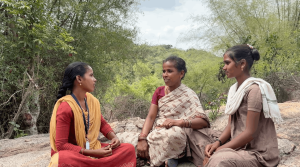
Bhavani, a resident of Alleri, says the village has long struggled without proper roads and healthcare facilities.
“Whenever we have a child delivery or a health emergency, we have to carry the person on a makeshift stretcher. We have even recorded the videos and shared them, but nothing has changed. Whenever we suffer, there is no hospital, no school and no road facility for us. But today, they are doing so much for a dam. We do not want that dam,” she said.
The only government institution in the village is a dilapidated primary school, they said. The teaching is irregular. Many families therefore send their children to a school run by a private service organisation located on the hills.
Environmental activist Vetriselvan Muthuraj of Poovulagin Nanbargal said the dam project remains far from final approval.
“Adani Group has applied to the Union government for various approvals. At present, it is only in the Terms of Reference stage. After this, they have to conduct studies based on the ToR, present the findings to the public, seek public opinion, and only then can the recommendations be placed before the Expert Appraisal Committee. The committee will then examine them and decide whether to grant environmental clearance. It is a long process. The project could even be rejected,” he said.
He added that commencing the road and other infrastructure-related activities without following the required procedures would undermine the appraisal process. Since the proposed project falls within the Arasampattu Reserve Forest, Muthuraj also said forest-related approvals and the consent of the Gram Sabha would be important.
For years, the government has turned a deaf ear to the villagers’ repeated petitions for a road. But over the past few weeks, the government is listening.
According to reports, a new road is being laid to connect Varadalampattu with Nelli Marakollai, an approximately 8-km stretch through the hills. Coincidentally, Nelli Marakollai is also the village near which the project’s proposed upper reservoir and dam are planned.
The project report identified Nelli Marakollai as the village near the proposed upper reservoir, which is planned in the Arasampattu Reserve Forest hills.
On one hand, the Forest Department told a resident that no procedure related to implementing the 1,800-MW Alleri Pumped Storage Project is currently underway and that no preliminary permission has been granted. Meanwhile, road work toward the proposed project area appears to be moving ahead.
Notably, Minister for Handlooms, Textiles and Khadi M Vijay Balaji visited the village on 15 August to inspect the development works. When villagers tried to hand over a petition raising their long-pending demands and concerns over the proposed project, they say their pleas received little attention and went unheard. Villagers said neither the government nor the Adani Group has explained what is happening in their village, nor have they sought their views.
Also Read: Eloor — a gas chamber in God’s Own Country
The project has not yet taken its final shape. But fear has already taken root. Yet, villagers repeated the same concern:
“Once they bring the materials down to the foothills, that’s it. Nobody will be able to stop them. They will somehow complete the project, drive us out, and our water will disappear,” says Ramasamy, a villager.
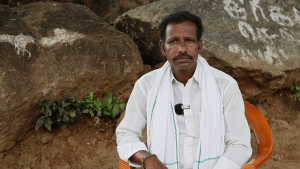
Ramasamy, a resident of Alleri, says the community fears losing its forests, water resources and way of life if the proposed project goes ahead.
Instead, their opposition began after they heard environmental activists discussing the project on Instagram and other social media platforms.
For Ramasamy, water is at the centre of the problem.
“The rains have already failed in these hills. It rains only occasionally, and groundwater levels have fallen drastically. In this situation, if they dig massive pits in the name of building two huge dams, groundwater could flow into those pits, and they could pump it out. Whatever little water we have would disappear. Then we will have no choice but to leave these villages,” he said.
According to the project documents, it proposes to draw 14.34 million cubic metres of water from the Palar River for the initial filling of the reservoirs through an intake-cum-pumping station and an approximately 18-km pipeline to the lower reservoir.
After that, around 1.2 million cubic metres of water would be required every year to compensate for evaporation and transmission losses.
This water would be drawn during the monsoon or periods of surplus flow. Otherwise, water would circulate between the upper and lower reservoirs in a closed-loop system.
The PFR estimates the Palar’s annual yield at 2,885 million cubic metres, with a 90% dependable annual yield of 798 million cubic metres.
Muthuraj cautioned that the water arrangement could change as the project progresses.
“There is a fundamental question here. If the company comes into an area and creates its own water resources, by developing rainwater harvesting systems or other measures, wouldn’t that itself create a problem for the people living there?” He also questioned why the project was proposed for this particular location.
“Logically, building a pumped-storage power project in a place where water is available makes sense. But why did they choose a location where there is hardly any water? That is a question that needs to be asked.”
His concerns extended beyond water.
“This is an Eastern Ghats region where significant mineral resources may be available. If something valuable is discovered tomorrow, there is a danger that they could also try to extract that,” he said.
There are also fears of displacement.
If the project comes up, people living close to the proposed site could be affected. If groundwater is severely impacted, residents fear that tribal communities could eventually be forced to leave the hills altogether.
The EAC has now specifically sought a 10-km-radius water availability and usage study.
That means the project’s potential relationship with the surrounding water system remains one of the issues that must be examined during the environmental assessment.
Muthuraj also pointed to the broader vulnerability of tribal communities in Tamil Nadu.
“Under the Forest Rights Act, Tamil Nadu is among the states that have issued the fewest pattas to tribal people. From obtaining community certificates to securing land rights, tribal people have continuously faced the erosion of their rights.”
“So, in Tamil Nadu, there is already no consistent approach that is genuinely supportive of tribal communities. That is why, whenever projects like this are proposed, there is a need to question and oppose them,” he said.
Also Read: Musi river turns into Nalgonda’s sorrow
Water is not the only environmental concern. The project would require diverting 228.352 hectares of forest land in the Arasampattu Reserve Forest.

Vetriselvan Muthuraj of Poovulagin Nanbargal
The construction of reservoirs, dams, roads, tunnels and other infrastructure could involve clearing vegetation and altering the existing hill ecosystem.
Environmental groups have raised concerns over wildlife habitats and rare and threatened species.
Muthuraj said the Eastern Ghats have not received the same level of attention and protection as the Western Ghats, even though pockets of relatively undisturbed ecosystems and wildlife continue to survive.
“There are more than 200 species of rare birds in this region. The region also has several other forms of wildlife. This is an area with significant biodiversity and an eco-sensitive ecosystem. The arrival of this project could disrupt that ecological balance,” he warned.
According to Poovulagin Nanbargal, an environmental organisation, the area is home to the Malabar grey hornbill, Indian barn owl, spotted owlet and several other owl species, as well as the Sri Lankan flying snake, Malabar green pit viper and the Jawadhu leaf-litter skink (Dravidoseps jawadhuensis), a species named after the Jawadhu Hills.
The group also listed Indian pangolin, slender loris, civet cat, Asian palm civet, Indian giant squirrel, gaur, leopard, chital, barking deer, sambar, dhole and wild boar among the species found in the landscape.
It also said migratory birds such as the common rose finch and forest wagtail visit the area. In contrast, the ecological corridor connecting the nearby Jawadhu Hills and Amirthi forests supports species including the Asian fairy-bluebird, Malabar whistling thrush, Indian paradise flycatcher, emerald dove and Indian pitta.
Also Read: Why climate change is not just a stranded polar bear on Arctic floe
The people of Alleri have a question. Development for whom? Will the electricity generated here benefit the communities living in these hills? Will it bring them the schools, healthcare, water and other basic facilities they have been demanding for generations?
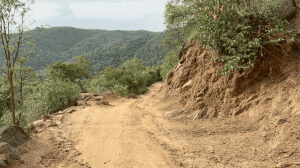
Villagers say road work has accelerated amid concerns over the proposed pumped-storage project.
If not, why should they bear the environmental and social consequences?
“You are cutting down trees. Where is the development in that? Trees are what bring rain. If there are no trees, the earth will dry up,” Ramasamy said.
“You are building a dam, generating electricity and selling it elsewhere. What benefit will our people get from this? We cannot leave this place for that. This is our home. We have nature, clean air and a clean way of life here.”
Muthuraj questioned whether communities living near major energy projects necessarily benefit from the electricity generated there.
“Electricity generated from Neyveli is not necessarily supplied to the people living in that region. The Union government decides how this country’s resources are distributed and to whom. Even if a state government generates electricity, it cannot simply decide how it will be distributed.”
He argued that the same would apply to Alleri.
“Similarly, this electricity is not going to be given to people for free. When a business group undertakes such a project for commercial purposes, we do not know whom they will ultimately supply it to.”
But his argument goes beyond electricity.
“The electricity generated here is not necessarily going to reach these people. More importantly, these communities have been living in harmony with nature. If that is the way they have lived, then the best thing we can do for them is to allow them to continue living that way.
“Why should they be affected so that electricity can be generated for someone else? Isn’t that a legitimate question?”
Also Read: Hidden cost of Kerala’s disaster vulnerability
The agreement with the Adani Group was signed during the previous DMK government.
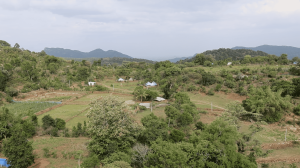
A view of the agricultural landscape and hills around Alleri in Vellore district’s Jawadhu Hills.
Following the 2026 Tamil Nadu Assembly elections, the Tamilaga Vettri Kazhagam (TVK)-led government came to power.
Allegations have already emerged that the new administration is putting several projects initiated by the previous government on hold.
That has raised another question over Alleri: What will the government do with a project inherited from the DMK administration?
Muthuraj said the government should take a clear position.
“In the case of the Parandur airport project, the government has already said that it will not implement it in its entirety. The airport too was a project brought by the DMK government. So, just as the government took a position on that project, it should take a position on this one as well.”
But there is a legal question.
If the government has already entered into an agreement with a private company and later withdraws from the project, could the company challenge the decision?
Muthuraj felt the current stage of the Alleri project gives the government room to reconsider it.
“At present, the project has not obtained any of the required approvals. Secondly, a government can decide to withdraw from a project it had previously announced. There is no legal obstacle to doing that.”
“All that is required to cancel this project is political will. There is no other major obstacle. We hope that the Tamil Nadu government will reconsider the project and cancel it,” he says.
Whether the government ultimately takes that position remains to be seen.
For now, the people of Alleri have made their position clear. They do not want the dam. And they say they will continue opposing the project rather than allow their forests, water and homes to be taken from them.
South First has sought a response from Adani Green Energy Limited, but it has not yet responded.
(Edited by Majnu Babu).



