

Published Jul 16, 2026 | 10:09 AM ⚊ Updated Jul 16, 2026 | 10:26 AM

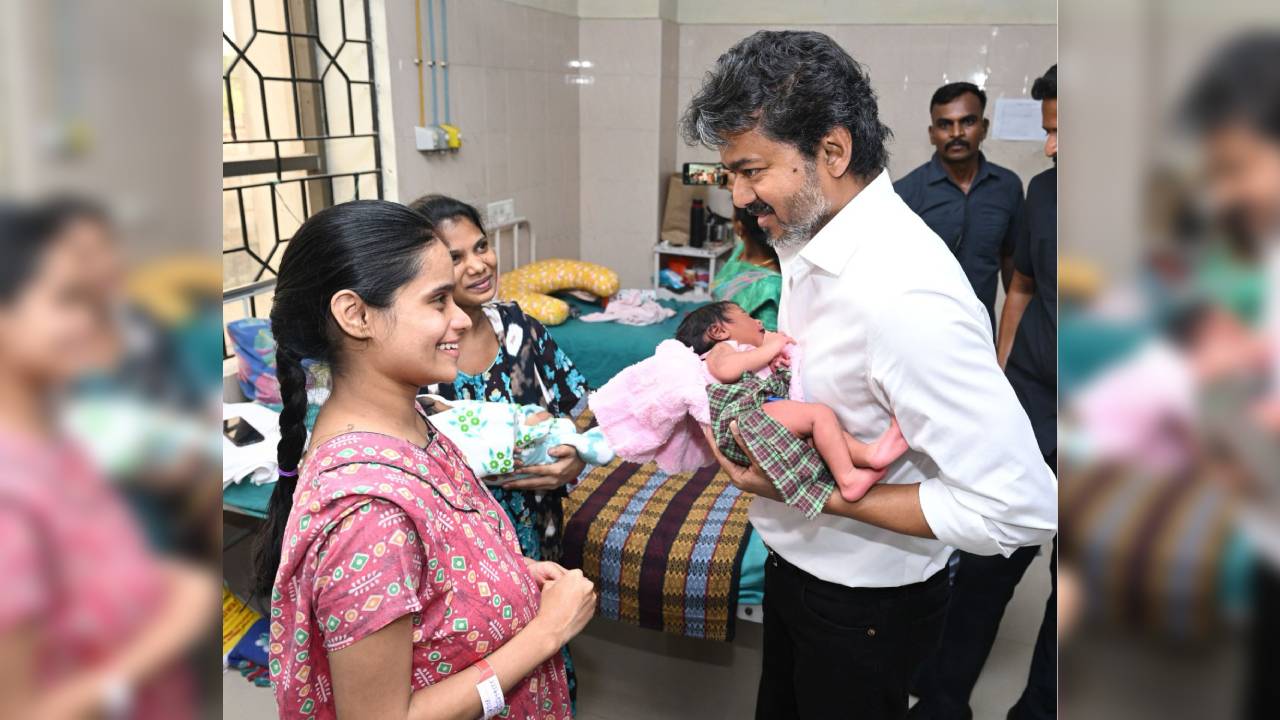
Tamil Nadu Chief Minister C Joseph Vijay during an inspection of a government hospital in Egmore.

Synopsis: The Tamil Nadu government’s promise of a gold ring for every newborn in a state-run hospital has reignited a debate over welfare priorities. From emergency funding to staffing shortages in hospitals, experts ask whether the scheme addresses Tamil Nadu’s most pressing healthcare needs.
Questions have been raised over the Tamil Nadu government’s ‘Thaai Maaman’ Gold Ring Scheme, meant to present a gold ring weighing one gram to every child born in government hospitals.
The scheme is part of the Tamilaga Vettri Kazhagam’s (TVK) pre-election promise. The government issued an order on 23 June to implement the scheme.
As part of the initiative, a tender has now been floated through the Tamil Nadu Medical Services Corporation Ltd. (TNMSC) to procure 441,667 one-gram gold rings at an estimated cost of ₹750 crore.
The scheme has drawn criticism from sections of society. They described it as a regressive welfare measure. The government order has triggered another debate: is it appropriate to entrust a corporation established to procure medicines and medical equipment with the purchase of gold?
Another question raised was about the order stating that the first phase of funding will come from the Contingency Fund. Given that Tamil Nadu already has one of the lowest Maternal Mortality Ratios (MMR) in India, critics questioned the urgency in implementing the scheme using emergency funds.
Also Read: Sensitive files from India’s biggest nuclear plant leaked on internet
Thaai Maaman Gold Ring scheme
In its election manifesto, the TVK promised, under the heading ‘Thaai Maaman Seer’, that every child born in a government hospital would receive a one-gram gold ring.
To fulfil that promise, the government has now issued operational guidelines through the Tamil Nadu Medical Services Corporation Ltd.
According to the guidelines, the scheme aims to:
However, critics questioned how the government would achieve those objectives when government hospitals were facing serious infrastructure deficiencies.
Speaking to South First on condition of anonymity, the chief medical officer of a district government hospital said that while hospital capacity had increased significantly in recent years, staffing had not kept pace.
“Hospitals that earlier had 100 beds now have 200 or even 300 beds. While there was one doctor for every 100 beds, today, in many places, a single doctor is handling nearly 300 beds. Addressing this imbalance should be the priority,” the doctor said.
The problem extended beyond doctors, according to Dr GR Ravindranath, physician and president of the Tamil Nadu Doctors’ Association for Social Equality. He highlighted manpower shortages across the healthcare workforce, including nurses and sanitation workers.
“There is nothing wrong with a welfare scheme for poor families. But doctors’ salaries in Tamil Nadu have not been revised for more than a decade. Many nurses continue to work on contract. Contract employees receive at most ₹20,000 a month, while contract sanitation workers earn only around ₹5,000. They should be given permanent appointments,” he said.
He added that funds for such improvements could be generated by reducing the government’s expenditure on large-scale publicity events.
The chief medical officer, who earlier spoke on the condition of anonymity, however, pointed out the relatively low financial allocation for the scheme in the health budget.
“The amount allocated for this scheme is too small to undertake large-scale recruitment. Tamil Nadu already has several maternity welfare schemes, and this is just another addition. I would not say it will significantly burden or benefit the healthcare sector,” the doctor said.
Former Thousand Lights MLA and physician Dr Ezhilan Naganathan, however, argued that strengthening public healthcare should take precedence over distributing gold rings.
“Primary Health Centres and medical college hospitals in Tamil Nadu function reasonably well. But district hospitals and Comprehensive Emergency Obstetric and Newborn Care (CEmONC) centres continue to face severe shortages of anaesthetists and obstetricians. Medical college hospitals somehow manage with postgraduate students. Every CEmONC centre should have a paediatrician, an anaesthetist, and an obstetrician-gynaecologist. Instead, these emergency care centres suffer from serious staff shortages,” he said.
Dr Naganathan argued that if the scheme succeeded in attracting more women to government hospitals for deliveries, the government must simultaneously strengthen healthcare infrastructure.
“Recruiting doctors across all CEmONC centres in Tamil Nadu would cost only around ₹350 crore, nearly half of what is being spent on the gold ring scheme. This is a recurring expenditure, but one that directly strengthens healthcare,” he said.
He added that Tamil Nadu’s three-tier healthcare system required adequate nurses, ward assistants and support staff.
“Strengthening CEmONC centres is not a one-time expense. It is a recurring investment that directly improves public healthcare,” he said.
Meanwhile, on 14 June, Chief Minister C Joseph Vijay launched the NalamTN portal.
Health Minister KN Arunraj said the portal would enable members of the public, businesspersons and industrialists to donate towards improving Tamil Nadu’s healthcare infrastructure, with all donations being utilised transparently.
Following the launch, social media users questioned the government spending hundreds of crores on gold rings while simultaneously seeking public donations to strengthen the health sector.
Also Read: TVK expels Mambakkam panchayat president after bribery video triggers row
Why TNMSC?
The TNMSC was established in 1994 to ensure uninterrupted procurement, storage and distribution of essential medicines and medical equipment for government hospitals.
For the first time, the Tamil Nadu government assigned the corporation the additional responsibility of procuring gold.
“It is like asking a doctor to perform the duties of a revenue officer. This is actually a responsibility that belongs to the Social Welfare Department,” Dr Naganathan said.
“TNMSC has evolved into one of India’s most advanced and transparent scientific procurement systems for medicines and medical equipment. It operates with only a handful of senior officials who oversee quality assurance and procurement for 37 medical college hospitals, 220 district hospitals, around 2,400 Primary Health Centres and nearly 8,000 sub-health centres. Rising costs have already increased recurring expenditure in the health sector. Ensuring medicine procurement and quality control is a massive responsibility in itself. They are doing a good job. Burdening the same institution with procuring gold is unnecessary,” he said.
Also Read: Three jail wardens held in Nagercoil custodial death case
Why the Contingency Fund?
Another issue raised was on the government’s plan to utilise the contingency fund for the scheme because the Assembly had not approved the financial allocation.
While the move may be legally permissible, questions have been raised over its justification.
“The contingency fund is meant for emergencies such as pandemics, cholera outbreaks or disasters involving large-scale loss of life. Since the chief minister had made this electoral promise, the government appears determined to deliver something quickly. But tapping emergency funds for this purpose is risky. Tamil Nadu is prone to cyclones, and climate change increases the likelihood of sudden disease outbreaks. If an emergency arises requiring large-scale procurement of medicines, this could create serious problems,” Dr Naganathan said.
Also Read: South continues domination as NMC adds 9,911 MBBS seats
Karunanidhi’s Welfare Model vs Vijay’s Gold Ring Scheme
Tamil Nadu has long been recognised as a pioneer in welfare programmes. The state already has several schemes supporting mothers, including financial assistance of ₹14,000 paid in instalments during pregnancy and after childbirth, along with nutrition kits worth ₹4,000 for newborns. In addition, several Union government maternity welfare schemes are also in operation.
Dr Naganathan said every welfare scheme inevitably attracted criticism, but they should deliver a clear and measurable public benefit.
Referring to the Dr Muthulakshmi Reddy Maternity Benefit Scheme, he said it was introduced to increase institutional deliveries through direct cash assistance, medical care and nutritional support, and went on to significantly improve maternal and child health outcomes. Its success prompted the Union Government to adopt a similar model.
He argued that Tamil Nadu already ranked among the best-performing states in terms of Infant Mortality Rate (IMR), Maternal Mortality Ratio (MMR) and vaccination coverage, with major improvements achieved over the years.
“The question is, what more are we going to achieve with a gold ring welfare scheme?” he asked.
While acknowledging Tamil Nadu’s legacy of pioneering welfare schemes, he said each scheme must address a genuine need and produce measurable outcomes.
Unlike cash assistance, which could be spent on nutrition and healthcare during pregnancy and after childbirth, a gold ring would likely be preserved rather than used immediately. Welfare programmes, he argued, should be designed to meet practical needs and produce tangible public health benefits.
(Edited by Majnu Babu).



