

Published May 12, 2026 | 7:00 AM ⚊ Updated May 12, 2026 | 9:14 PM

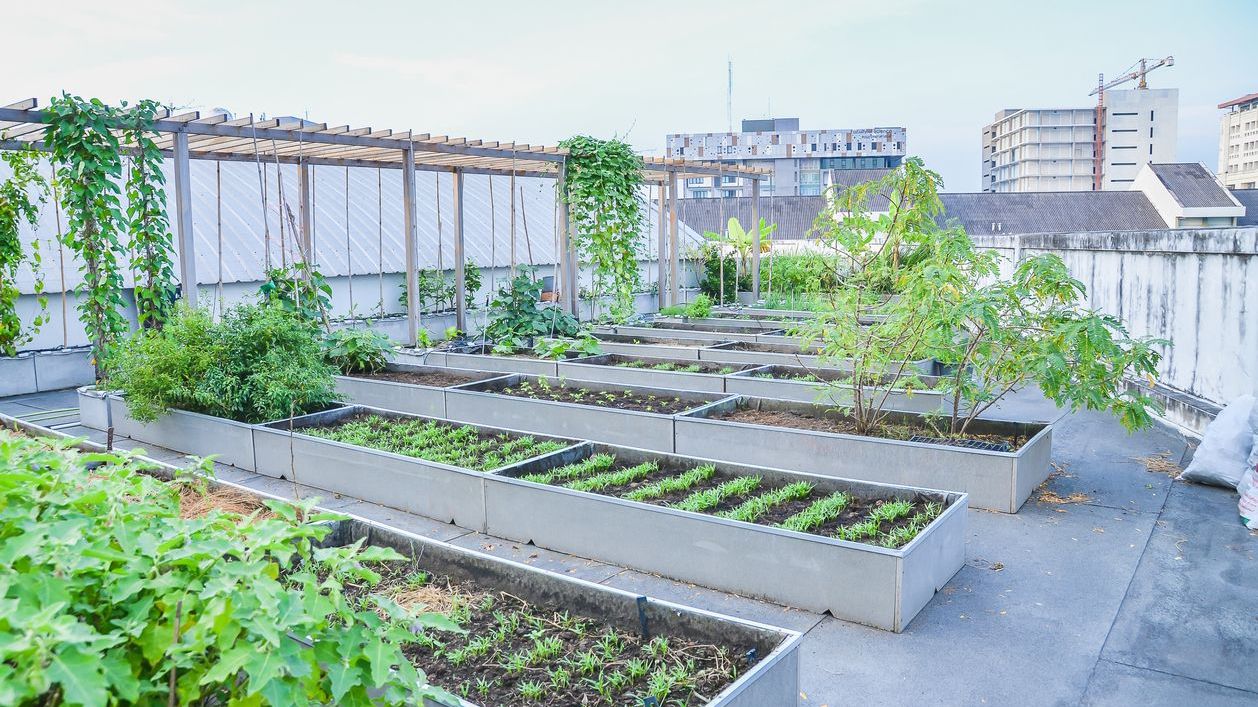
Agriculture in urban on rooftop. (iStock)

Synopsis: As Chennai faces rising heat, rooftop gardens are being promoted as a solution to cool buildings and support urban resilience. But the move has also raised concerns over water use in a city already struggling with recurring shortages.
As summer tightens its grip over Tamil Nadu, Chennai faces two crises at once — rising heat and shrinking water supply.
With the India Meteorological Department having warned of intensifying heatwaves across the nation, cities like Chennai are already feeling the strain in concrete-heavy areas where natural shade from trees is scarce, and heat lingers well past sunset.
Now, policymakers are pushing green roofs as a solution to one problem. These rooftop systems are designed not just to reduce indoor temperatures by 2–7°C, but to support food production, manage water through reuse and rainwater capture, and improve urban biodiversity.
However, beneath the optimism, questions are emerging about whether these ideas can work at scale — or whether they risk overlooking deeper structural challenges.
Also Read: Inside emergency ward of Chennai hospitals this summer
The promise of green roofs is closely tied to water — and that is where doubts deepen. The 2019 “Day Zero,” when supplies ran critically low for many residents, remains a key reference point in the city’s water debate.
The concept sounds fine, but it depends on how deeply they examine implementation,” said Raju KK, member of the Chennai Wetlands Action Collective. He questioned whether there is clarity on budgets or execution.
“Chennai is already on a path of water stress,” said Raju. “Urban gardening solutions require much more water than what is currently available.”
He pointed out that supply from the Chennai Metro Water Supply and Sewerage Board averages about 110 litres per person per day — a figure that leaves little room for additional consumption.
This raises the possibility of unintended trade-offs. “This might not be a real environmental solution for large parts of the city,” he said, suggesting that green roofs could become a “false trade-off” if they increase water demand.
He drew parallels to global water conservation efforts, where reducing water use — not expanding it — became central to sustainability.
But not all green roofs are being imagined the same way. “These are not just green roofs — these are edible, climate-resilient systems,” Krishna Mohan Ramachandran, Chief Resilience Officer (CRO), Chennai Resilience Centre, told South First.
He argued that concerns over water supply often emerge when rooftop farming is viewed in isolation. He pointed out that integrated systems — combining rainwater harvesting and the reuse of treated greywater — can significantly reduce additional water demand, turning rooftops into part of the solution rather than an added burden.
During the Covid-19 lockdown, disruptions exposed gaps in access to fresh vegetables, especially for vulnerable communities.
Rooftop systems, Ramachandran said, were conceived as a supplementary source of nutrition before their climate benefits became evident.
“Our focus was not only on looking at heat,” he explained. “We realised there is also a need for a supplementary source of fresh, organic greens and vegetables — particularly for vulnerable communities.”
That dual function is central to the model. “In our studies, it has ranged from two to seven degrees cooler in the rooms directly below the edible rooftop garden,” he said, citing field observations.
Unlike ornamental green roofs, these systems are designed for scale. “One garden kit occupies only about 20 square feet, with five grow bags in a kit,” he noted, highlighting how modular setups can work even in space-constrained settings like schools and anganwadis.
The goal, he added, is replication. Expanding such systems across public institutions could deliver combined benefits — cooling, nutrition, and efficient use of limited urban space.
Concerns around water remain central to the debate. However, Ramachandran argued that the issue is often framed too narrowly.
“Suddenly, when it’s summer, we all start talking about water stress. All this while, we’ve only been talking about flooding.”
For him, this reveals a deeper inconsistency in how the city understands water.
“You have to look at Chennai’s water challenges from the perspective that we are a monsoon-dependent city,” he said, adding that this shifts the focus from scarcity alone to storage, reuse, and seasonal management.
Infrastructure concerns, especially waterproofing in low-income settings, are acknowledged but not seen as barriers.
“It is a concern, but the government is now doing what is called a high albedo painting in order to reduce the heat,” said Ramachandran.
These coatings are primarily designed to reflect heat, but “also serve as a way to seal the surface against water,” offering an added benefit alongside heat reduction.
In practice, roofs are assessed case by case, with added leak-proofing where needed. Controlled irrigation remains key.
“The best way to do this is really to give them a drip irrigation system that delivers the right quantity of water to each plant,” he noted.
Ramachandran said each grow bag typically requires about 1–1.5 litres of water a day, with a 20 sq.ft rooftop vegetable garden (garden kit) usually containing five grow bags.
This brings the daily water requirement for such a setup to around 5–7.5 litres, though demand can rise during peak summer months depending on soil type and weather conditions.
Defending the model, he said drip irrigation systems help conserve water while also minimising leakage.
Also Read: Monsoon-driven “moist heatwaves” pose hidden health risk across India
Tamil Nadu’s decision to declare extreme heat a state-specific disaster in 2024 marked a shift in how climate risks are understood.
Since then, the government has rolled out cooling strategies, including a programme covering over 700 schools led by the Environment and Education Departments.
The rollout of rooftop gardens has focused on public institutions, particularly schools and anganwadis under the Integrated Child Development Services (ICDS)
“Our emphasis was really on growing them in schools and ICDS centres, because the objective was to encourage vegetable gardens in the communities surrounding those centres,” said Ramachandran.
“These are anganwadis that cater to children from vulnerable communities in the age group of two to five,” he added, underscoring the focus on those most at risk.
At its core, the approach is driven by nutrition. “The primary purpose of that was really to provide nutritive, fresh, chemical-free vegetables to the children, because this was being fed into the midday meal scheme.”
This framing shifts rooftop gardens beyond a purely climate response. Rather than standalone cooling tools, they function as part of a broader public health system, with heat reduction as a co-benefit.
Early outcomes point to practical impact. Many of the ICDS centres have stopped buying greens from outside — they use only the greens that are grown within the centre.
Taken together, the model positions schools and anganwadis as community anchors — linking nutrition, local food production, and climate adaptation in ways that extend beyond institutional spaces.
For G Sundarrajan, a member of the Tamil Nadu Governing Council on Climate Change and coordinator of Poovulagin Nanbargal, the answer lies not on rooftops but at street level.
“The only real solution lies in strengthening urban greening policies,” he said. His emphasis is clear: cities need more trees, more shade, and better-designed public spaces.
“Improving urban greening policy is essential,” he added, arguing that increasing tree cover can directly reduce heat exposure. Unlike rooftop gardens, which depend on individual effort, shaded streets and public areas offer broader and more equitable benefits.
He believes the focus must shift toward scale. “The focus should be on expanding urban greenery at scale,” he said, stressing that such measures provide immediate relief.
In his view, green roofs can play a role, but only as part of a larger strategy that prioritises canopy cover and shared spaces over fragmented interventions.
Even so, the idea will ultimately be tested not in pilot projects, but in how well it holds up against everyday constraints — water limits, costs, upkeep, and the realities of scaling across the city.
(Edited by Muhammed Fazil.)



