

Published Jun 25, 2026 | 3:03 PM ⚊ Updated Jun 25, 2026 | 3:04 PM

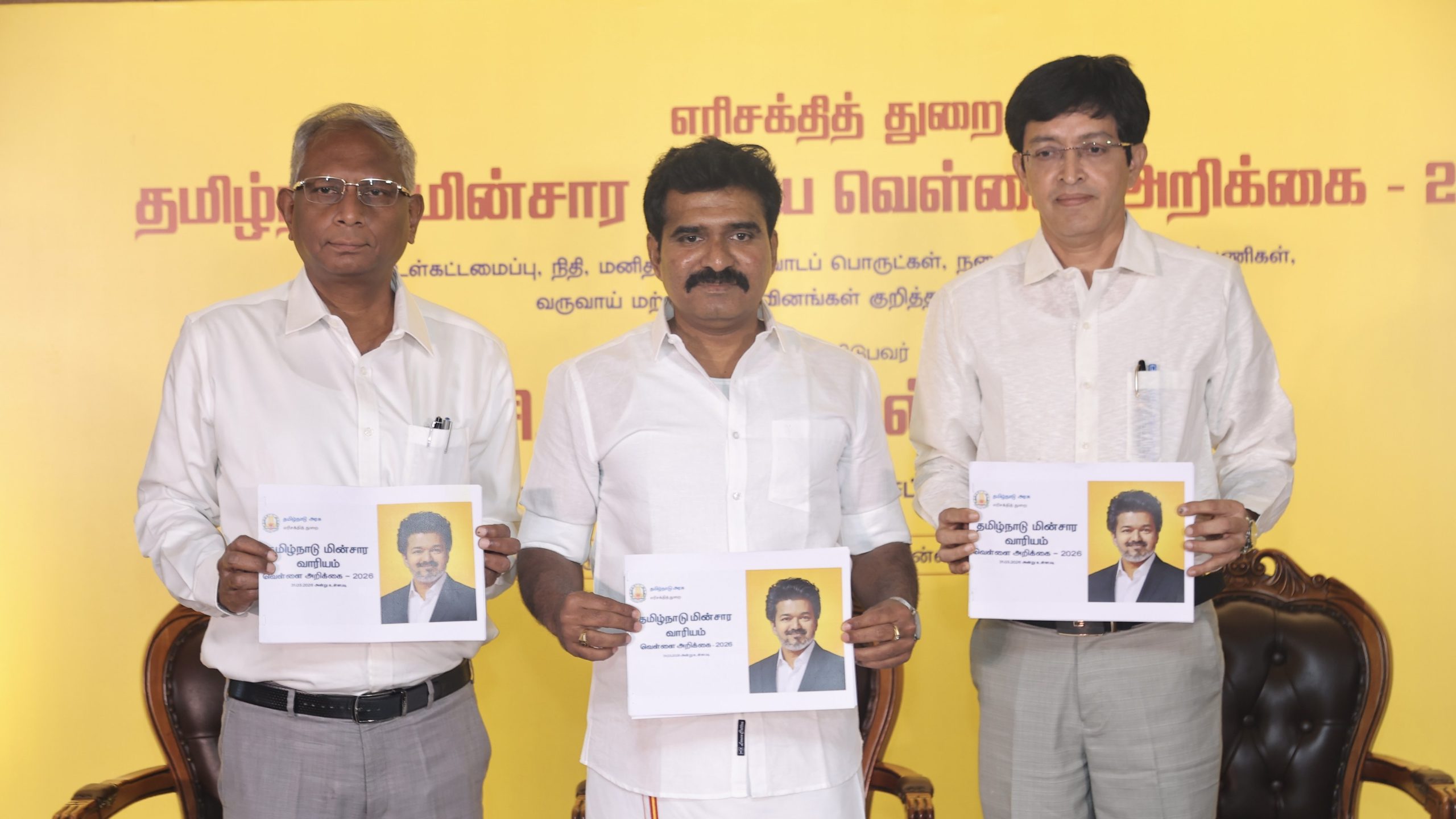
Released by CTR Nirmal Kumar, Minister for Energy Resources and Law, the White Paper carries an unmistakable political message.

Synopsis: The Tamil Nadu government has released a White Paper showing the state’s power sector is burdened with ₹2.47 lakh crore in debt after years of financial mismanagement, ageing infrastructure and delayed power projects. The report states that earlier administrations failed to address structural problems while highlighting improvements in the sector’s recent financial performance and announcing a ₹43,855 crore investment plan to modernise infrastructure.
The Tamil Nadu government on Thursday, 25 June, released a detailed White Paper on the state’s power sector, laying out what it describes as the true financial and operational condition of the Tamil Nadu Electricity Board (TNEB) and its successor companies after years of mounting debt, infrastructure neglect and stalled power projects.
Released by CTR Nirmal Kumar, Minister for Energy Resources and Law, the report not only maps the current condition of the state’s electricity sector but also suggests that decades of poor planning and financial mismanagement under previous governments have pushed Tamil Nadu’s power sector into a structural crisis.
Much like the state government’s fiscal White Paper released earlier this month, the document appears aimed at establishing that the current administration inherited a deeply troubled power sector and is now being forced to undertake expensive corrective measures.
“We are already aware of the irregularities that took place in transformer procurement. Similarly, irregularities worth nearly ₹1,028 crore have now been detected in nine tenders related to conductor procurement. Orders have been issued for an investigation, and cases will soon be registered,” Energy Minister CTR Nirmal Kumar told reporters.
Also Read: Sridhar Vembu hails Vijay for fast-tracking rural school where DMK allegedly demanded money
The most significant revelation in the White Paper is the enormous debt accumulated by Tamil Nadu’s electricity sector.
According to the report, the consolidated outstanding debt of TNEB and its four successor companies stood at ₹2.47 lakh crore as of 31 March 2026. Over the last two decades, repeated restructuring exercises were undertaken in an attempt to improve efficiency.
TNEB was first spun off in 2010 into TANGEDCO and TANTRANSCO before being restructured again in 2024 into four separate entities handling distribution, generation, green energy and transmission.
However, despite these reforms, the sector’s financial distress has only deepened.
The White Paper shows that the distribution company TNPDCL now carries debt of ₹1.07 lakh crore, while the generation company TNPGCL has liabilities of ₹1.03 lakh crore. TANTRANSCO, which is responsible for transmission infrastructure, carries another ₹30,965 crore in debt.
One of the strongest political undertones in the White Paper is its attempt to trace the origins of the crisis to previous governments.
The report presents comparative financial data from successive five-year periods beginning in 2001.
It shows that during 2011–2016, the power sector recorded losses of ₹56,361 crore, followed by an even larger deficit of ₹58,534 crore between 2016 and 2021.
In contrast, the current five-year period between 2021 and 2026 recorded a lower cumulative deficit of ₹34,447 crore.
The comparison suggests that the revenue gap in Tamil Nadu’s power sector narrowed during the DMK government’s 2021–2026 term compared with the AIADMK government’s tenure between 2011 and 2021, indicating an improvement in the sector’s financial management.
The government appears to use these figures to argue that the sharpest financial deterioration occurred under earlier administrations, when borrowing rose sharply but structural reforms were either delayed or ineffective.
The report also highlights that electricity tariffs were revised three times between 2012 and 2014, including a steep 37 percent increase, followed by hikes of 3.57 percent and 16.33 percent. Despite these tariff increases, however, losses continued to mount.
The White Paper uses this to argue that previous governments increased the burden on consumers while failing to address the electricity sector’s structural weaknesses.
Though no government is directly named, the implication is clear: the state’s present crisis is attributed largely to financial decisions made over the past decade.
For 2025–26, Tamil Nadu’s electricity sector has nearly reached operational break-even.
The figures show:
Compared with previous years, this represents a significant reduction in the deficit.
The figures also raise a critical question.
The improvement comes shortly after the government revised electricity tariffs in July 2025, increasing charges by 3.16 percent.
This raises an important policy debate: has the financial recovery been driven by better administrative reforms, or are consumers simply paying more?
For ordinary consumers already facing rising household expenses, the question remains unresolved.
Beyond its financial findings, the White Paper reveals that Tamil Nadu’s electricity infrastructure has aged significantly and now requires urgent intervention.
Large parts of the state’s transmission and distribution network are now more than 25 years old.
The report identifies:
The government estimates that ₹8,318 crore is immediately required to repair and upgrade these ageing assets.
The report also suggests that earlier governments prioritised expansion over maintenance and modernisation, allowing infrastructure gaps to accumulate over decades.
Tamil Nadu’s electricity demand has risen sharply over the past 25 years.
In 2001, the state had around 143 lakh electricity consumers, with peak demand at 6,687 MW.
By 2026, the consumer base had expanded to 351 lakh, while peak demand reached 20,321 MW. The state has also recorded a peak demand of 21,307 MW, among the highest ever.
But infrastructure development has not kept pace with this growth.
The White Paper suggests Tamil Nadu has increasingly relied on expensive short-term market purchases to bridge supply shortages, exposing weaknesses in long-term generation planning.
One of the sharpest criticisms in the White Paper concerns delays in major thermal power projects.
The report highlights several projects where delays have led to significant cost escalations.
The Ennore SEZ Thermal Power Project is the most prominent example.
Originally estimated at ₹9,799 crore, the project’s cost has now risen to ₹20,663 crore, more than double its original estimate. According to the report, the escalation was driven by interest accrued during construction, changes in taxation and prolonged project execution.
Similarly, the Udangudi Thermal Power Project saw its cost rise from ₹13,076 crore to ₹14,571 crore.
Two other major thermal projects remain stalled.
The ETPS Expansion Project was halted midway in February 2024, while the Uppur Thermal Project has remained suspended since March 2021.
The report states that revival efforts are underway but provides no timeline.
The implication is serious: years of project delays have forced Tamil Nadu to rely increasingly on external power purchases instead of expanding its own generation capacity.
Also Read: Vijay may soon discover that defeating Dravidian parties is easier than replacing them
Another major challenge highlighted in the White Paper is the staffing crisis.
Across the four electricity corporations, Tamil Nadu has 1.40 lakh sanctioned posts, but only 74,714 employees are currently in service.
This leaves 65,921 vacancies, meaning nearly half of the sanctioned workforce remains unfilled.
The White Paper notes that more than 20,000 employees retired between 2015 and 2025, while another 16,782 are expected to retire by 2030.
The government has proposed recruiting 20,449 employees during 2026–27, including engineers, technical assistants and more than 12,500 field assistants.
While presenting the White Paper, Minister CTR Nirmal Kumar alleged that despite large-scale vacancies in the electricity sector, the previous government recruited only a few hundred employees. He also claimed that despite securing substantial loans, it failed to initiate major new power projects, further worsening the sector’s long-term operational crisis.
Also Read: After left parties, IUML too exits DMK alliance; shifts to Vijay-led TVK camp
Having outlined the scale of the crisis, the government has announced one of the largest infrastructure investment programmes in the power sector.
Over the next four years, Tamil Nadu plans to invest ₹43,855 crore to modernise power infrastructure and improve reliability.
Major initiatives include:
For 2026–27 alone, the government has proposed procurement and infrastructure investment worth ₹21,512 crore.
Additionally, the state aims to construct 469 new substations by 2031, excluding 121 projects already under implementation.



