

Published Aug 12, 2026 | 10:55 AM ⚊ Updated Aug 12, 2026 | 10:55 AM

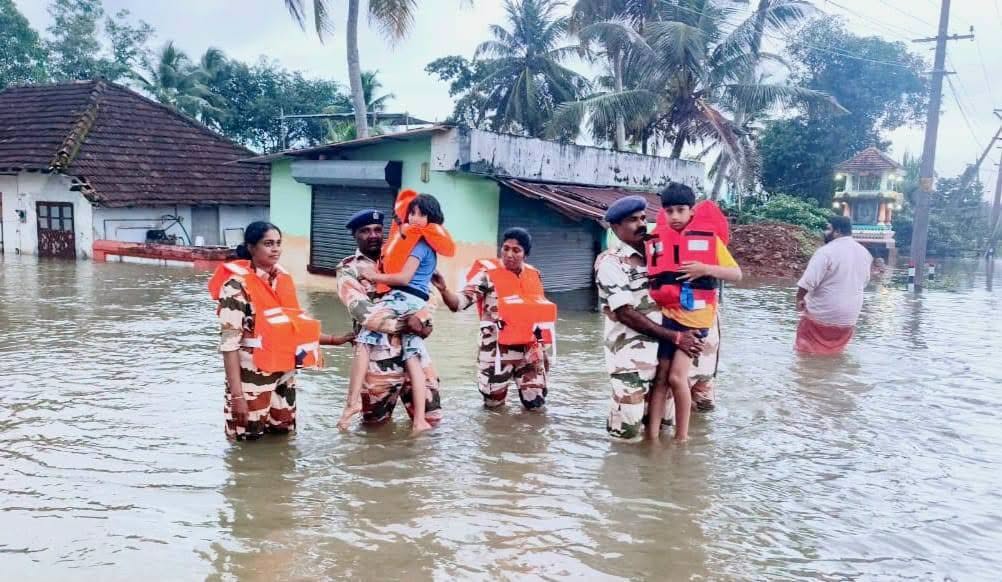
ITBP personnel rescuing children from an area in Kuttanadu which got inundated

Synopsis: Flood-related displacement, interruptions in food supplies, loss of household income, infectious diseases and psychological distress can all affect a child’s health and development. The 2018 floods, one of the most severe disasters to hit Kerala, brought the vulnerability of children in Alappuzha into sharp focus, with widespread disruption to food availability and concerns over their health and nutrition.
The damage caused by floods is usually measured in washed-out roads, damaged homes and lost livelihoods.
But for children living in Kerala’s flood-prone areas, the impact may be showing up in a less visible form — on their growth and nutritional health.
A study conducted among children in five flood-prone panchayats of Alappuzha has found a higher prevalence of underweight, stunting and wasting compared with recent state-level averages, drawing attention to the possible nutritional consequences of repeated flooding.
The study was carried out by the Achutha Menon Centre for Health Science Studies (AMCHSS), a centre of excellence for public health training under the Union Ministry of Health and Family Welfare.
Its findings suggested that children in areas repeatedly exposed to floods may be carrying a greater nutritional burden, with both socio-demographic conditions and disaster-related factors influencing their nutritional status.
The findings assumed added significance as Kerala once again grapples with flooding.
While the immediate concerns during a flood are rescue, relief and rehabilitation, the study highlights a longer-term consequence that may not become apparent until much later.
The issue also comes against the backdrop of growing concerns over Kerala’s vulnerability to natural disasters.
The 261st Report on Disaster Management, tabled in both Houses of Parliament on 7 August by the Department-related Parliamentary Standing Committee on Home Affairs, noted that the state’s geographical setting and dense population leave it particularly exposed to several natural hazards.
According to the parliamentary panel, around 14.5% of the state’s geographical area is flood-prone, while another 14.4% is vulnerable to landslides. More than half of Kerala’s coastline, it noted, is also exposed to coastal hazards.
Also Read: In Kerala’s relief camps, caste proves harder to wash away
The researchers point out that Alappuzha’s low-lying coastal belt is increasingly exposed to flooding and the threat posed by a rising sea level.
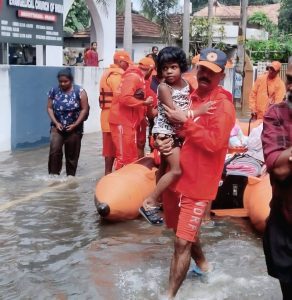
An NDRF personnel member with a child in Alappuzha.
Repeated floods have disrupted daily life in the district, but their impact on children can be particularly serious.
“Flood-related displacement, interruptions in food supplies, loss of household income, infectious diseases and psychological distress can all affect a child’s health and development. The 2018 floods, one of the most severe disasters to hit Kerala, brought the vulnerability of children in Alappuzha into sharp focus, with widespread disruption to food availability and concerns over their health and nutrition,” an excerpt from the report read.
The increasing frequency and intensity of extreme rainfall, including instances of localised cloudbursts, has added to these concerns.
Yet, the researchers pointed out that there has been limited research on how repeated flooding is linked to the nutritional health of young children living in vulnerable parts of Alappuzha.
Against this backdrop, the study examined the nutritional status of children in communities that regularly face flooding.
Researchers focused on children aged six to 59 months, a period when adequate nutrition is crucial for physical growth and development.
Particular attention was given to underweight and stunting, which can indicate inadequate nutrition over the short, medium and longer term.
Five flood-prone panchayats — Champakulam, Kainakary, Pulinkunnu, Ramankary and Veliyanad — were selected for the study. Eight wards were randomly chosen from each panchayat, giving a total of 40 wards. Ten households with children in the specified age group were then randomly selected from each ward.
The study was intended to generate baseline evidence that could help guide future public health research and interventions in communities facing repeated flooding and other extreme climate events.
Also Read: Environment Committee report sounds alarm on Kerala’s landslide crisis
Children living in the flood-prone areas of Alappuzha district face a greater burden of undernutrition than children covered by broader state and national estimates, according to the study.
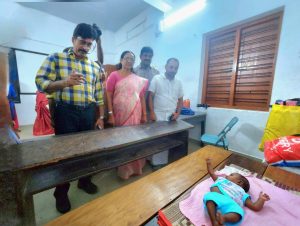
An infant at a flood-relief camp in Alappuzha.
It recorded underweight among 28.25% of children, while 31% were stunted and 21% were wasted.
These figures were higher than the corresponding NFHS-5 (2019–21) estimates for under-five children across India — 19.9% underweight, 26.4% stunting and 15.5% wasting.
The prevalence was also above the levels reported in an earlier Kerala study among socioeconomically disadvantaged under-five children, which found 24.4% underweight, 25.6% stunting and 14.4% wasting.
Girls in the flood-prone study population recorded a higher prevalence of underweight, stunting, wasting and overall anthropometric failure than boys.
The study also pointed to the role of household socioeconomic conditions.
Children whose fathers were employed in non-elementary occupations, generally associated with more stable incomes, had a lower risk of undernutrition than those whose fathers were engaged in elementary occupations.
Lower maternal education was associated with increased odds of stunting and wasting, underlining the influence of parental education and economic security on children’s nutritional status.
Flood-related displacement emerged as another concern.
Children who had stayed in relief camps during floods were more likely to be underweight and show anthropometric failure than those who took shelter elsewhere.
The researchers suggested that families most severely affected by floods and facing greater resource constraints may have been more dependent on relief camps.
Disruption of normal life, coupled with difficulties in accessing food, safe water and healthcare, could further worsen children’s nutritional status.
The study called for greater attention to children in flood-vulnerable parts of Alappuzha and recommends comparative and long-term research to establish how recurrent flooding affects childhood nutrition.
Also Read: Why climate change is not just a stranded polar bear on Arctic floe
Though the findings of the study were made available in December 2025, an official with the Directorate of Health Services opined that it has wider relevance for Kerala as the state continues to face recurring floods, landslides and other weather-related disasters.
According to the official, although the study focused on Alappuzha, its findings cannot be viewed in isolation as the district is only one among several parts of Kerala that remain vulnerable to natural disasters.
Each district faces its own combination of risks, and the displacement of families and setting up of relief camps during such events can have a disproportionate impact on children.
“When a disaster strikes, children are among those who are most affected by displacement and the disruption of their normal surroundings,” the official said.
The closure of schools, movement to relief camps, separation from familiar surroundings and disruption of healthcare and other essential services can leave children particularly vulnerable during and after a disaster.
The need to examine these issues in other vulnerable areas has become more pressing with the continuing spells of heavy monsoon rain across the state.
Several areas have witnessed inundation in recent weeks, including parts of Alappuzha, where Kuttanad remains particularly vulnerable because of its low-lying geography and dependence on an extensive network of canals and waterways.
The official said a similar assessment would be required in areas repeatedly affected by floods and other disasters so that the specific needs of children during evacuation, displacement and their stay in relief camps can be identified and addressed.
The wider disaster profile of Kerala also underlines why such studies cannot remain confined to a single district.
The Department-related Parliamentary Standing Committee on Home Affairs, in its 261st Report on Disaster Management, described Kerala as particularly vulnerable to multiple natural hazards.
The committee noted that Kerala’s narrow coastal belt, dense network of rivers, ecologically fragile Western Ghats and high population density expose the state to overlapping risks. Floods, landslides, coastal erosion, lightning and cyclonic events have emerged as recurring threats, particularly during periods of intense monsoon rainfall.
According to the committee, around 14.5 per cent of Kerala’s geographical area is flood-prone, and another 14.4 per cent is classified as landslide-prone. More than half of the state’s coastline is also vulnerable to coastal hazards.
The report identified shortcomings in the enforcement of building regulations, land-use planning norms and coastal regulation provisions, particularly at the local level. Encroachments and unplanned development in environmentally sensitive areas, along with environmental degradation and the state’s high population density, were cited as factors that could further intensify the impact of disasters.
The committee also pointed to weaknesses in the last-mile dissemination of early warnings. In remote and landslide-prone areas, receiving an alert does not always translate into timely evacuation.
An official with the Disaster Management Department pointed to the significance of the study.
“Its focus on how children are affected when disasters force families out of their homes and into relief camps offers a basis for examining preparedness and response measures in other vulnerable parts of Kerala,” he said.
(Edited by Majnu Babu).



