

Published Aug 24, 2026 | 7:00 AM ⚊ Updated Aug 24, 2026 | 7:00 AM

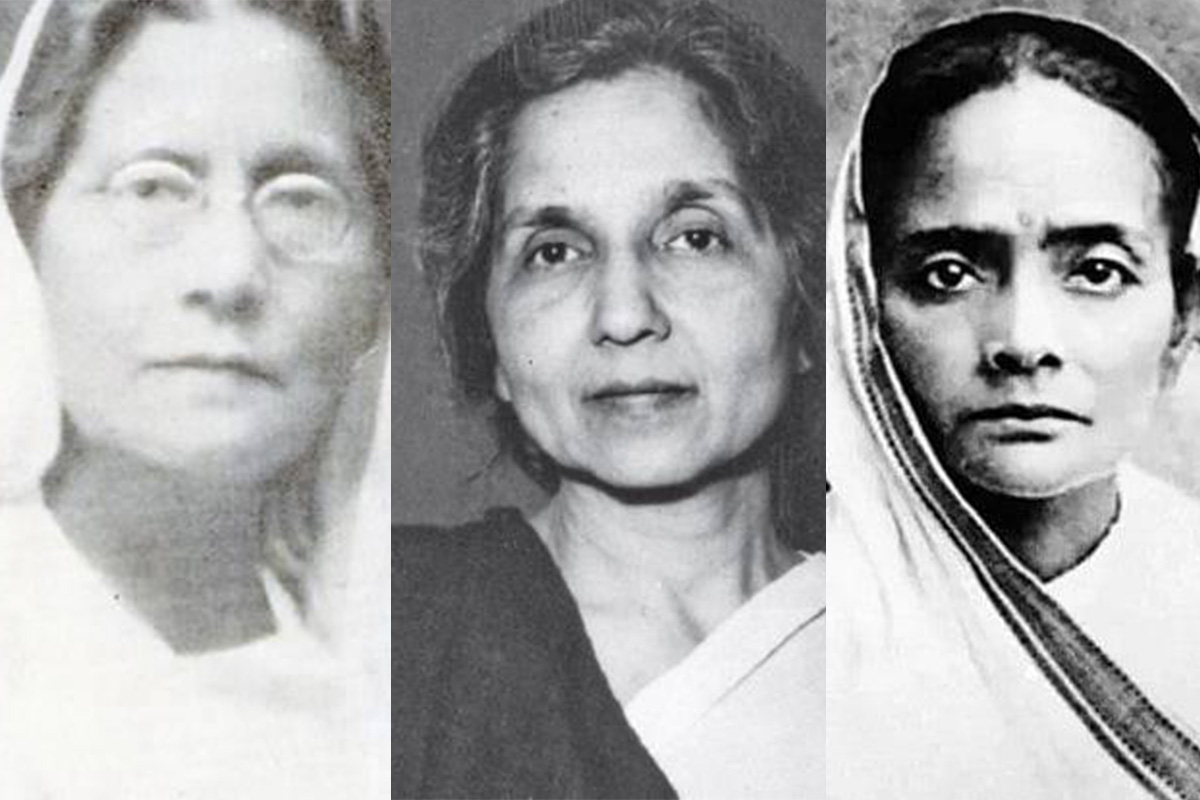
True-life heroines all: Matangini Hazra, Aruna Asaf Ali and Usha Mehta.

Synopsis: Indian women helped us win freedom from the British Raj. Almost eight decades later, misogyny, violence and institutional barriers continue to stand in the way of the equality, safety and power they deserve.
The Quit India Movement took place in 1942, when women did not enjoy equal rights to property under the Mitakshara joint family system.
When most of the Quit India Movement’s top male leaders were arrested in the early hours of August 9, a day after the All India Congress Committee passed the resolution, the British hoped the agitation would die out. However, to their surprise, Indian women came to the forefront of the movement following those arrests. They took the lead in conducting secret meetings and operations in remote villages. Raising the Indian national flag at the Gowalia Tank Maidan on August 9 itself, Aruna Asaf Ali became an icon of the Indian national struggle.
Usha Mehta, who established the ‘Secret Congress Radio’ five days later on August 14, 1942, conveyed the messages of freedom fighters to the public till her arrest in November that year. Women were also at the forefront of the Non-Cooperation Movement by burning foreign clothes and picketing liquor shops. The killing of Matangini Hazra, affectionately called Gandhi Buri, while she was leading a procession carrying the national flag, further intensified the agitation.
Sucheta Kripalani, a heroine of the Quit India Movement who led the protests, especially underground operations, later became independent India’s first female Chief Minister. Indira Gandhi, who participated in the movement at a young age, later rose to the position of Prime Minister of India.
Independent India came into being with equal voting rights for men and women. While Article 15(1) of the Constitution of Independent India prohibits discrimination on the grounds of sex, Article 15(3) paved the way for special rights for women and children.
The Dowry Prohibition Act came into force in 1961. The Equal Remuneration Act came into effect in 1976. A continuous series of laws strengthening women’s rights was enacted, including the Domestic Violence Act (2005); the Hindu Succession (Amendment) Act, 2005, which gave Hindu women equal coparcenary rights in joint family property; the law to prevent sexual harassment at the workplace (2013); and the Criminal Law Amendment following the Nirbhaya case (2013).
Additionally, several landmark Supreme Court judgments were delivered to secure women’s safety and property rights. The Mary Roy case (1986) paved the way for securing Syrian Christian women’s rights to ancestral property. The Shah Bano case (1985) brought to the fore a divorced Muslim woman’s right to maintenance. In the Vineeta Sharma case (2020), women’s coparcenary rights in joint family property were firmly reinforced.
We can also see a series of government schemes such as Beti Bachao-Beti Padhao, One Stop Crisis Centres, Nirbhaya Fund, Ujjawala Scheme, and Mission Shakti.
Also Read | Condemned to a prison without bars: Ex-DGP reflects on Mohanlal’s ‘Drishyam’
However, according to data released by the National Crime Records Bureau, 1,210 cases of crimes against women are registered daily in the country, with a total of 29,536 rape cases logged in a single year recently. Cruelty by husbands and their relatives accounts for the highest number of crimes against women. It must be remembered that these figures are being quoted in a context where only a very small portion of committed crimes are reported due to lack of legal literacy and fear of potential social repercussions.
The Bharatiya Nagarik Suraksha Sanhita 2023 provides for victim compensation, and in-camera trials have been made mandatory for offences like rape. However, in many instances, it has not made the plight of the victim any better.
We are no strangers to a judiciary that sits by when lawyers present witnesses in court solely to make them turn hostile. If the accused is prominent, opportunities might arise where material evidence is taken away and destroyed. Disgusted by all of this, a victim often ends up withdrawing.
From our archives | Time to shed light on invisible and unpaid work of women in India
Civil Services: Women account for roughly 31% of recommended candidates in recent Civil Service Examinations conducted by the UPSC. The representation of women among active IPS officers is lower, at roughly 12%. The representation of women in police forces all over India is also roughly 12%.
Judiciary: Women’s representation in the Supreme Court is roughly 3% to 5%. In the High Courts, only around 14% of sitting judges are women, though numbers vary widely from state to state. However, at district and lower levels of the judiciary, women’s representation is around 35%.
Military: Women make up about 13.4% of the Indian Air Force, 6% of the Indian Navy, and nearly 4% of the Indian Army (excluding medical, dental, and nursing cadres).
Politics: Women comprise roughly 9.7% of ministers in the Union cabinet in India. Today, women make up 14% of the Lok Sabha (74 members). It is extremely rare to see women in prominent positions within political parties. Meanwhile, the 106th Constitutional Amendment Act, which reserves 33% of seats for women, still has many hurdles to cross.
Corporate leadership: Globally, women occupy 31% of overall corporate leadership roles and 24% to 29% of high-level C-suite positions. In India, female representation in senior corporate leadership stands at 20% to 34%, but it drops drastically to just 5% to 8% for Chief Executive Officer (CEO) positions. Only 6% of the Fortune 500 companies globally are run by female CEOs. Corporate gender diversity metrics exhibit a sharp “hourglass pattern,” where high representation at entry levels fails to translate to executive management due to severe mid-career dropouts.
Across corporate and government jobs, women are kept away from leadership positions as much as possible. Various forms of “lobbying” almost always turn out to be unfavourable to women. Organised attempts regularly take place to label women as arrogant, “bad,” or incompetent.
Given the difficulty of moving about safely in the day or night and securing equality at the workplace and home, how many educated women end up having a “Quit India” mindset? If young women migrate to places with better work-life balance and professionalism, can they be blamed?
While 1.3 lakh young Keralite women went abroad in 1998, that number rose to 4.2 lakh in 2023. 72% of them are well-educated, and their average age is 28 years. Kerala is the state where the feminisation of migration is the most pronounced. A recent survey indicates that 39% of young women aged 25–30 prefer to remain unmarried, pointing to the lack of freedom in a male-dominated world as the reason.
India must not forget the lesson of Punjab and Haryana, where generations of dowry-related harassment of women led to a decline in the female population, leaving men there unable to find women to marry. These men are now seeking women for marriage from states like Odisha or even Kerala, sometimes leading to other types of trafficking chains.
Today, India ranks 131st out of 148 in the global Gender Gap Index (WEF), and 103rd out of 193 in the Gender Inequality Index (UNDP HDR). We must understand that the likelihood of India becoming a developed country is extremely slim unless women’s participation in employment and political representation increases.
Also Read | ‘If we could die together, can’t you live together?’: Freedom as Ashfaq and Bismil saw it
We can ensure this only through:
* Gender justice within families
* Prevention and prosecution of crimes against women, and
* Higher representation of women in the employment and political spheres.
A critical mass (around 33 per cent) of women in the police force, judiciary, prosecution, corporate higher echelons, and political and professional spheres is necessary to ensure that their voices are heard. Until this happens, we will struggle to say a decisive “Quit India” to violence and discrimination against them.
Also Read:
In South India, more women are widowed, divorced or separated than the national average
Beyond numbers: Reimagining justice for women in India
Kerala’s Women’s Policy 2026 turns lens on state’s quietest inequalities
(Edited by R Rajesh Kumar.)



