

Published Aug 25, 2026 | 2:00 PM ⚊ Updated Aug 25, 2026 | 2:41 PM

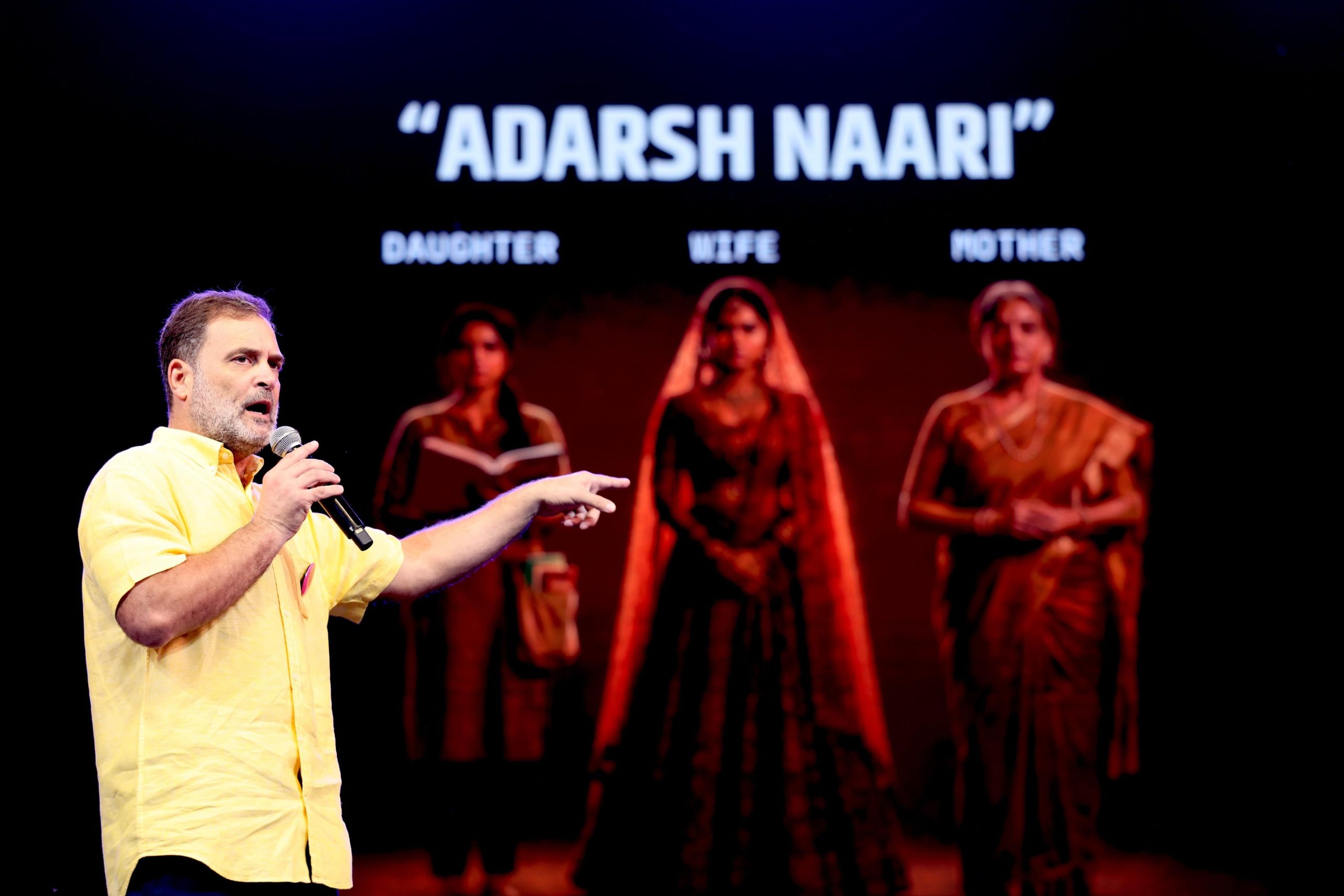
Rahul Gandhi speaking at the Chhatron Ki Goonj programme in Pune on August 22. (Photo | inc.in)

Synopsis: Rahul Gandhi’s Manusmriti remarks have triggered a political controversy. But beneath the politics lies a larger question: can women claim an identity beyond the roles that were assigned to them by a patriarchal society? The argument echoes BR Ambedkar’s vision of equality and social democracy.
Rahul Gandhi’s recent remarks on the Manusmriti have reopened a debate that India has never quite settled: whether the country’s constitutional commitment to equality can coexist with social ideas that define women primarily through their relationships with men.
Speaking at the Chhatron Ki Goonj programme in Pune on August 22, the Leader of the Opposition in the Lok Sabha referred to verses from the Manusmriti to argue that women must not be placed under the authority of fathers, husbands or sons. “The Manusmriti says, ‘in childhood, a female must be subject to her father; in youth, she belongs to her husband; and when her lord is dead, she belongs to her sons. A woman must never be independent.’ This is a direct quote from the Manusmriti, and these words are a shame, because these words should never ever have been spoken,” he said.
Rahul’s larger point was about identity: a woman cannot be reduced to being someone’s daughter, wife or mother. “Whenever I speak to a man, women are put in three boxes. You are seen as a daughter, a wife, or a mother. Now, there is nothing wrong with being seen as a wife, daughter, or mother. But this cannot be your only identity,” he said.
The political controversy surrounding the remarks is less significant than the question they raise. The Manusmriti is not merely a historical text in India’s social discourse. For generations, it has been invoked by critics as a symbol of a hierarchical social order, even as scholars and traditionalists have contested how the text should be read and understood. Rahul’s intervention therefore inevitably carries political overtones. Yet dismissing it as mere political opportunism would also overlook the constitutional and intellectual tradition behind his argument.
At the heart of Rahul’s remarks is a simple proposition: women are individuals before they are defined by familial relationships. There is nothing inherently diminishing about being a mother, wife or daughter. The problem begins when those roles become the limits of a woman’s identity. A woman may simultaneously be a professional, athlete, entrepreneur, political leader, creator or worker. Her autonomy cannot depend on the stage of life she occupies or the man with whom she is related.
In that sense, Rahul’s argument has a clear resonance with BR Ambedkar’s critique of social hierarchy. Ambedkar regarded the emancipation of women as inseparable from the struggle against caste and social inequality. “I measure the progress of a community by the degree of progress which women have achieved,” he famously said on July 20, 1942.
“I want women to go about with their heads on their shoulders and their minds working,” he said in that speech made at the All-India Depressed Classes Women’s Conference in Nagpur.
Ambedkar’s opposition to the Manusmriti was rooted in his conviction that inherited social hierarchies could not override the principles of liberty, equality and human dignity. His public burning of the Manusmriti at Mahad on December 25, 1927 became one of the most powerful symbols of that challenge.
Rahul’s remarks, therefore, may be read as part of a much larger Ambedkarite constitutional argument: that individual rights cannot be subordinated to inherited social hierarchies. The Constitution, rather than tradition, is the ultimate framework for guaranteeing rights and equality in modern India.
The Bharatiya Janata Party’s criticism that Gandhi is using the Manusmriti for political purposes is unsurprising. Political parties have long contested Ambedkar’s legacy and the meaning of social reform. But dismissing the argument as partisan politics risks reducing a substantive question of women’s autonomy to a familiar political exchange.
Congress has its own record to place before the electorate. Indira Gandhi became India’s first and, so far, only woman Prime Minister, while Sonia Gandhi played a major political role in the party and as the chairperson during the United Progressive Alliance years. Congress governments have also supported measures aimed at expanding women’s political participation. The party can point to the strengthening of women’s reservations in local bodies as part of a broader effort to increase women’s representation in public life.
Yet political claims about women’s empowerment must ultimately be tested against outcomes rather than rhetoric. India has made considerable progress in education, political representation and legal rights, but social attitudes remain uneven.
Women continue to encounter barriers relating to employment, mobility, property, marriage, political participation and personal choice. Constitutional guarantees have not automatically dismantled patriarchal practices.
This is where the Ambedkarite dimension of the debate assumes importance. Ambedkar’s enduring contribution was to insist that political democracy cannot survive without social democracy. Equality before the law has limited meaning if social relationships continue to deny equal dignity. His critique of entrenched social hierarchies was therefore not confined to the political sphere; it was a demand for transformation in everyday social relations.
The debate over the Manusmriti should consequently not become another contest over who owns Ambedkar’s legacy. No political party has a monopoly over his ideas. Ambedkar’s relevance lies precisely in the fact that his constitutional vision challenges every form of inherited privilege and discrimination.
The contemporary question is therefore much larger than whether Rahul Gandhi was politically justified in invoking an ancient text. It is whether Indian society is prepared to accept women as autonomous citizens rather than merely as daughters, wives and mothers. The Constitution has already provided the answer. The unfinished task is to translate that constitutional promise into social reality.
The controversy may fade, but the question will remain: should a woman be defined by whom she belongs to, or by who she is? In asking that question, Rahul Gandhi has touched upon an argument that lies close to the heart of Ambedkar’s vision of a modern India.
Also Read:
Women helped India win freedom. When will we grant them theirs?
Keralam’s Gulf story has another remittance: regressive ideas about women, honour and control
In South India, more women are widowed, divorced or separated than the national average
(Edited by R Rajesh Kumar.)



