
Published Jun 30, 2026 | 8:00 AM ⚊ Updated Jun 30, 2026 | 8:00 AM

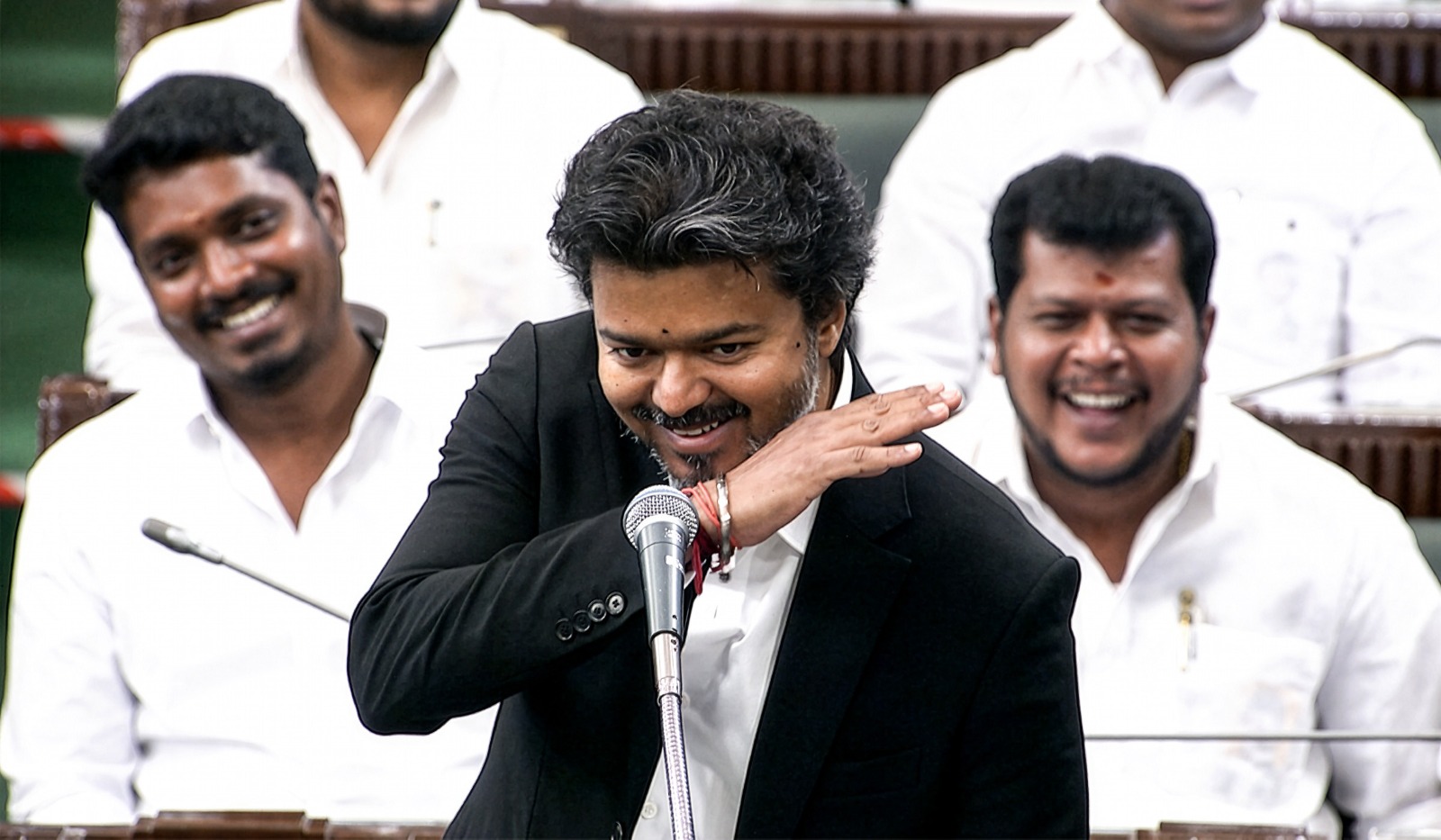
The sooner Vijay understands that Assembly sessions aren't just for laughs the better. (Screengrab)

Synopsis: A motion of thanks to the Governor’s address is the moment when a Chief Minister tells the House and the people what the government intends to do and how. Vijay should not have reduced it to a mere content opportunity.
Tamil Nadu has a new Chief Minister. He has been in the job for ten weeks. On June 23, he stood up in the state Assembly to respond to the Governor’s address, his first real test as a legislator, not a campaigner. Sadly, it did not go well. Not because the speech was bad. It was, in fact, rather entertaining. And that, perhaps, is the real problem.
The opposition had been demanding for weeks that the Chief Minister speak, alleging he had been conspicuously silent even on important issues. They even carried a placard into the Assembly taunting him to open his mouth. And he did, finally. But were they expecting him to speak like this? Do they wish now, in hindsight, that he had not spoken at all?
A motion of thanks to the Governor’s address is not a rally or a press conference, or a content opportunity. It is the moment when a Chief Minister tells the House and the people what the government intends to do and how. Vijay had that moment. However, he used it to attack the previous government, narrate a story mocking the absent MK Stalin, and close with a hand gesture borrowed from his predecessor. The treasury benches cheered. Clips went viral. But governance was largely unattended.
To be fair, Vijay did mention some things his government has done in ten weeks: a women’s protection force, steps on power sector reform, and funds for the Jal Jeevan Mission. But these were listed like footnotes. There were no timelines, no details, and of course, no answers to the opposition’s specific questions.
Two hundred and fifty reported crimes were raised by opposition members. But the Chief Minister did not address them. Surely, a state that was promised a “women-safe” administration deserved better than a deflection dressed up as a punchline.
What it got instead was a catalogue of DMK failures: TASMAC funds allegedly siphoned off, no DGP appointed for ten months, law and order in decay. All of this may be true. But the people of Tamil Nadu already knew this. They voted on it two months ago. The Assembly speech, therefore, was not the place to keep fighting the last battle.
There is also the matter of selective memory.
Vijay’s critique of past governments conveniently began in 2017. Everything before that (the combined decades of Jayalalithaa and Karunanidhi) was left untouched. This cannot be a coincidence. It is a political calculation. True, attacking only the DMK keeps the door open to the AIADMK voter without closing it on the nostalgia vote. But it is intellectually dishonest. Tamil Nadu’s governance problems did not begin in 2017. A Chief Minister who genuinely wants to break with the past should be willing to name the whole past.
Above all, there was the “kutty story”, a short tale about an old man who wanders around searching for a young boy’s father, who is nowhere to be found. The target was unmistakable: MK Stalin, who lost his Kolathur seat in the May elections and was hence absent from the Assembly. The story was delivered with deliberate theatrical timing, to loud desk-thumping from the treasury benches. Many observers, including those not sympathetic to the DMK, called it a new low for Assembly proceedings. No doubt, it cheapened what could have been a dignified occasion.
Lastly, to the grand finale: the gesture.
At the end of the speech, with the opposition benches empty after the DMK walkout, Vijay sought the Speaker’s permission to perform a hand movement. He noted, with visible amusement, that the people for whom the gesture was intended were no longer in the room. The Speaker allowed it. Vijay smiled and recreated MK Stalin’s now-famous hand signal from a pre-election press interaction. The treasury benches erupted. It immediately became the most-shared clip of the session. Ironically, just the day before, the Speaker had warned members against making signs and gestures inside the House. Twenty-four hours later, the Chief Minister performed one, with the Speaker’s blessing.
The Speaker’s double standard, however, did not end there. When Udhayanidhi Stalin accused ruling party members of involvement in crimes, the Speaker promptly demanded that the Leader of Opposition speak with evidence. Udhayanidhi obliged, detailing the charges with names and positions of TVK (Tamilaga Vettri Kazhagam) officials. Yet when the Chief Minister spoke in sweeping generalities, accusing the opposition of collecting illegal party funds, and the opposition demanded specifics, the Speaker raised no such objection. The asymmetry was glaring. It is a signal about how this Assembly intends to function, and to whom the rules apply. The “change” that TVK deployed as a buzzword to capture power may, on this evidence, be little more than a façade and an election gimmick.
Also Read: Vijay may soon discover that defeating Dravidian parties is easier than replacing them
Well, MK Stalin termed Vijay’s maiden speech a performance. Udhayanidhi Stalin said the Assembly had been turned into a shooting spot for reels. These are opposition voices, and opposition voices exaggerate. However, on this occasion, they were not entirely wrong.
The strange part is that Vijay saw the criticism coming. “Some people say I came directly from a film set to become Chief Minister,” he said mid-speech. “In their own language, I would say that was just a reel, not real.” He then finished with a cinematic gesture and walked off to applause. If he was trying to prove that the actor and the administrator are two different people, he proved the opposite.
The Tamil Nadu assembly now has two film-world politicians facing each other. On one side sits Udhayanidhi Stalin, also from the film industry, but carrying a political legacy, currently asking pointed questions about governance and demanding accountability from the new government. On the other side sits Vijay, the bigger star, with the bigger electoral mandate. However, Udhayanidhi’s blunt demand, directed at the Chief Minister, that he forget the actor he was and start conducting himself as the Chief Minister he is now, landed well because it was true.
Of course, Vijay is only ten weeks into the job, and governments need time to find their feet. But the Assembly speech was not a governance failure. It was a choice. Unfortunately, the choice was to perform rather than govern, to attack rather than propose, to entertain rather than answer. That choice says something about what this government currently thinks the job requires.
Tamil Nadu has seen Chief Ministers who were brilliant orators and poor administrators. It has seen the reverse as well. The best among them understood that the Assembly is where you are held to account, not where you hold court. June 23 suggested that Vijay has not yet clearly learned that distinction. The cameras were rolling. The benches were cheering. The gesture landed perfectly. And somewhere in all of that, the real questions went unanswered.
Also Read | Politics of goosebumps; democracy as spectacle: Rise of Vijay as Tamil Nadu CM
(Edited by R Rajesh Kumar.)



