
Published Nov 05, 2026 | 12:30 PM ⚊ Updated Nov 05, 2026 | 12:30 PM

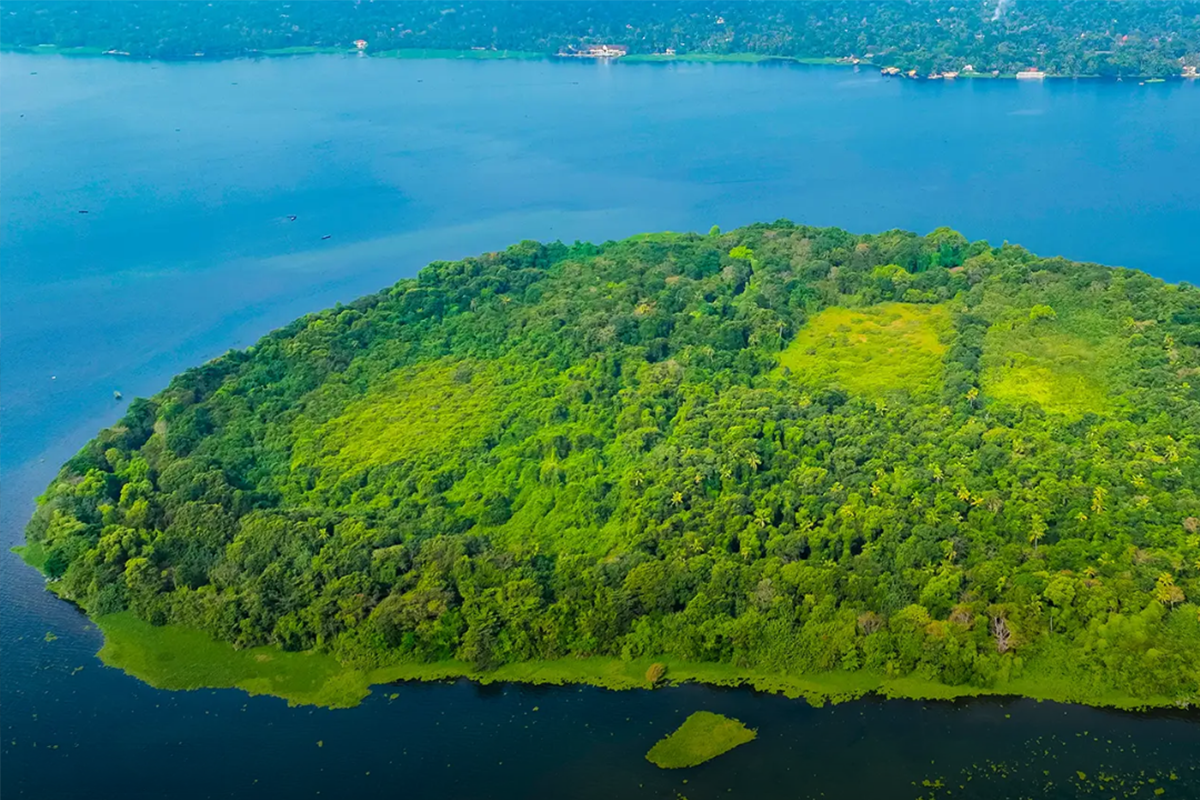
An aerial view of Pathiramanal Island in Vembanad Lake. (Photo | dtpcalappuzha.com)

After years of working with fishers on the Kerala coast, my first visit to coastal Sri Lanka in 1978 felt less like stepping into a foreign country and more like looking into a mirror across the sea.
The coastal landscape, framed by the ubiquitous coconut palms and the relentless rhythm of the surf, felt like an ecological extension of Kerala. Even the clothing mirrored Trivandrum’s fishing villages: the women wore blouses paired with brightly patterned lungis, a thorthu draped casually across the chest. I was constantly approached by locals speaking to me in Sinhala; to their eyes, I looked like I was native.
The similarities went far beyond the visual and the vocal. The cuisine was a mirror image: puttu (pittu), appam (hopper), and iddi-appam (string hopper). The puttu was served with the exact same combination — green gram (payar) and pappadam — a culinary trinity that, as far as I could tell, existed only in Sri Lanka and Kerala.
While wandering through the National Museum in Colombo, I stopped dead in front of a display shelf housing several puttu-kutti — the bamboo cylinder tied with cloth used to steam the rice flour to make puttu — sourced from Sri Lankan royal households. It was the same device used in Kerala’s kitchens till the advent of aluminium.
These weren’t just coincidences; they were artefacts of deep historical migration and cultural exchange. I became convinced that the Thiyya/Ezhava community of Kerala, who share the skills of toddy tapping, must have roots that trace back across the Palk Strait, bringing the coconut palm and its associated livelihoods with them.
Even the political climates mirrored each other; the initial socialism of Sirimavo Bandaranaike and the Trotskyist communism of the left in Sri Lanka rhymed well with Kerala’s socially progressive policies and Stalinist politics.
My visits to Sri Lanka on work between 1978 and 1983 took me all over the coasts of the island — initially starting in Negombo and crossing over to Batticaloa in the east, and later years particularly to the south-western coastal parts of Galle, Tangalle and Hambantota. Everywhere I went, I felt as though I was in Kerala.
But that comforting illusion of a mirror across the sea was shattered by the Sinhala-Tamil riots of July 1983. The violence drew a line between my early memories and the reality that followed, but the memory of those pre-1983 years stayed with me.
It is precisely this profound sense of shared identity that makes my concerns with the current divergence in our tourism outcomes so baffling.
In 2010, Kerala and Sri Lanka were statistical twins in the global tourism market. That year, Kerala welcomed 6.59 lakh foreign tourists, while Sri Lanka recorded 6.54 lakh. They shared a tropical ecology, deep socio-cultural ties, and, crucially, exceptionally high Human Development (HD) indicators. Both achieved high literacy and life expectancy long before their economies could support them, becoming classic examples of “human development without high income” as acclaimed by economists like Amartya Sen.
Fast forward to 2026, and that parity has vanished. In 2025, Sri Lanka recorded an all-time high of 23.62 lakh foreign tourist arrivals, surpassing its pre-COVID peak. Kerala, meanwhile, received just 8.21 lakh foreign tourists, recovering only about 70% of its pre-pandemic figures.
How did a sovereign nation that suffered the Easter Sunday bombings in 2019, a global pandemic, a catastrophic sovereign debt default in 2022 and a political upheaval in 2024 manage to vastly outperform an Indian state that remained relatively stable and peaceful? The answer lies at the intersection of physical geography, environmental management, and strategic governance.
At first glance, both destinations offer similar coastal experiences. But the physical geography of their hinterlands dictates the health of their beaches and the nature of the visitor experience.
Kerala is crisscrossed by 41 short, fast-flowing rivers that rush directly from the Western Ghats to the Arabian Sea. During the intense southwest monsoon, these rivers act as massive funnels, washing agricultural runoff, urban waste, and plastics from the villages and towns in the mountains and midlands directly onto the coast. Tackling Kerala’s coastal pollution is a basin-wide nightmare; you cannot simply clean the beach; you have to manage waste all the way from the mountains.
Sri Lanka lacks this concentrated mountain-to-sea river network. Its pollution challenges are highly localised — such as the century-old sewage outfalls in Colombo or industrial discharge near the capital — making coastal management a far more targeted and achievable endeavour.
Furthermore, Kerala is fighting a losing battle against coastal erosion, greatly exacerbated by coastal infrastructure, with roughly half of its 590-km coastline receding. The state’s response has been heavily defensive, erecting massive, visually intrusive granite and tetrapod seawalls and groynes that temporarily protect the land but physically replace the natural sandy beach and make it an eyesore to tourists. Sri Lanka, while also facing severe erosion (such as at Calido Beach in Kalutara, where a river mouth breach triggered massive erosion), has leaned toward softer engineering, including beach nourishment, preserving the aesthetic — that sun-and-soft sand — which tourists crave.
The physical degradation of Kerala’s beaches directly impacts its tourism economy, and the data bears this out.
Sri Lanka’s tourism infrastructure is structurally beach-centric. Over 60% of its registered hotel rooms are concentrated in the Western and Southern coastal provinces, forming an undisputed tourism heartland from Negombo down to Hambantota. Its tourism recovery is driven by a laser focus on leisure, wellness, and MICE (Meetings, Incentives, Conferences, and Exhibitions) tourism, heavily targeting the Indian market, which now accounts for roughly 22.5% of its arrivals. Indian corporate executives and family tourists rave about the great food, clean beaches and welcoming people.
Kerala, on the other hand, boasts a highly diversified product: backwaters, hill stations, and Ayurveda. While this diversity is a strength, its beach product is declining. Kovalam, once Kerala’s flagship beach destination, has seen a slump in both domestic and foreign arrivals due to lagging infrastructure and cleanliness issues. In 2024, it received just 79,000 foreign tourists. Kerala’s high hotel occupancy rate (around 70%) is driven by urban business travel and cultural events like the Kochi-Muziris Biennale, not its coastline.
The ultimate irony lies in the wellness sector. Sri Lanka successfully markets Ayurveda globally, despite the fact that roughly 70% of the trained professionals running Sri Lanka’s Ayurvedic wellness centres are from Kerala. Kerala invented the product, but Sri Lanka packaged and sold it better to the international market.
Does this massive divergence in tourism outcomes reflect a problem of nature or governance? In my understanding, it is a combination of both, but governance is the decisive factor.
Nature sets the difficulty level. Kerala’s funnel-like rivers make coastal pollution a systemic nightmare, and its severe coastal erosion, tackled with hard, beach-destroying seawalls, an eyesore. Sri Lanka’s geography made localised beach management slightly easier through its efficient Coast Conservation Department. Nature dealt Kerala a tougher hand.
But governance determined the outcome. Sri Lanka’s tourism authorities demonstrated remarkable professional acumen and institutional resilience. Even amid a national economic collapse and widespread civil unrest, they kept their foot on the pedal. The Sri Lanka Tourism Promotion Bureau intensified targeted marketing campaigns, diversified into cinema and wedding tourism, and maintained a standard of cleanliness on major tourist beaches that the country’s economic crisis could not break.
Kerala, conversely, suffers from a “lack of vision,” as Sajeev Kurup of the Confederation of Kerala Tourism Industries puts it. Despite its superior baseline human development and a richer diversity of natural assets, the state has been complacent. Its beach cleanliness deteriorated to the point where the National Green Tribunal had to intervene in 2026 to mandate daily cleaning at Fort Kochi. The state’s environmental enforcement has been reactive rather than proactive.
Kerala and Sri Lanka prove that high Human Development Indicators and breathtaking natural beauty are not enough to guarantee tourism success.
Sri Lanka’s triumph in crisis shows that a focused, resilient, dedicated and aggressive governance framework can overcome even national economic collapse. Kerala’s stagnation shows that without strategic vision, rigorous environmental maintenance, and a willingness to adapt the tourism product, even “God’s Own Country” can lose its competitive edge.
Looking back, that puttu-kutti in the Colombo Museum is a reminder that the cultural and ecological DNA of these two regions is virtually identical. The divergent paths they have taken since that day in 1983 are not a result of nature or culture, but of the choices made by those who govern them.
Also Read:
The Sea speaks Malayalam: The 122 words that sailed back with Vasco da Gama from Calicut
A country between empires: Lessons from the Serbian election surprise for young Indians
(The trigger for writing this piece comes from the article by Dhinesh Kallungal in The Hindu of November 2, 2026, titled: “Sri Lanka tourism thrives in crisis, Keralam plays catch-up”. Several of the data points are drawn from it.)
(Edited by R Rajesh Kumar.)



