

Published Jul 23, 2026 | 7:00 AM ⚊ Updated Jul 27, 2026 | 3:14 PM

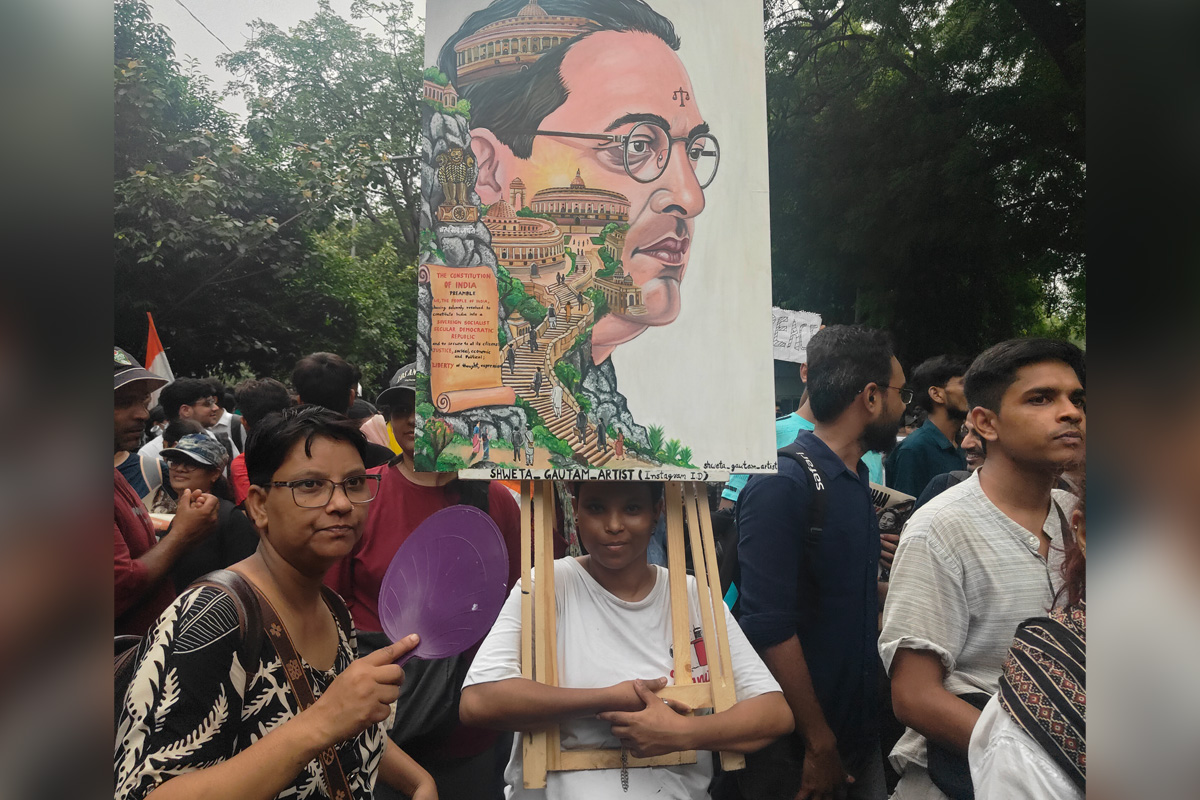
A protester holding a placard during the CJP protest against NEET-UG paper leak. (Photo | Kaushik Raj)

Synopsis: The July 20 Sansad Chalo march revealed that the youth of the country can speak truth to power and unflinchingly demand answers. Like Anna Hazare’s protest at Jantar Mantar all those years ago, this movement too is bound to leave a lasting mark on Indian politics.
“Jai Bhim,” “Jab Jab Modi Darta Hai, Police Ko Aage Karta Hai” (Whenever Modi is scared, he puts the police in front), “Inquilab Zindabad,” “Vande Mataram,” and “Bharat Mata Ki Jai.”
With the air of Delhi reverberating with these slogans, the youth of the country succeeded in doing what the Opposition has been struggling to achieve in the last 12 years. Their non-violent Sansad Chalo protest on July 20 saw them demonstrate an unshakeable courage to question authority and seek accountability. The BJP government has been left grappling for answers and the country has probably gained a glimpse of leaders of tomorrow who won’t flinch from talking truth to power.
Although the July 20 CJP protest aimed to cover the relatively short distance from Jantar Mantar to Parliament, its message travelled farther. It awakened young people from Kashmir to Kanyakumari, instilling confidence in them to exercise the constitutional freedoms guaranteed under Article 19 that grants us the freedom of speech and to assemble peaceably and without arms.
The significance of the movement lies not merely in the physical protest but in its ability to inspire participation across the country. That, in many ways, is the true Bharat Jodo Yatra—one that united citizens across democratic participation.
One of the defining features of this movement has been its ability to transcend religion, caste, and regional identities. The cause resonated with young people across political and ideological lines, making it difficult to dismiss or divide the movement along traditional fault lines.
Social media emerged as the movement’s most powerful amplifier. At a time when many participants believed mainstream media was not giving the protests adequate attention, digital platforms carried the message directly to millions of young Indians. Memes, short videos, and online conversations transformed symbols into powerful tools of political communication. What began as a protest on the internet after the Chief Justice of India termed youth who don’t get any employment and don’t have any place in the profession ‘Cockroaches’ has evolved into a protest through which an entire generation connected.
Political or apolitical, young people found common ground because of shared concerns. Frustration over the quality of education, uncertainty in employment opportunities, and the growing gap between aspirations and outcomes had been building for years. The movement provided an outlet for those frustrations.
Several developments contributed to this growing discontent.
Debates surrounding the National Education Policy 2020, with the introduction of three languages, generated concerns among sections of students in different states.
Questions over the evaluation of CBSE examinations, including irregularities in the tendering process for the On-Screen Marking (OSM) system highlighted by a 17-year-old student, further fueled discussions about transparency.
Suicides by students following the cancellation of their examination due to the NEET paper leak became a major flashpoint. Images of extensive security checks outside NEET examination centres, coupled with reports of examination controversies, left many students feeling that they were being treated with suspicion.
Generation Z differs from previous generations in important ways. It is digitally connected, highly informed, impatient for change, ambitious, and willing to challenge institutions that it believes are failing to meet public expectations. Unlike earlier generations that often accepted delays and bureaucratic hurdles as inevitable, today’s youth expect transparency, efficiency, and accountability.
Previous governments, including Congress-led alliances, often accepted political responsibility by seeking resignations of ministers during major controversies. With the current NDA government adopting a different approach by choosing to defend its decisions rather than accept political responsibility, they are being increasingly viewed as overconfident and drawing heavily on its strong recent electoral mandates.
This perception is reinforced by its apparent parliamentary manoeuvring to pass constitutional amendments on Delimitation and the Women’s Reservation Bill, moves seen as strategic attempts to significantly boost its seat share, particularly through its strongholds in North India. Some even speculate that this could pave the way for ‘One Nation, One Election,’ and a shift toward a more presidential-style system that would disproportionately favour national parties, especially the NDA.
Regardless of where one stands politically, one conclusion is difficult to ignore: this movement demonstrated the growing political consciousness of India’s youth. Its greatest achievement may not be any immediate policy change, but the confidence it has instilled in an entire generation to participate in democracy, question authority, and demand accountability.
Like the Anna Hazare movement over a decade ago, this moment will leave a lasting mark on Indian politics.
Whether history ultimately judges it as larger or more influential will depend on its long-term impact. What is already evident, however, is that it has inspired a generation to believe that their voices matter—and that democracy is strongest when citizens choose to participate rather than remain silent.
Also Read:
India’s students’ revolt has exposed BJP’s biggest political blind spot
To resign or not? Inside story of how Dharmendra Pradhan is holding on
(Edited by R Rajesh Kumar.)



