
Published Sep 19, 2026 | 12:05 PM ⚊ Updated Sep 19, 2026 | 12:05 PM

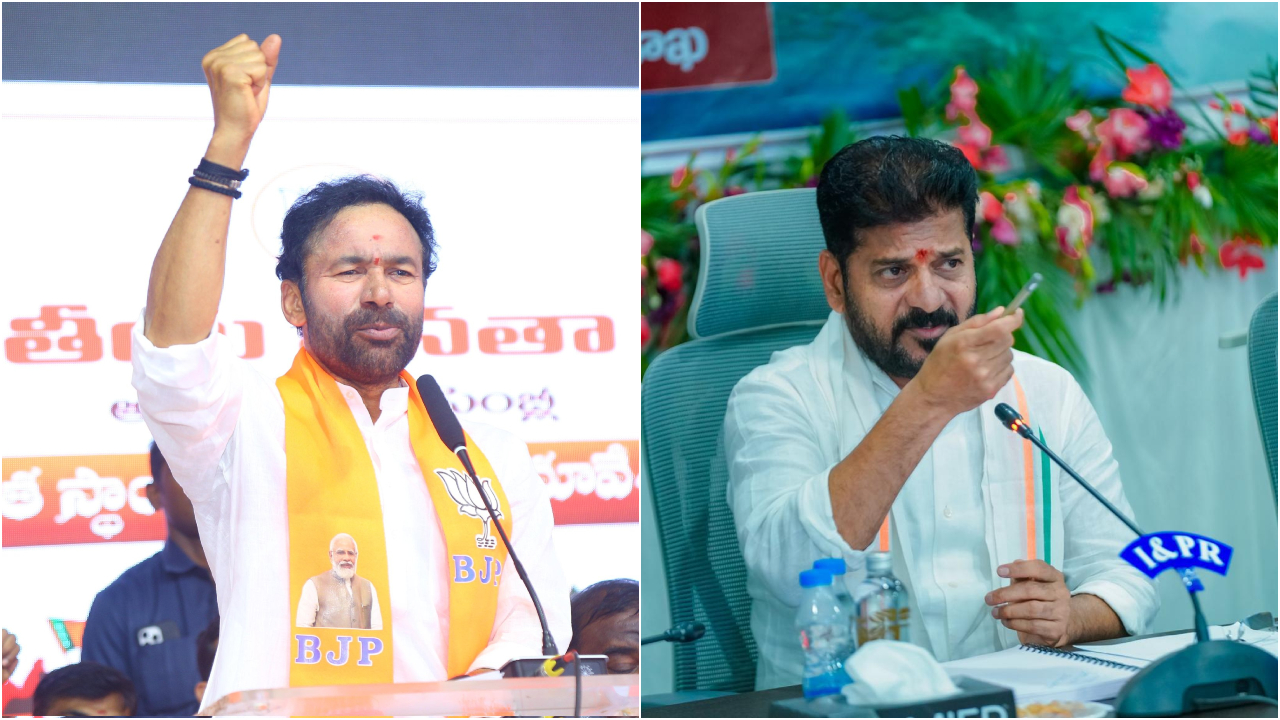
Union Minister G Kishan Reddy (L), Telangana CM Revanth Reddy. Credit: x.com/kishanreddybjp, x.com/revanth_anumula

Part 1 of this series looked at how closely Telangana’s Congress government has mirrored BJP-style policy and infrastructure — a Central bill replicated almost without debate, a flagship river project modelled explicitly on Gujarat’s Sabarmati, an industrial “future city” pitched as bigger than Modi’s GIFT City, and a state minister publicly defending the very E20 policy his own party’s national leadership has been attacking. None of that, on its own, proves a deliberate political arrangement with the BJP-led Centre.
This second piece turns to the politics: who the Chief Minister Revanth Reddy picks fights with, who he avoids doing so with, how his tone has shifted since taking office, and the silences that are harder to document but just as telling.
The one Union Minister the Chief Minister reliably targets in public is G Kishan Reddy — Telangana’s most visible BJP face, accused at various points of blocking Hyderabad Metro Phase-2 funding, discouraging Maharashtra’s cooperation on the Tummidihetti irrigation project, and generally sitting on Telangana’s dues. What is missing is any comparable public confrontation with the other Union Ministers who actually hold the relevant portfolios — the Ministers of Railways, Urban Development, or Finance, whose sign-off the state needs just as much.
Revanth Reddy has, by his own account, met Prime Minister Modi and Ministers Manohar Lal Khattar and Ashwini Vaishnaw directly and repeatedly to lobby for the same approvals, and those meetings are reported as cooperative, almost solicitous engagements rather than confrontations. State officials, meanwhile, rarely spar publicly with their Union counterparts at the bureaucratic level; it is the Chief Minister’s own, camera-ready visits to Delhi that generate headlines.
Read charitably, targeting Kishan Reddy looks like ordinary retail politics — he is the most recognisable BJP face from Telangana, so naming him is the obvious way to personalise a grievance for a domestic audience. Read less charitably, it looks like a deliberate substitute for a fight the government isn’t actually having.
As the “double-engine sarkar” impression has gained ground, a visible, recurring quarrel with one individual minister does useful work: it lets the government pretend opposition to the BJP without disturbing its underlying accommodation with the BJP-led Centre. A structural, federal dispute — over fund devolution formulas, project-sanction criteria, or the unmet bifurcation commitments that cut across every ministry — gets reduced to a personality clash with Kishan Reddy, which is easier to sustain in headlines, easier to walk back when convenient, and far less threatening to the actual working relationship with Delhi than a genuine institutional confrontation would be. The individual becomes a lightning rod so that the arrangement itself never has to answer for anything.
It is worth remembering how combative this same Chief Minister sounded before December 2023. On the campaign trail, he warned the BJP it would meet “the fate of the Razakars and the Nizams,” cast the contest as “Telangana pride versus Gujarat dominance,” accused Modi of insulting the state over bifurcation, and flagged what he called outright discrimination in project sanctions given to Gujarat over Telangana. Two years into office, that register has almost entirely given way to the language of “cooperative federalism” — a phrase Revanth Reddy now uses to defend his own frequent trips to meet the Prime Minister, arguing states and Centre “must work together for the people.”
The flashes that remain — a public spat over a denied US travel clearance in August 2026, the recurring broadsides against Kishan Reddy over Metro Phase-2 — read as isolated, quickly-resolved incidents rather than the sustained institutional confrontation that characterised the BRS decade, when K Chandrashekar Rao’s government fought running battles with the Centre over GST compensation, IAS cadre rules, and irrigation clearances.
The money broadly tracks the mood. Telangana’s own officials have credited “improved coordination with the Centre” for a rise in Centrally Sponsored Scheme receipts, from roughly Rs 4,826 crore in 2021-22 under BRS to Rs 7,072 crore in 2025-26 under Congress.
On railways, the contrast in tone is stark: in 2023, BRS minister KT Rama Rao was writing letters to the Union Railway Minister alleging “blatant discrimination,” pointing to barely 100 km of new track laid over eight years and the Centre’s refusal to sanction a promised rail coach factory. By 2025-26, the Centre was publicly announcing a “sixfold” jump in Telangana’s rail budget allocation, over Rs 41,000 crore of ongoing investment, full electrification of the state’s network, and inclusion in fresh multi-tracking sanctions under PM Gati Shakti — all framed as evidence of goodwill rather than grievance.
This isn’t a uniform picture — a 2025 urea shortage did produce a genuine blame-game between the state’s Agriculture Minister and Union Minister Kishan Reddy, and Congress MPs have separately complained that railway sanctions aren’t translating into actual work on the ground — but the overall arc, compared to the sustained combativeness of the BRS years, is unmistakably one of the Centre extending Telangana’s Congress government a working relationship it never extended to the state’s previous government.
Regional airports are a useful test of whether either government is actually willing to spend political capital on Telangana’s less glamorous districts, and for years the results split cleanly along a fault line. Warangal’s long-stalled Mamnoor airport got Central clearance in early 2025 after the state government did the legwork — securing a no-objection certificate from the Hyderabad airport operator to waive a rule blocking any competing airport within 150 km — and by September 2026 the Union Civil Aviation Minister was telling the Chief Minister that tenders would be invited within two weeks, finalised by December, with foundation work to follow the same month.
Adilabad, which a Chief Minister had first promised an airport for back in 2018, has moved at a visibly different pace: an in-principle Defence Ministry clearance in April 2025, a joint ground survey on April 17, 2026 that concluded the runway would need to run 2.75 km and the state would need to acquire another 1,500 acres — and then, remarkably, another “review meeting” on September 12, 2026, five months after the survey, at which the outcome was not construction news but a decision to appoint nodal officers within a week and pursue the project in “mission mode.”
That phrase is worth sitting with. Five months after a technical survey concluded what the runway needs and how much land is required, the announcement out of Delhi was not a tender or a foundation date — it was a promise to appoint the officials who will eventually get around to it. Compare that to Warangal, where an equivalent gap between survey-stage clarity and tender announcements ran to a matter of weeks.
Both projects enjoy the same nominal alignment of interests: a state government lobbying for speed, a Union government publicly committed to delivering, senior ministers holding meetings and photo opportunities. Yet one district gets tenders and a construction date, and the other gets its second or third “mission mode” announcement in under a year, each one restating the same intent without producing the runway. If this is what convergence between the state and the Centre looks like when there is no political friction to blame for the delay, that convergence itself may be the story — a shared willingness to hold meetings, issue statements, and repeat the same commitment, without either side treating actual delivery for a tribal-belt district on the Maharashtra border with the urgency both governments reserve for Hyderabad’s own showpiece projects.
The convergence isn’t only about new projects Congress has embraced; it’s also about old ones it hasn’t undone. The UPA’s Land Acquisition Act of 2013 was meant to replace the colonial-era 1897 law with something more protective of displaced landholders. The BRS government diluted it substantially during its decade in power. Telangana’s Congress government, despite campaigning against BRS’s record, has not moved to restore it.
On irrigation, project planning continues in the same broad direction as before, without a visible course correction. And on Kaleshwaram — the state’s most expensive and most criticised irrigation project, whose barrage failures triggered a judicial commission — there has been no action against the main contractor responsible for the debacle, despite the political capital Congress spent attacking the project before coming to power.
Nor has the bifurcation promise been revisited with any urgency. The commitments made to Telangana at the time of Andhra Pradesh’s 2014 split — on institutions, funds, and railway zones among them — remain substantially unmet, and the state government has offered little sustained pushback to the Centre on this front.
None of this exists in a vacuum. Revanth Reddy’s own political biography — a stint in the RSS-linked ABVP before he moved through the TDP and into Congress — feeds a running suspicion in Telangana’s political class that he could shift allegiance again if the arithmetic in Delhi ever demanded it.
That speculation may or may not be fair to the Chief Minister personally. But governments are judged by what they do, not just by who leads them, and on that count, Telangana’s Congress government has picked remarkably few fights with the Union government — on GST devolution, on Central schemes, on federal overreach, on anything that would mark it out as an opposition-ruled state rather than an ally in waiting.
The clearest evidence that BJP’s opposition to Congress in Telangana operates more as theatre than substance is the mismatch between how the two governments’ housing schemes have been treated. BRS’s double-bedroom housing programme was for years a favourite target — of both the BJP and Congress — precisely because it was framed as the previous government’s central welfare promise, deceiving villagers who never received the flats they were told to expect.
Indiramma Indlu, Congress’s own like-for-like replacement — five lakh rupees in direct assistance per household, again pitched explicitly as the anti-double-bedroom-scheme guarantee — has drawn only sporadic BJP criticism: a press conference here alleging fee “loot” and slow rollout, a complaint there about a companion urban-governance bill, but nothing resembling a sustained opposition campaign of the kind double-bedroom houses faced for a decade. A flagship welfare scheme that would once have been prime opposition ammunition barely registers as an issue when the government running it is Congress rather than BRS.
Adilabad supplies the most candid illustration of why. Congress’s own Khanapur MLA, Vedma Bojju, has publicly complained that state ministers keep BJP legislators — Adilabad’s Payal Shankar and Nirmal’s Alleti Maheshwar Reddy — briefed and involved in official business while sidelining Congress’s own representatives, going so far as to say he learns what is happening in his district from outsiders rather than his own party’s government. The Chief Minister, during a district tour, publicly credited the BJP’s Payal Shankar for progress on local issues — a courtesy no state government typically extends to opposition legislators. When a ruling party’s own MLA is complaining, on record, that the opposition’s writ runs stronger in his district than his own party’s, “double-engine sarkar” stops being a rhetorical flourish and starts looking like a description of how the state is actually being administered.
September 17 supplies a subtler version of the same pattern.
When Congress came to power, it neither adopted the Centre’s “Hyderabad Liberation Day” nor reverted to the CPI-and-TPCC-preferred “Telangana Integration Day” that Congress’s own state unit still uses informally. Instead, Revanth Reddy coined a third label — “Praja Palana Dinotsavam,” People’s Governance Day — hoists the tricolour at a separate venue, and each year insists it would be “ridiculous” to seek political mileage from the date. On its face, this reads as principled neutrality: neither the BJP’s “liberation” framing nor the old appeasement charge attached to “integration.”
But look at what the rebrand actually gives up. It drops the language of integration and secular nation-building that Congress’s own ideological tradition would defend, replaces it with an anodyne governance slogan that takes no position on the Nizam period at all, and — critically — stops actively contesting the substance of the BJP’s narrative that September 17, 1948 was a liberation from oppressive rule. Congress still won’t say the word “liberation,” but it no longer argues against the idea either; it simply changes the subject to “people’s governance.”
Symbolic distance on the label, while conceding the substantive ground and giving up the fight, is its own quiet form of capitulation — arguably more effective for the BJP than an outright adoption of “Liberation Day” would have been, since it removes Congress from the argument altogether rather than leaving two competing accounts of history in the field.
The BJP’s version of double-engine sarkar promises efficiency through alignment: one party, one vision, no friction between Centre and state.
Telangana appears to be delivering exactly that outcome without the branding — a Congress government that borrows Central legislation, replicates Central-style flagship projects, leaves BRS-era regressions on land acquisition untouched, and treats Kaleshwaram accountability and bifurcation promises as someone else’s problem, while reserving its visible opposition for a single minister and a rebranded holiday. If that is what governance under the “grand old party” now looks like in Telangana, voters who chose Congress as an alternative to both BRS and the BJP deserve an answer to a simple question: what, precisely, is the difference?
[Author’s note for publication: These two parts argue one side of a live political debate. A fuller treatment would also weigh the Congress government’s counter-claims — e.g., that Jan Vishwas–style decriminalisation is a genuinely non-partisan ease-of-business reform, that Musi’s flood-control and ecological goals differ from Sabarmati’s aesthetics-led approach, that a state government pursuing large private investment has few real alternatives to the existing industrial-policy template regardless of ruling party, that the 2025 urea shortage shows real Centre-state friction still exists, that BJP has in fact criticised Indiramma on cost and rollout grounds even if less sustained than its attacks on double-bedroom houses, that Congress has consistently refused the “Liberation Day” label itself and invited (rebuffed) BJP leaders to its own event, and that some bifurcation and irrigation issues are constrained by Central cooperation the state does not fully control. The E20 contradiction, the selective targeting of Kishan Reddy, the CSS/rail-budget funding comparison with the BRS years, and the Adilabad MLA’s on-record complaint are the most factually clean examples across both pieces and probably deserve the most prominent placement if space is limited; the September 17 rebrand and the Adilabad airport’s repeated “mission mode” announcements are interpretive arguments built on solid facts, and should be flagged to readers as argued readings rather than settled conclusions. Readers should weigh the counter-claims before concluding. The upcoming third part will look at why the Congress mirroring BJP-style policy does not generate real friction.]
Also Read:
Even a dead worker’s family wasn’t spared: The decline and fall of Telangana’s police
Ageing India, faster-ageing Telangana: Opportunity or trouble?
Telangana’s invisible farmers need a name before they need a scheme



