
Published Sep 17, 2026 | 11:30 AM ⚊ Updated Sep 17, 2026 | 11:30 AM

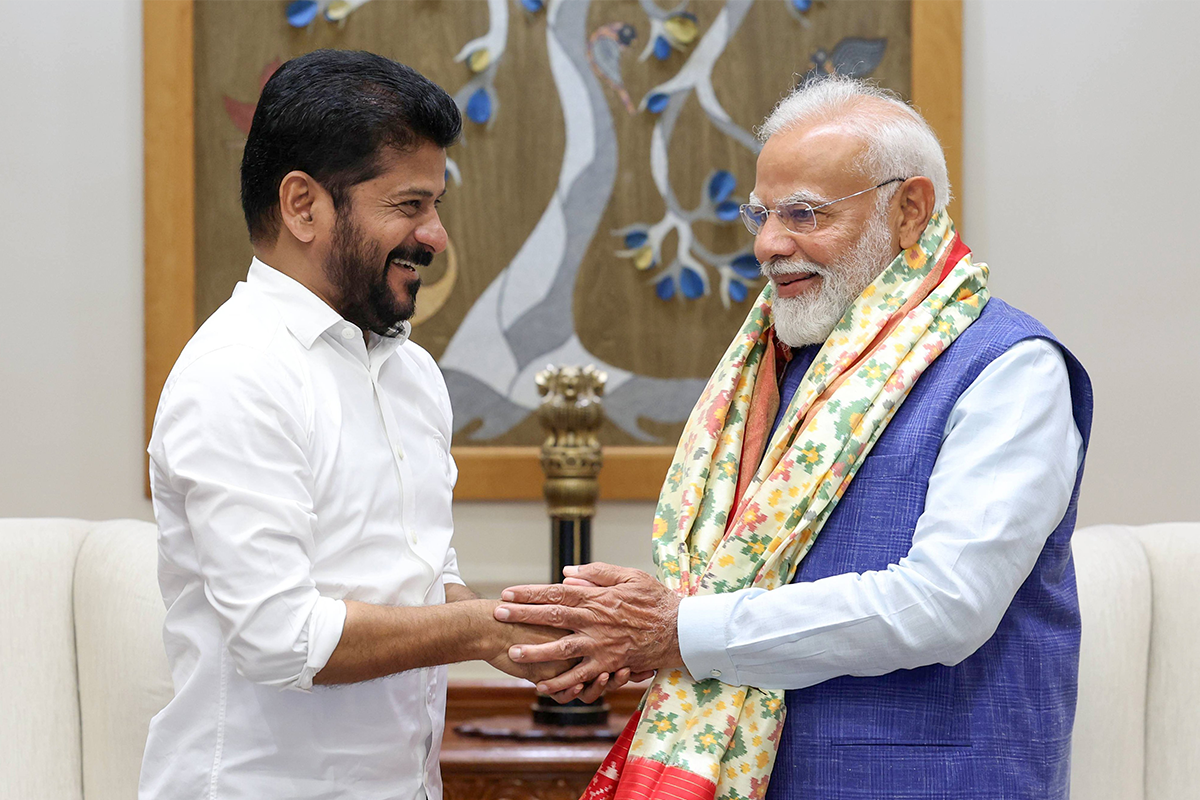
Telangana Chief Minister Revanth Reddy shake hands with Prime Minister Narendra Modi in Delhi.

Synopsis: There is nothing wrong with learning from a successful project elsewhere. But when a Congress government’s flagship urban vision is a bigger, costlier version of the BJP’s own template, it is worth asking what happened to any distinctly Congress idea of urban development.
“Double engine sarkar” — the same party ruling at the Centre and the state, working in lockstep — has long been the BJP’s pitch to voters. Telangana was supposed to be the counter-example: a Congress government elected in December 2023 on the promise of a different, more accountable model of governance. Two years in, that promise looks harder to find than the slogan itself.
This is the first of three pieces on how that convergence actually shows up — starting with policy and infrastructure, where the mimicry is easiest to document. Part 2 turns to the politics: the rhetoric, the selective targeting of one BJP minister, and the silences that are harder to prove but just as telling. The third piece asks the harder question underneath both: why does none of this generate real friction?
On September 12, 2026, the Telangana Assembly passed the Telangana Praja Viswasam (Amendment of Provisions) Bill, decriminalising more than 400 minor regulatory offences and replacing criminal prosecution with monetary penalties. State Industries Minister D Sridhar Babu was candid about its parentage: the bill was drafted to align with the Centre’s own Jan Vishwas (Amendment of Provisions) Act, passed by Parliament earlier this year.
There was no floor fight, no ideological resistance, no attempt to recast the framework for Telangana’s own priorities — just a state-level mirror of a Central law, adopted on the Assembly’s last day of session with barely a debate. That, on its own, might be defensible policy borrowing. But it sits inside a much longer pattern.
The Chief Minister’s own signature project — the Rs 58,000-crore Musi River rejuvenation — is explicitly modelled on the Sabarmati Riverfront in Ahmedabad, the flagship urban showpiece most associated with the Gujarat model that the BJP has exported nationally. Revanth Reddy has said so himself, repeatedly, citing his visits to Ahmedabad alongside London and Singapore as inspiration, and vowing that Musi will eventually surpass Sabarmati.
There is nothing wrong with learning from a successful project elsewhere. But when a Congress government’s flagship urban vision is a bigger, costlier version of the BJP’s own template, it is worth asking what happened to any distinctly Congress idea of urban development — one, for instance, that centres resettlement and livelihoods of riverbank communities rather than a beautification-led, investment-magnet framing borrowed wholesale from Ahmedabad.
The pattern repeats elsewhere: a bullet train corridor, health-record digitisation drives that mirror the Centre’s Ayushman/digital health push, “net zero” city branding, and a slate of greenfield and highway-widening projects that both the Union and state governments are equally eager to inaugurate. Contractors for many of these projects — road works in particular — are often the same firms working both Central and state contracts, blurring any real distinction between “whose” infrastructure this is.
Even Hyderabad Metro Rail Phase-2 — ostensibly a flashpoint with the Centre over delayed approvals — has proceeded entirely within the Centre’s preferred funding architecture: state equity, a central government NOC and an IRFC loan structure, the same template used for metro expansions in BJP-run cities. The fight has been over the pace of sanction, never over the model itself.
Nowhere is the mimicry more explicit than in the state’s own marketing. Chief Minister Revanth Reddy has repeatedly pitched Bharat Future City — the 30,000-acre investment hub on Hyderabad’s outskirts — as a direct answer to Gujarat’s GIFT City, telling industry delegations that Telangana’s version, at roughly 40 times the acreage, will “outscale” Modi’s flagship financial city.
The comparison is telling on two levels. First, the ambition is framed entirely in relation to a BJP-run showpiece, not as an independent vision. Second, and more revealing, the Chief Minister has himself said in public that there has been no real change in industrial policy across Telangana’s successive governments — from the BRS years back to the undivided Andhra Pradesh era and now under Congress.
That is an unusual admission for a party that came to power promising a break from the BRS’s investor-first, big-ticket approach to development; it suggests the state’s industrial and land-use playbook — tax breaks, single-window clearances, land pooling for mega-projects — has simply been inherited and rebranded, whichever party is in charge.
The disconnect between Telangana Congress and the national party is nowhere sharper than on E20 ethanol-blended petrol. In New Delhi, Congress general secretary Jairam Ramesh and the Congress Working Committee have spent recent months attacking the Centre’s E20 rollout — citing falling mileage, rising sugar and grain prices from feedstock diversion, and unresolved questions about vehicle compatibility, and demanding that motorists be given a non-ethanol option.
In Hyderabad, Telangana’s own Transport Minister, Ponnam Prabhakar, told the Assembly on September 9 that there was no evidence E20 damages vehicles and that the department had received no complaints — effectively defending the Centre’s position that his own party’s national leadership has been actively contesting.
Two arms of the same party, taking opposite public positions on an identical Central policy, is not a detail; it is the clearest evidence that Telangana Congress calibrates its stance to local convenience rather than party line, and that convenience keeps pointing in the Centre’s direction.
None of this, on its own, proves an intentional political arrangement between Congress and the BJP. Governments copy successful policy ideas across party lines all the time, and a poorer state chasing investment has genuinely limited room to reinvent its industrial playbook. What the pattern does establish is that, on paper, there is remarkably little daylight between how a BJP government would run Telangana and how this Congress government actually is running it.
Whether that convergence is coincidence, pragmatism, or something more deliberate is a question of political conduct rather than policy text — and that is where Part 2 picks up: with how the Chief Minister manages the optics of opposition to Delhi, who he picks fights with and who he doesn’t, and the silences on land acquisition, Kaleshwaram accountability, and bifurcation promises that no policy document can explain away.
Also Read:
Real issues aside, police raj is the answer in Telangana!
Telangana: A state rich in corruption
Telangana’s invisible farmers need a name before they need a scheme
(Edited by R Rajesh Kumar.)
(Part 2 covers: the selective targeting of one Union minister as a substitute for structural confrontation; the arc from combative 2024 campaign rhetoric to “cooperative federalism”; comparative CSS and railway funding trends; the Adilabad airport’s repeated “mission mode” announcements; unresolved land acquisition, irrigation, and Kaleshwaram accountability questions; the bifurcation promises still unmet; the asymmetric treatment of BRS’s double-bedroom scheme versus Congress’s Indiramma Indlu; an Adilabad MLA’s on-record complaint about which party’s legislators get ministerial access; and the September 17 nomenclature dispute.)



