

Published Nov 15, 2026 | 12:00 PM ⚊ Updated Nov 15, 2026 | 12:00 PM

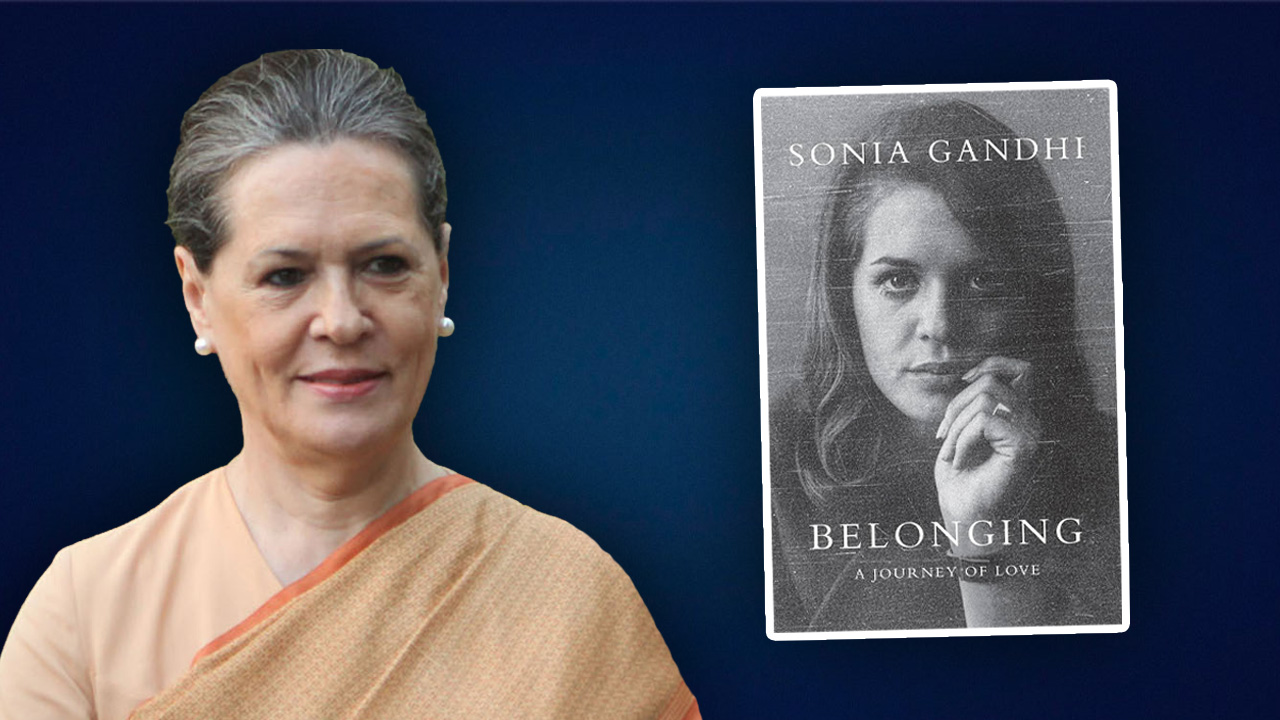
Autobiographies are not written to satisfy the expectations of others. What matters is the degree of truth in the accounts.

Synopsis: Autobiographies are not written to satisfy the expectations of others. An author cannot be criticised simply for choosing not to write about certain subjects. What matters is the degree of truth in the accounts that have actually been presented. Sonia Gandhi is approaching her eightieth year in a few weeks. Having battled the dreaded disease of cancer and undergone surgery twice, she is gradually withdrawing from active politics. It is at this stage of her life that she has decided to share her experiences with the world.
The autobiography of senior Congress leader Sonia Gandhi, titled Belonging: A Journey of Love, has been published. She is no ordinary individual. She is an heir to the Gandhi-Nehru political dynasty and has been part of India’s political history for several decades.
Her critics may call her a foreigner, but her contribution to Indian politics, particularly Congress politics, is an undeniable fact. As Congress president, UPA chairperson, Member of Parliament, daughter-in-law of a former prime minister and wife of a former prime minister, she has witnessed the country’s politics and governance from very close quarters.
Several books on Sonia Gandhi’s life have already been published in different languages. Around half a dozen of them are particularly noteworthy. Some are analytical accounts of her life. Among them, political journalist Rashid Kidwai’s Sonia: A Biography, written in English, and Spanish author Javier Moro’s The Red Sari deserve special mention.
From the moment Sonia Gandhi’s autobiography Belonging was released, people ranging from BJP national president Nitin Nabin to local BJP leaders in the lanes of Hyderabad began attacking its contents.
When Sonia writes that she was moved to tears while watching the demolition of the Babri Masjid, Nitin Nabin mocks her, asking whether she did not shed tears during the 1984 anti-Sikh massacre, or during some other incident at some other point in time. A junior BJP worker took to social media to taunt her, saying, “Read The Red Sari before reading Belonging.”
It is difficult to believe that any of these critics had actually read both books before making such comments. What is particularly unfortunate is that the BJP’s national president appears unaware that senior BJP leaders LK Advani and Atal Bihari Vajpayee had themselves expressed their anguish over the demolition of the Babri Masjid in the past.
The statements being made across the country today by BJP leaders and those promoting or supporting Hindutva politics, both on social media and national television channels, make it evident that they have not even read the book. Their criticism, however, has helped sell more copies than the publishers might have anticipated.
The Congress party and its leadership officially acknowledged long ago that the Emergency was a mistake and that the anti-Sikh massacre was a grave wrongdoing. Yet, the BJP refuses to let go of these issues. Perhaps it is because there is little else available to launch fresh criticism.
Just the other day, following Rahul Gandhi’s call, all opposition parties came together at Delhi’s Ramlila Maidan and organised a rally that drew hundreds of thousands of people. In response, the BJP organised a rather lacklustre rally against the 1984 anti-Sikh massacre that followed the assassination of Indira Gandhi. Perhaps the party believes this could yield some political dividends in the Punjab Assembly elections scheduled for the first half of 2027.
Also Read: Karnataka’s price-rise politics tells only half the story
The BJP’s comments seem intended to create the impression that Javier Moro’s The Red Sari is a sharply critical account that contradicts her autobiography. Let us examine more closely what the Spanish author actually wrote in that book.
In 1965, while studying at Cambridge, 19-year-old Italian student Sonia Maino met a young Indian man named Rajiv Gandhi. She was born into an ordinary family on the outskirts of Turin, Italy. Her father was known for his strict discipline and kept a constant watch over his three daughters. He was particularly protective of his second daughter, Sonia Maino.
Much to her father’s disappointment, however, the extremely shy Sonia fell in love with a man belonging to one of India’s most powerful families.
Thus began the extraordinary story of a young woman who had been living a comfortable and carefree life in Italy but was destined to enter the complex world of Indian politics.
Based on information gathered from close friends and associates, the book examines how Sonia’s courage and commitment eventually helped her emerge as a leader in a country representing one-sixth of the world’s population.
That, in essence, is the story told in Javier Moro’s The Red Sari.
There is a considerable difference between an autobiography and a biography. Honesty is essential for anyone writing an autobiography. Similarly, biographers must exercise great care in gathering information and conducting research.
The celebrated English writer George Orwell once observed that an autobiography cannot be entirely trusted because people tend to present themselves in a favourable light. He also believed that autobiographies acquire real value only when authors honestly acknowledge their own weaknesses.
Another literary giant, Mark Twain, asked his descendants to publish portions of his three-volume autobiography a hundred years after his death. Twain died in 1910, and in accordance with his wishes, his family withheld the controversial portions until 2010.
He explained his reasoning in these words: “There is a good reason why I should speak from my grave instead of my tongue while I am alive. It is the freedom to speak.”
He wanted the freedom to express his views honestly, without being constrained by the reactions of his contemporaries, and believed that delaying publication would reduce the immediate consequences of controversial remarks.
The observations of these writers underline the importance of autobiographies and the honesty expected of those who write them.
Also Read: India’s largest dam project ever: Why Arunachal’s indigenous communities are fighting back
Does Sonia Gandhi’s autobiography reflect such honesty? Those who have read Belonging: A Journey of Love in its entirety appear to answer in the affirmative. However, there may be several subjects she has chosen not to address.
Why did relations between the Bachchan family and the Gandhi-Nehru family deteriorate so sharply? What exactly happened in the Bofors controversy? Was Ottavio Quattrocchi not widely described as someone extremely close to the Gandhi-Nehru family?
Why did her relationship with PV Narasimha Rao, the Prime Minister and Congress president who pulled the country out of an economic crisis and initiated economic reforms, deteriorate? Why was Sonia Gandhi so hostile towards him that, following his death, his mortal remains were not even allowed inside the Congress party’s headquarters in Delhi for public homage?
Why did events following the tragic death of Dr YS Rajasekhara Reddy, one of the most influential Congress leaders and Chief Minister of Andhra Pradesh, take such a turn?
What led to the disastrous failures of UPA-II? Why is there no mention of the historic creation of Telangana state?
Several commentators have pointed out the absence of these and many other significant subjects from Sonia Gandhi’s autobiography.
Autobiographies are not written to satisfy the expectations of others. An author cannot be criticised simply for choosing not to write about certain subjects. What matters is the degree of truth in the accounts that have actually been presented.
Sonia Gandhi is approaching her eightieth year in a few weeks. Having battled the dreaded disease of cancer and undergone surgery twice, she is gradually withdrawing from active politics. It is at this stage of her life that she has decided to share her experiences with the world.
However, given that the Congress party, which she once led, is now headed by her son Rahul Gandhi, who could potentially become Prime Minister, she may have exercised a degree of caution while discussing political matters in her autobiography.
The book also helps us understand how deeply Sonia Gandhi was hurt by repeated accusations, both within and outside the country, that she was a foreigner. She left her motherland to be with the man she loved, came to another country, embraced it as her own and decided to live here until her last breath.
Following Rajiv Gandhi’s assassination, when her sister visited her and urged her to return to Italy, Sonia refused, saying, “This is my motherland.”
She also describes the anguish she experienced when Congress leaders such as PA Sangma, Tariq Anwar and Sharad Pawar objected to her becoming Congress president on the grounds that she was a foreign-born woman.
There is little need to elaborate on the BJP’s position on this issue. A particularly striking example was the statement by late senior BJP leader Sushma Swaraj, who declared that she would shave her head if Sonia Gandhi ever became Prime Minister of India.
Sonia Gandhi has been a Member of the Lok Sabha for over two decades and is currently a member of the Rajya Sabha. She has remained at the centre of Indian politics for a considerable period.
Also Read: How Super El Niño could hit Telangana’s rural milk production
In her book, she writes that Lok Sabha members are elected, whereas Rajya Sabha members are nominated. This is factually incorrect. Of the 250 members of the Rajya Sabha, 238 are indirectly elected by elected members of state legislative assemblies, while only 12 are nominated by the President of India.
The manuscript should have undergone a thorough final review before publication. The book contains at least 55 errors, both major and minor.
For instance, the Rashtriya Swayamsevak Sangh (RSS) was not founded in 1921, as stated in the book, but in 1925. It was established in Nagpur by KB Hedgewar.
Ahmed Patel, who served as Sonia Gandhi’s political secretary for a long time, did not die in 2022, as she writes. He passed away in November 2020 during the COVID-19 pandemic.
Gandhinagar has been the capital of Gujarat since 1970, not Ahmedabad. During the Godhra incident, it was coach S-6 of the Sabarmati Express that was set on fire, not four coaches as mentioned in the book.
Such errors could easily be dismissed as lapses of memory. However, when documenting history, the editors responsible for the manuscript should have exercised greater care.
It was KR Narayanan who served as the President of India, not the celebrated writer RK Narayan.
Memories can fade and certain details may slip through the cracks when people document their life experiences. Autobiographies are not history textbooks. Nevertheless, greater care in recording factual details would certainly have improved the book.
There were also considerable efforts to prevent the publication of Sonia Gandhi’s autobiography, Belonging, even before it reached the market.
Penguin Random House India, which had initially agreed to publish the book, reportedly imposed a condition that certain portions be removed. Consequently, the manuscript was eventually published by the international publishing house HarperCollins India.
Commenting on Penguin Random House India’s reluctance, apparently driven by apprehensions about displeasing those in power, senior journalist and editor N Ram invoked the Greek philosophical term Akrasia.
He explained it as a situation in which a person knowingly does something wrong, even while being aware that it is not in their own interest. According to him, “That is exactly what Penguin did.”
Having overcome these obstacles and weathered the hostility of the BJP, Sonia Gandhi’s autobiography has finally made it into print.
Rather than merely describing the contents of Belonging here, it would be far more worthwhile for readers to pick up the book and read it themselves.
(Views are personal. Edited by Dese Gowda)



