

Published Nov 14, 2026 | 4:06 PM ⚊ Updated Nov 14, 2026 | 4:06 PM

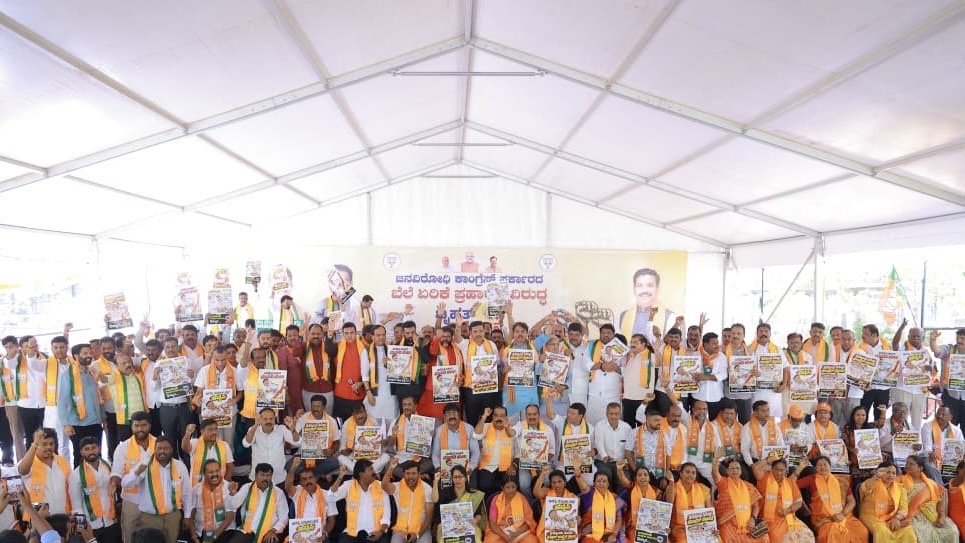
BJP protesting against the hike in milk prices and bus fares in Bengaluru on 11 November,

Synopsis: Both the Karnataka and Union governments owe Kannadigas transparent, data-backed justifications whenever essential prices and fares rise. Political opposition to price hikes is a vital democratic check, especially for commuters and consumers who fall outside welfare exemptions. However, true economic accountability requires looking beyond isolated sticker prices. Governance must ultimately be judged by the net financial security ordinary families retain after wages, direct welfare transfers, and essential living expenses are tallied together.
At a protest in Bengaluru on Wednesday, 11 November, BJP leaders demanded the Karnataka government immediately withdraw its recent hike in milk prices and bus fares, saying it has severely burdened ordinary citizens.
BJP state president BY Vijayendra called the price rise the government’s “sixth guarantee” and argued that the government should bear the additional ₹7 per litre paid to dairy farmers rather than pass the cost on to consumers. Yet judging these price revisions in isolation ignores the broader household balance sheet.
A family’s economic security depends not merely on the sticker price of goods and services, but on its net income, everyday expenses, and the public benefits it receives. That analytical standard must apply equally to both the state and Union governments.
Consider the 1 November revision in Nandini milk prices, which carries a clear redistributive design rather than a revenue-raising motive. While critics have pointed to steeper retail adjustments across dairy products like curd and ghee, the baseline toned milk price rose from
₹46 to ₹54 per litre.
Also Read: Karnataka hikes bus fares by 23% to 35%
For an urban household purchasing one litre daily, this adds ₹240 to monthly expenses. However, ₹7 of the ₹8 increase goes directly to dairy farmers, while ₹1 supports milk unions. A rural farmer supplying 10 litres daily stands to earn an extra ₹2,100 a month. Rather than filling state coffers, the consumer’s additional outlay transfers directly into the incomes of agricultural households grappling with rising cattle feed, fodder, and veterinary costs.
Similarly, the 4 November bus fare revision affects commuters unevenly across the state. The Karnataka government approved average hikes of 23% for KSRTC and other regional transport corporations, and 33% to 35% for BMTC, amid rising diesel, wage, and maintenance costs.
Male passengers, non-exempt commuters, and those paying luggage charges undeniably bear the brunt of these steeper ticket prices. Yet, according to the transport minister, women take approximately 74.4 lakh free passenger journeys daily under Shakti. For millions of working women, students, and daily wage earners who rely on public buses for mobility and livelihood, the effective fare remains zero.
Shakti is just one pillar of a wider social safety net that cushions household budgets against everyday inflation. Under Gruha Lakshmi, eligible women heads of households receive ₹2,000 monthly, or ₹24,000 annually. Gruha Jyothi eliminates or reduces qualifying domestic
electricity bills, Anna Bhagya bolsters household food security, and Yuva Nidhi provides temporary financial assistance to unemployed graduates and diploma holders.
For lower- and lower-middle-class families whose earnings leave thin financial margins, these programmes simultaneously supplement disposable income and lower fixed living costs.
When a household saves on electricity and bus travel while receiving direct cash support, a ₹240 monthly increase in milk expenditure looks markedly different on a net ledger. Evidence from household surveys demonstrates the financial importance of these guarantees.
A 2025 King’s College London study involving 2,045 women across 10 districts found that Gruha Lakshmi’s ₹2,000 monthly transfer represented 13% of household income among surveyed beneficiaries. The study also found that 94% of respondents surveyed about Gruha.
Jyothi savings to meet routine household expenses.
While the state’s ₹51,286 crore allocation for these guarantees in 2026–27, roughly 12% of total expenditure excluding debt repayments, warrants rigorous fiscal scrutiny and long-term sustainability planning, its immediate impact on household resilience and local consumption cannot be dismissed.
Also Read: Day after fare hike, BMTC bus pass rates raised by up to 25%
When the BJP critiques state-level price adjustments, its argument would carry more credibility if it applied the same standard to the Union government. In December 2025, Indian Railways raised passenger fares across several non-suburban categories, and in March 2026,
public-sector oil marketing companies hiked domestic LPG prices by ₹60 per cylinder. Indian Railways cited operational sustainability, while the Union government attributed LPG price pressures to international energy markets.
Yet unlike Karnataka, the Union government offers no comparable nationwide combination of monthly income support for eligible women, free ordinary bus travel and household electricity relief to offset these higher costs.
Disputes over central transfers add to the fiscal pressures the Karnataka government faces. In August 2025, then Chief Minister Siddaramaiah estimated nearly ₹80,000 crore in cumulative losses from lower tax devolution and unreleased grants. The figure represents the Karnataka government’s estimate of foregone resources.
A July 2026 parliamentary reply separately recorded ₹3,850.11 crore in unreleased Finance Commission grants for Karnataka’s rural local bodies, which the Union government attributed to unmet eligibility conditions. These grants are earmarked for local services, but the wider dispute over fiscal transfers affects Karnataka’s budgetary flexibility. More predictable central support could ease pressure on the state’s finances and improve its capacity to absorb rising costs without passing them on to consumers.
Both the Karnataka and Union governments owe Kannadigas transparent, data-backed justifications whenever essential prices and fares rise. Political opposition to price hikes is a vital democratic check, especially for commuters and consumers who fall outside welfare exemptions.
However, true economic accountability requires looking beyond isolated sticker prices. Governance must ultimately be judged by the net financial security ordinary families retain after wages, direct welfare transfers, and essential living expenses are tallied together.
(Views are personal. Edited by Majnu Babu).



