
Published Jul 21, 2026 | 2:57 PM ⚊ Updated Jul 27, 2026 | 3:15 PM

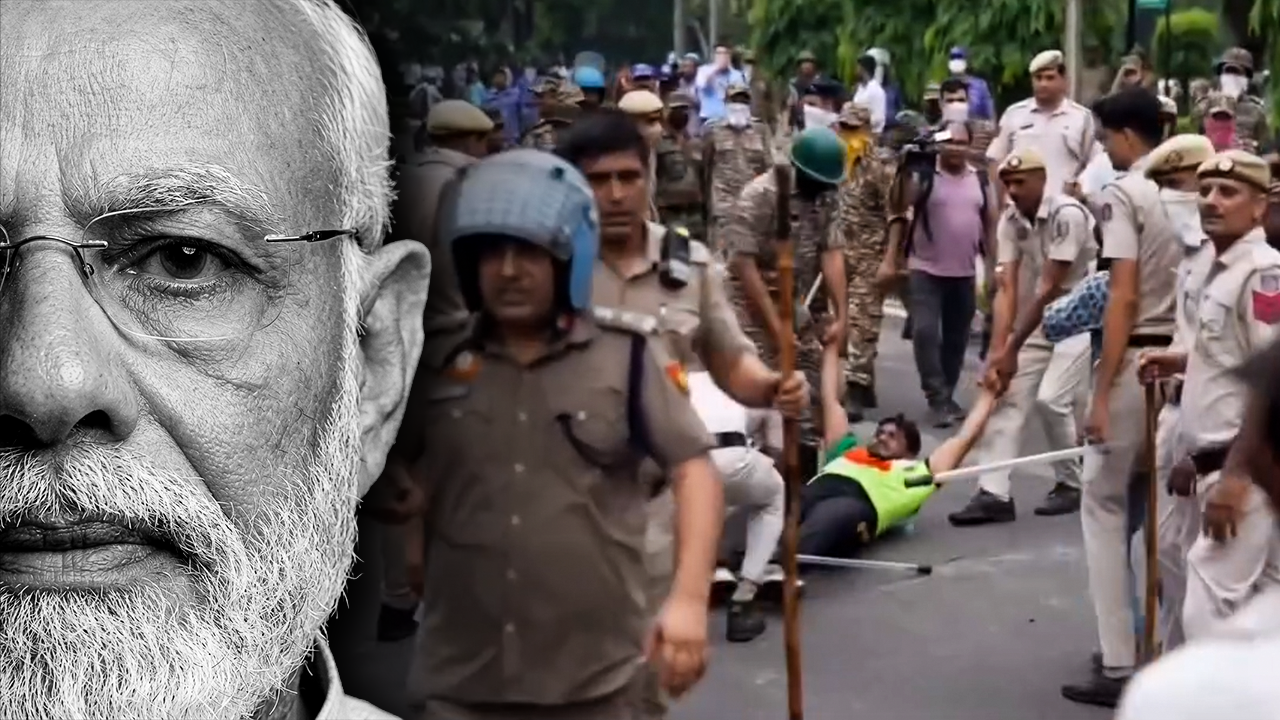
Opposition leader Rahul Gandhi is among the leaders who questioned the "brutality" unleashed on the students. Modi's maun vrat on the issue continues.

Synopsis: The insensitive treatment of protestors who poured onto Jantar Mantar on Monday was no surprise knowing the ruling dispensation’s playbook. For the Modi government, protests only matter when they fear it will cost them votes.
Visuals of tear gas shells filling the air, batons spiked with nails thrashing youngsters, defiant students standing up to a group of policemen challenging them to continue their assault, teary-eyed minors asking why the police—meant to protect them—were attacking them with brute force, angry protestors damaging police vehicles, protestors and police pelting stones at each other, protestors targeting lone police constables were some of the scenes that unfolded on the streets of New Delhi on Monday.
Thousands of protestors filled the streets of the national capital, toppled high barricades that had been welded together by Delhi police at Jantar Mantar to march towards the Parliament where the monsoon session had begun. Some of them managed to breach the security cordon and reach Raisina Marg, with security personnel aiming guns at citizens closer to the Parliament. By evening, over 100 people—protestors and police—were admitted to hospitals with fractures, deep wounds, and head and eye injuries. Most of the injured, including those critically wounded, were citizens. Police only acts on orders and on Monday their orders seemed to have been to use brute force. The Delhi Police comes directly under the Union Home Ministry headed by Amit Shah.
All of it was caught on cameras, but most of it reached citizens through their mobile phones, social media handles and not mainstream television channels until it all became too overwhelming to ignore.
Youngsters kept coming in waves despite internet shutdowns and prohibitory orders, shouting slogans against Prime Minister Narendra Modi and his cabinet colleague, Education Minister Dharmendra Pradhan. What started as solidarity with the Cockroach Janata Party (CJP) protest over exam paper leaks grew into a massive people’s movement to express dissent, disappointment, ask questions and demand accountability from the BJP-led NDA government at the Centre, going beyond the issues of exam mismanagement.
For any political party, the sudden surge of public outrage would raise multiple red flags, but this does not apply to the BJP under Narendra Modi.
Anger against the government spilling onto the streets is usually a sign of severe public frustration against the dispensation. Political parties, conventionally, read them as political threats that need immediate redressal. But not the BJP under Narendra Modi.
Not very long ago, in the same national capital of Delhi, the India Against Corruption (IAC) protests fueled a nationwide momentum to oust the then Congress-led UPA government despite then PM Dr Manmohan Singh’s government yielding to Anna Hazare’s hunger strike and bringing changes to the Jan Lokpal bill. The people’s movement would cost the previous dispensation dearly.
But for the BJP under Narendra Modi, things are different. For over 20 days, when Sonam Wangchuk sat on an indefinite hunger strike at Jantar Mantar, nobody from the government initiated a dialogue. The talks came only after Wangchuk was forcefully evacuated by the Delhi Police on the eve of the monsoon session in Parliament. It was too little, too late.
This is in keeping with a script. Every time there has been a public outcry or mass democratic protests against Narendra Modi, his government’s policies or his colleagues, the BJP-led dispensation’s reaction to it has been brutal crackdown, violent suppression, police excess and communication blackout. As desired, an anti-opposition ecosystem and media aids and abets in branding protestors ‘anti-national’, ‘anarchists’, ‘urban naxals’ etc. Dialogue, engagement or talks simply aren’t on the list. Modi himself, infamously referring to dissenters as “andolanjeevis” in Parliament, paints a perfect picture of the BJP’s take on democratic protests.
Democratic protest is not a language the BJP under Narendra Modi understands. It only speaks one language – electoral outcomes. As long as a people’s movement doesn’t make an electoral difference, it means little for the Modi dispensation.
Despite protest after protest, the BJP’s electoral victory juggernaut continues, giving it the confidence that it remains the popular choice of the largest section of voters irrespective of protests. Protests mean nothing to a political party if they don’t cost electorally. The BJP is a beneficiary of this feedback system.
Till date, the biggest setback—policy-wise—for the Modi government was when it was forced to repeal the three farm laws. It took 750 deaths of mostly farmers and a prolonged 24-month protest between September 2020 and November 2021 for the Modi government to swallow its pride and withdraw the bills. The protestors faced death, violence, digital takedowns, communication blackouts, police brutality, arrests and being branded “anti-nationals”, “khalistanis”.
The repeal came only after the BJP realised it was going to pay an electoral price if it didn’t yield. First, the BJP lost its ally in Punjab, the Shiromani Akali Dal (SAD), owing to the farm laws. They then paid an electoral cost in the 2024 Lok Sabha elections, losing seats in agrarian regions of Haryana, Rajasthan, Punjab and even Maharashtra.
The situation was different with the CAA-NRC protests. The crackdown on protestors in the national capital helped the BJP gain electorally, not just in Delhi but also in Assam. It, though, lost seats due to the Congress in states like Karnataka and Telangana.
For a BJP that takes pride in managing elections like clockwork and for a government whose home minister—Amit Shah—is hailed by mainstream media as a ‘Chanakya’ of political strategies, sadly, only number games matter. A host of activists and citizens have been appealing to the moral conscience and constitutional responsibility of the Narendra Modi government to pick dialogue over crackdown when dealing with protests. But when public outcry over unarmed students being thrashed by state machinery does not translate into electoral costs, the BJP has no reason to pay attention. Modi gets his validation from votes, not voices on the streets.
Also Read:
Chief Minister Vijay, Wangchuk and a collective swelling of chests
Addressing India’s exam crisis should be the target, not Sonam Wangchuk
(Edited by R Rajesh Kumar.)



