

Published Jul 21, 2026 | 11:46 AM ⚊ Updated Jul 21, 2026 | 11:46 AM

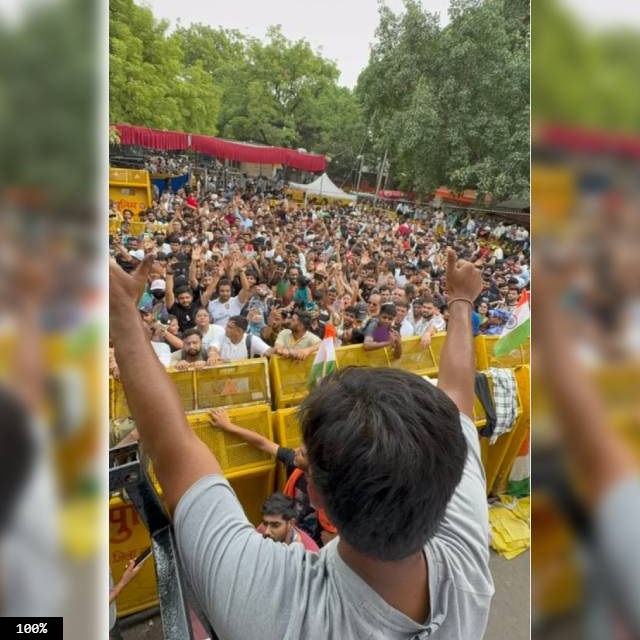
By refusing to be divided, labelled or silenced, this student-led movement has stripped the Modi regime of its standard playbook.

Synopsis: The Cockroach Janta Party began as a viral, satirical youth campaign after the “cockroach” remark by the Chief Justice of India (CJI), but what is now happening at Jantar Mantar and in the march to Parliament is a much broader, decentralised youth upsurge that has clearly spilt beyond the originating meme and organisation. This article was originally published in The Wire.
What began as online outrage over exam leaks has rapidly evolved into an offline generational revolt against a system that treats young Indians as disposable. By forcing the question of accountability all the way up to Prime Minister Narendra Modi himself, these students have turned Delhi’s streets into the one arena where power can no longer avert its gaze or hide behind procedure.
The students’ protest march to parliament marks a qualitative break from earlier agitations because they have turned a single‑issue exam scandal into a system‑wide indictment of Modi’s governance and institutional decay, led by a spontaneously politicised Gen Z.
Also Read: Parliament witnesses multiple adjournments; Dipke ends fast
The trigger remains the demand for Union education minister Dharmendra Pradhan’s resignation over repeated exam paper leaks, suicides and systemic failures, but the anger on the streets is now explicitly directed at Prime Minister Narendra Modi and his record over the past 12 years. Whether the education minister stays or goes has become irrelevant to the protesters, as the youth have directly turned the question toward Modi’s style of rule.
By shielding Pradhan despite his abysmal track record, Modi has made the protests a referendum on his personal leadership rather than a routine minister‑level accountability demand.
Also Read: Authorities planning ‘something heinous,’ says CJP’s Dipke
The Cockroach Janta Party (CJP) began as a viral, satirical youth campaign after the “cockroach” remark by the Chief Justice of India (CJI), but what is now happening at Jantar Mantar and in the march to the parliament is a much broader, decentralised youth upsurge that has clearly spilt beyond the originating meme and organisation. This movement isn’t standard political mobilisation driven by the organising capacity of the CJP or figures like Sonam Wangchuk. While individual leaders can sometimes be ‘managed’ or pressured by the establishment, this crowd consists of independent youth who arrived entirely on their own accord, not brought in on rented buses.
Even when confusion arose regarding terms for ending Wangchuk’s hunger strike, the students pushed past the rumours, proving that the movement has been completely taken over by the youth and cannot be easily negotiated away.
Also Read: Solidarity protests in Bengaluru, Hyderabad
Earlier mass movements were contained or delegitimised by the Modi government and Godi Media through identity‑based vilification. The anti-Citizenship Amendment Act protests were framed as “Muslim” unrest, protesting farmers painted as “Khalistanis”, and campus dissent labelled “anti‑national” or “Urban Naxal”. However, the present agitation is built around exam integrity, unemployment and institutional trust, issues that cut across caste, religion and region.
The protesters are overwhelmingly students and young job‑seekers drawn from mainstream aspirational India, including job aspirants and urban professionals, which makes it far harder to slot them into an enemy category without alienating the very demographic that powered Modi’s political rise. The crowd is also deeply diverse, cutting across religious lines, and the students are explicitly staying hyper-vigilant to maintain absolute peace, explicitly stating they will not give the Godi Media any excuse to label them as violent agitators. This movement, thus, completely defies the old demonisation strategy of the Modi regime, around a specific identity axis.
Also Read: Addressing India’s exam crisis should be the target, not Wangchuk
The origin story of the CJP itself is an indictment of the higher judiciary. Though the CJI “clarified” whom he meant when he said “parasites”, the “cockroach” remark crystallised a sense that even the highest courts were treating unemployed youth with contempt, and subsequent lack of substantive judicial relief on exam leaks reinforced the feeling that legal avenues are exhausted. A primary driver for people taking to the streets is the realisation that traditional institutional safety valves – specifically big media, the parliament and the judiciary – have collapsed.
Big TV channels are actively downplaying, ignoring the massive crowds, or actively trying to demonise the protestors. The memory of past protestors languishing in jail for years without bail remains fresh. Because the systems meant to address democratic grievances have shut their doors, the public has felt entirely forced to occupy the streets of Delhi directly to push for change.
Also Read: Chief Minister Vijay, Wangchuk and a collective swelling of chests
For a month, the government attempted to completely stonewall the students, refusing to send a single minister, legislator, or secretary to establish a dialogue. The protesters are articulating an insistence that the Modi government must be answerable to the people on basic questions: who is responsible for repeated exam failures, what reforms will be undertaken and why no minister has accepted responsibility despite lives being lost. By refusing to let the issue fade into the admission cycle of colleges, the youth are forcing a hard line on political accountability that the Modi regime is finding impossible to deflect. The massive influx of youth in protest has forced the issue of systemic corruption, continuous paper leaks and the decay of affordable public education right to the front door of the political leadership through the march to Parliament.
Also Read: Will Gen Z’s Cockroach Janata Party forge a new Janata dispensation?
The Modi government’s response so far has been a mix of silence, procedural stonewalling and dismissive rhetoric. That strategy, which worked against fragmented or easily stigmatised movements, now makes the government appear like a deer caught in the headlights: unwilling to negotiate, unable to crush a visibly peaceful youth‑led protest and confronted by a generation that has already proved it is here for the long battle.
Even though the regime and its apologists find the fear hard to articulate, they know what the youth have achieved through street protests in various countries when their voices were not heard.
Also Read: Gen Z in India vs the system
What makes this moment fundamentally different is that the public is no longer appearing terrified. Despite heavy police deployment, massive surveillance cameras and the use of tear gas and force, the sheer volume of everyday citizens broke the atmosphere of intimidation. People didn’t just step out of their homes. They stepped out and converted individual isolation into a loud, collective voice.
By refusing to be divided, labelled or silenced, this student-led movement has stripped the Modi regime of its standard playbook, leaving the political leadership, which banks on Modi’s ‘strongman’ image, looking visibly unsettled and facing an unavoidable crisis of accountability.
(This article was originally published by The Wire on 20 July).



