
Published Jun 20, 2026 | 7:00 AM ⚊ Updated Jun 20, 2026 | 7:00 AM

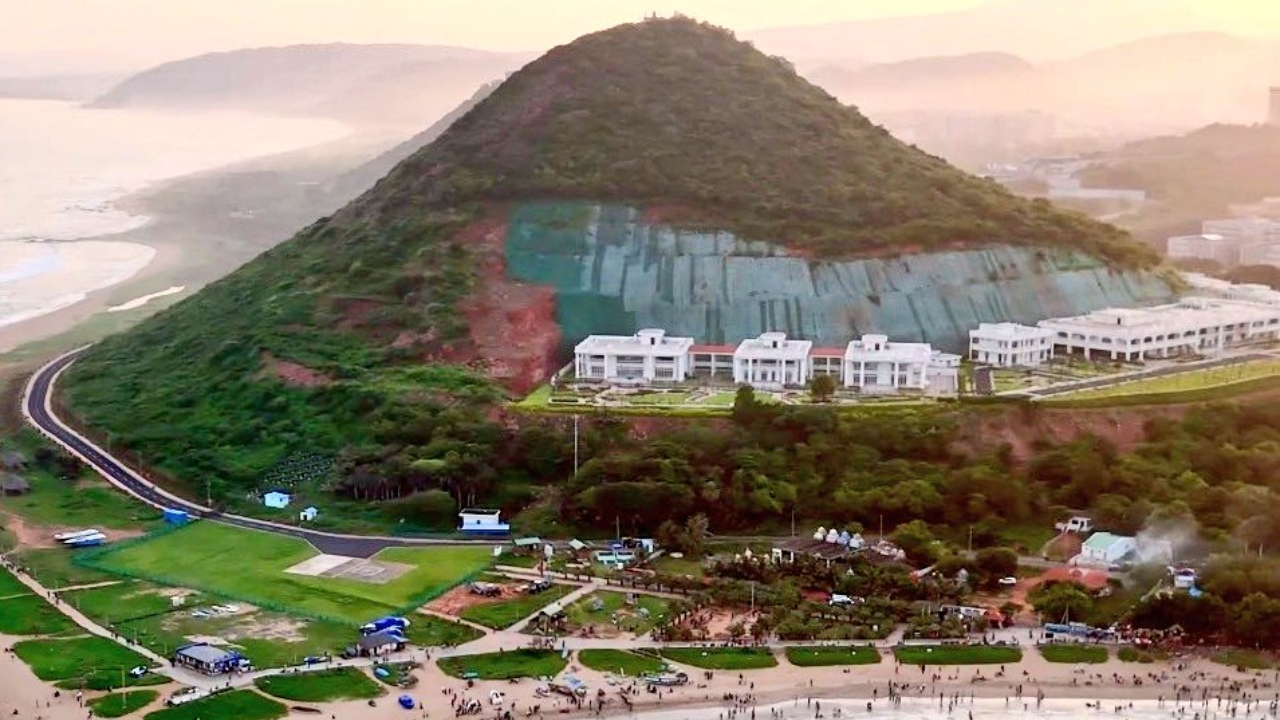
The Rushikonda project has turned into one of the most contentious in the past two years. (File Photo)

Synopsis: Many crores have been spent till now on the idle Rushikonda buildings in Visakhapatnam. Critics have questioned the Naidu government’s delay in arriving at a decision about its future—a question whose answer holds importance when it comes to AP’s developmental aims too.
Public controversies are an inevitable part of democratic governance. Governments inherit projects from their predecessors, reassess priorities and confront the challenge of reconciling political commitments with administrative realities. However, prolonged indecision can be as damaging as flawed decisions.
The continuing uncertainty over the future of the Rushikonda buildings in Visakhapatnam is increasingly emerging as a reminder that delays in governance carry costs that extend beyond finances. They influence public confidence and shape perceptions about the ability of governments to deliver on larger promises.
The latest we have after two years of uncertainty is a plan by the state’s Group of Ministers panel to recommend the development of the complex as an international-standard luxury resort under a Public-Private Partnership (PPP) model. But it still needs to reach the Cabinet and the decision needs to be taken after that.
The controversy surrounding Rushikonda predates the present administration.
During the previous YSR Congress Party regime, the old AP Tourism Haritha Resort located on the environmentally-sensitive Rushikonda hill was demolished and replaced with an ultra-modern complex. The project soon became among the most contentious in Andhra Pradesh, triggering allegations of environmental violations, excessive expenditure and misuse of public resources. Opposition parties, particularly the Telugu Desam Party and Jana Sena Party, repeatedly described the structure as a palace built with taxpayers’ money and assured the public that a thorough inquiry would be undertaken once they came to power.
When the NDA government assumed office in June 2024, expectations were naturally high. The Rushikonda complex emerged as one of the first major issues demanding attention from the new administration. Senior leaders and officials conducted inspections and reviewed legal, financial and environmental aspects. Deputy Chief Minister Pawan Kalyan undertook official visits to the site and directed officials to examine options for public utilisation. Chief Minister N Chandrababu Naidu also personally inspected the complex and instructed departments to prepare proposals after studying various aspects relating to expenditure and legality.
Months turned into years, but the fundamental question remained unanswered. What should be done with the buildings?
Successive review meetings involving the Tourism, Finance, Revenue and Law departments attempted to arrive at a solution. In August 2025, the State Cabinet constituted a Group of Ministers headed by Tourism Minister Kandula Durgesh to recommend a permanent utilisation plan after examining the expenditure involved, legal concerns, environmental issues and tourism potential. While committees are intended to facilitate informed decision-making, their effectiveness ultimately depends on the timeliness of their recommendations and the willingness of governments to act upon them. In the absence of visible outcomes, repeated inspections and reviews have increasingly contributed to a perception that the process itself has become an end rather than a means.
The financial implications of this prolonged uncertainty have also become difficult to ignore. During discussions in the Andhra Pradesh Legislative Assembly, the government disclosed that nearly ₹25 lakh is being spent every month merely towards maintenance. Despite the absence of any revenue generation, close to ₹4 crore has reportedly been spent over the last two years simply to maintain the idle structures.
Members belonging to different political parties participated in an extensive debate on the issue and offered several suggestions. Against this backdrop, the subsequent formation of committees has led sections of the public to view the exercise as one of postponement rather than resolution.
More importantly, questions are increasingly being raised about whether the uncertainty has allowed the issue to remain politically useful.
Critics argue that beyond using the controversy to corner the opposition YSR Congress Party, the government has shown little urgency in arriving at a final decision. Such perceptions gain strength because the issue does not involve the creation of a new asset but the utilisation of an already completed one. For a leadership with decades of political experience and several years in government, many believe that arriving at a clear and definitive course of action should not have required two years of deliberations.
The significance of the Rushikonda issue extends far beyond the fate of a single property. Governments are ultimately judged not by the number of inspections they conduct or committees they constitute, but by their ability to take decisions and execute them. Administrative credibility rests on timely action. Even well-intentioned governments risk appearing hesitant when decision-making becomes prolonged and uncertain.
Experience across the world demonstrates that controversial or underutilised public assets need not remain liabilities. Governments have often converted such properties into convention centres, tourism facilities, educational institutions and public service establishments. Once investments have been made, the challenge lies not in revisiting the past indefinitely but in ensuring that those assets are put to productive use in a manner that serves the public interest.
It is this larger context that explains why the Rushikonda issue has acquired significance beyond Visakhapatnam.
At the ground level, sections of the public increasingly view the episode as a reflection of administrative capacity. If a government finds itself unable to decide on the utilisation of a single completed structure even after two years in office, questions naturally arise over its ability to execute larger and far more ambitious projects.
This becomes particularly relevant in the context of Andhra Pradesh’s developmental aspirations.
The State government has repeatedly articulated its vision of transforming Amaravati into a world-class capital and creating infrastructure comparable to international standards. Such ambitions undoubtedly require sustained investments and long-term planning. Equally important, however, is the need to inspire confidence through visible execution. Citizens are more likely to trust transformative promises when they witness decisive action in matters that are already within the government’s control.
The Rushikonda episode is therefore no longer merely about architecture or politics. It has evolved into a broader test of governance. The issue presents an opportunity for the government to demonstrate administrative clarity and decisiveness. A time-bound resolution supported by transparency regarding expenditure and legal considerations would not only bring an end to prolonged uncertainty but also reinforce confidence in the government’s larger developmental agenda.
Ultimately, governance is measured not by the scale of promises made but by the ability to translate intentions into outcomes. In that sense, the story of Rushikonda is not simply about a building overlooking the Bay of Bengal. It is about the expectations citizens place on governments and the importance of ensuring that decisions do not become casualties of delay.
Also Read:
The silent anti-incumbency building in rural Andhra
Andhra Pradesh dreams of AI while millions cannot read
(Edited by R Rajesh Kumar.)



