

Published Aug 31, 2026 | 1:00 PM ⚊ Updated Aug 31, 2026 | 1:00 PM

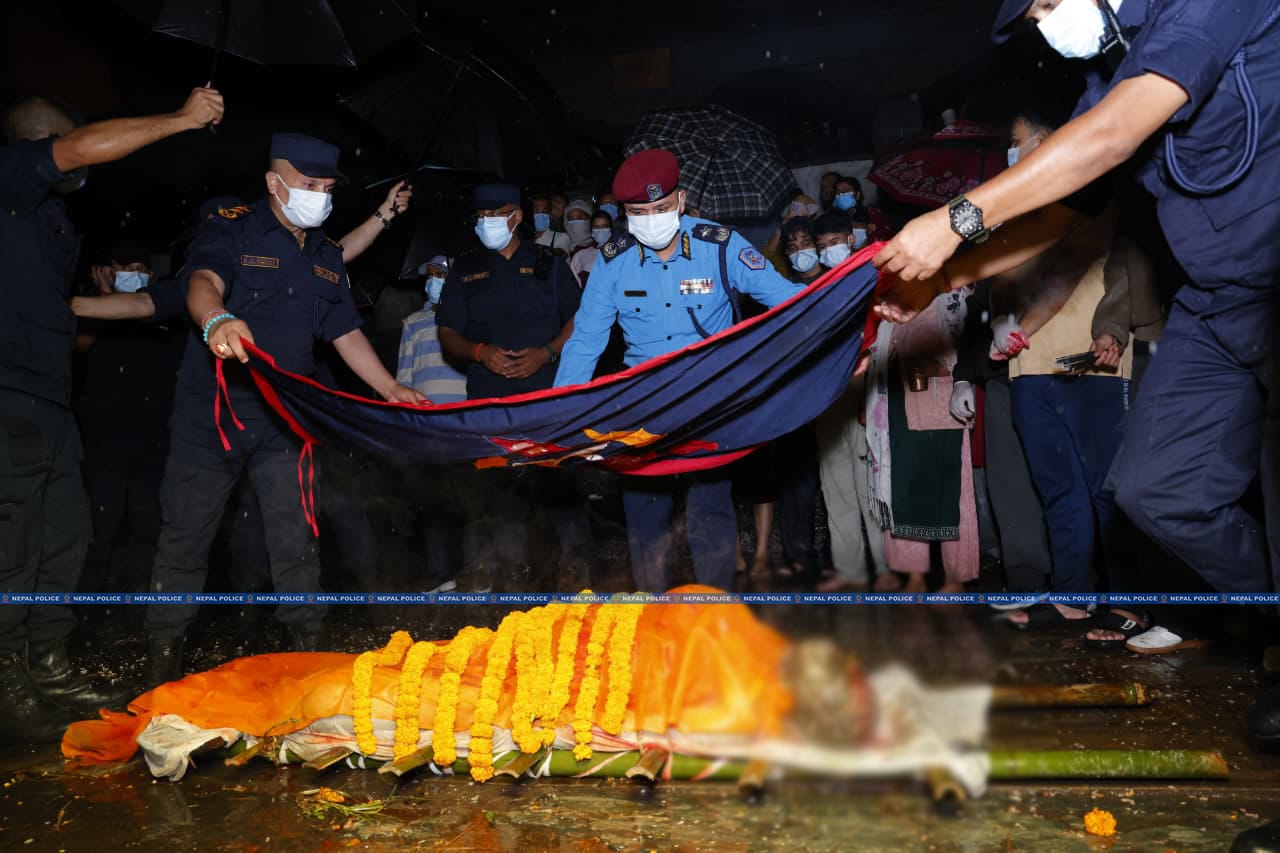
Nepal Police paying tribute to SI Timure and Inspector Ram Hari Khadka, who lost their lives in the flash floods. (Courtesy: Nepal Police)

Synopsis: What made the Bhote Koshi tragedy so devastating was its scale and speed. The flash floods hit with almost no warning. In contrast was what happened in Switzerland last year, where experts were able to deliver a warning weeks in advance. The Himalaya is not the Alps, but it needs similar practical solutions—shared data, joint early-warning systems and cooperation that puts the logic of the terrain above the logic of territorial dispute.
On the morning of August 26, in the high, narrow gorge where the Bhote Koshi river crosses from Tibet into Nepal’s Rasuwa district, a section of glacier and rock let go on the flank of the Langtang Himal. It fell into the headwaters of the Lende Khola, a small tributary, dammed it briefly, and then broke through. Within minutes, a wall of water, ice and debris tore down sixty kilometres of valley—through the Rasuwagadhi border post, the trading town of Timure, the Langtang trekking gateway of Syabrubesi, and onward through Nuwakot, Dhading and Chitwan, where the swollen Trishuli finally spread its fury across the plains.
Water levels are reported to have risen by as much as nine metres in half an hour. Over 900 people have been confirmed dead across Nepal and the Tibetan side of the border, with close to 2,500 still missing—among them pilgrims bound for Mount Kailash, trekkers, and nearly a thousand hydropower workers caught in tunnels and project sites. The dead and missing include citizens of over a dozen countries, from India and the United States to the United Kingdom and Malaysia. It is, by any measure, one of the gravest Himalayan disasters in living memory.
Faced with a tragedy of this scale, there is an instinct—in newsrooms, on television panels, on social media—to explain it immediately, and often to explain it wrongly. In the days since, we have heard three kinds of commentary that deserve to be named and set aside.
The first is the reflex to reach for large, generic causes—climate change, deforestation, unchecked infrastructure—and offer them as though they were sufficient explanations for this specific event, in this specific gorge, on this specific morning. These forces may well be part of the wider story of a warming, destabilising Himalaya. But invoking them as an instant verdict, before the facts are even in, explains nothing and helps no one; it merely lets commentators sound wise while actual families wait by riverbanks for news of the missing.
The second is worse: the temptation to manufacture suspicion between the two countries sharing this border, to suggest fault or concealment where evidence does not yet exist.
The third, worst of all, is to drag in old grievances about river basins, territory and general national “attitudes”—to use a human tragedy as a vehicle for an entirely different, pre-existing argument. Fishing in troubled waters, as it were, at the cost of people who are still being pulled from mud and debris.
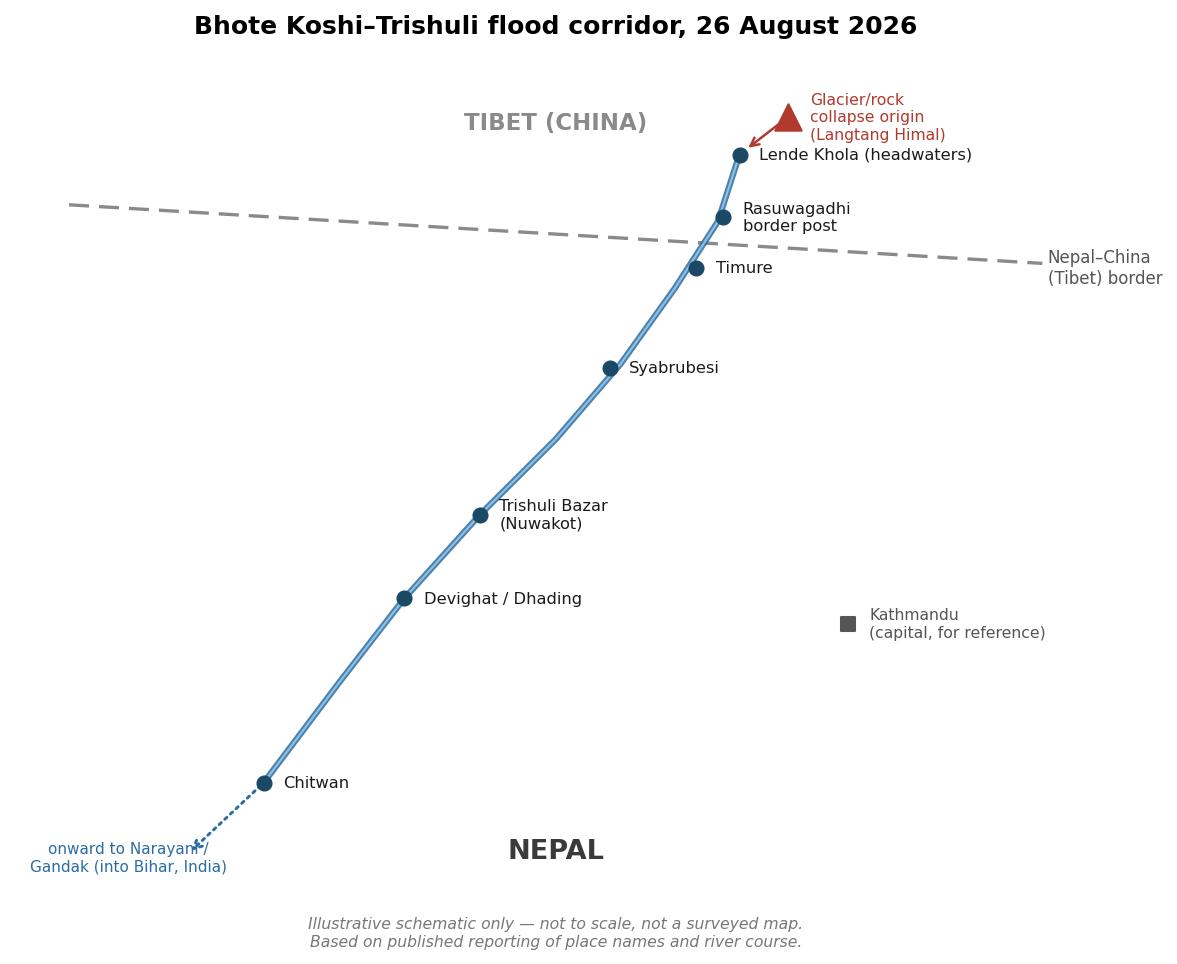
Fig. 1 — Schematic of the flood corridor along the Bhote Koshi and Trishuli rivers, from the Lende Khola headwaters near the Nepal–China border down t
What this moment actually calls for is restraint, solidarity and quiet, practical cooperation—sometimes simply less noise, more support, and space for grief. Basic compassion for those who have lost everything, and for the two governments and their rescue services working through impossible terrain, ought not to be a difficult thing to summon. It should not need to be argued for. That it apparently does says something about where public discourse has drifted.
None of this means the disaster is without lessons—only that the honest lessons are narrower and more useful than the loud ones.
The preliminary scientific picture, reconstructed from satellite data and seismic records, is instructive in itself.
Initial reports spoke of an earthquake triggering the flood; the seismic signal recorded that morning has since been reclassified—not as a tectonic quake, but as the shaking generated by the landslide itself, a mass of ice and rock large enough to register on instruments around the world. Roughly a hundred million cubic metres of debris-laden water are estimated to have come down that gorge. This is the pattern such disasters increasingly follow: a temporary, unstable dam of ice and debris high in the mountains, invisible from any populated area, holding back water until it can no longer bear the weight, and then releasing it all at once, with no rainfall and almost no warning at ground level.
This is not, in fact, unheard of in these mountains.
Nepal itself recorded severe glacial lake and flash-flood events in 2024 and 2025, and researchers have been warning for years that the eastern Himalaya is dotted with hundreds of glacial lakes in various states of instability. What made this event so devastating was not that it was unprecedented in kind, but that its scale and speed outran every available window for warning.
It is worth setting this against what happened in Switzerland only last year.
In May 2025, geologists monitoring the Birch Glacier above the village of Blatten, in the Lötschental valley, observed the ice accelerating alarmingly—moving several times faster than normal—and warned that a major collapse was likely within a period of weeks. Authorities evacuated the roughly 300 residents of Blatten and the neighbouring hamlet, moving out livestock as well, well before the glacier broke apart and buried some ninety per cent of the village under millions of cubic metres of ice, rock and mud.
The one person who died was a shepherd who had chosen to remain outside the evacuation zone despite the warnings. A temporary lake that formed behind the debris was subsequently managed and released in a controlled manner to avoid further damage downstream. Switzerland could not stop its glacier from collapsing. What its investment in monitoring technology and its institutional capacity to act on warnings gave it was time—weeks, not minutes—and in a mountain disaster, time is very nearly the whole difference between evacuation and catastrophe.
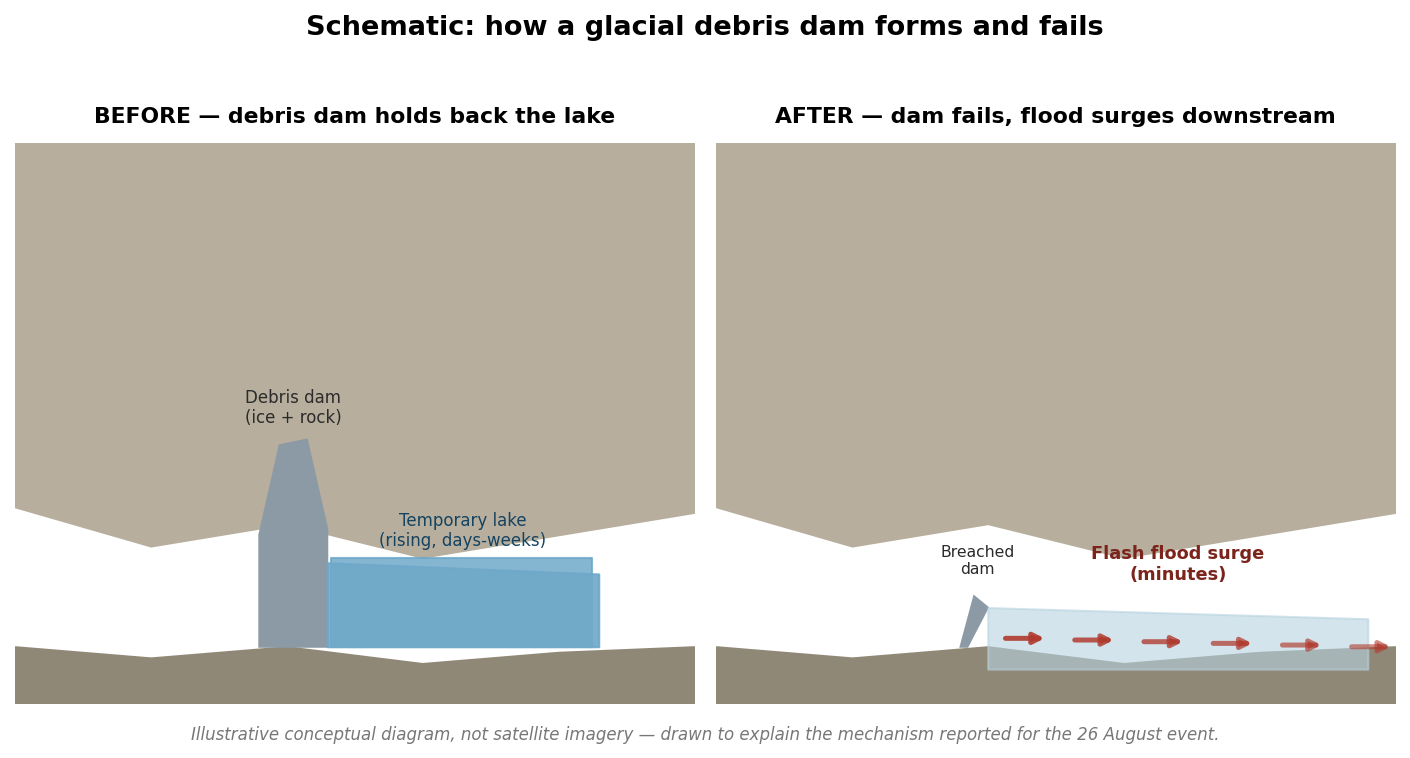
Conceptual before/after diagram of a glacial debris-dam failure, the mechanism preliminarily reported for the August 26 flash flood.
The Himalaya is not the Alps: the terrain is vaster, the settlements more numerous and remote, the instrumentation far thinner on the ground, and—critically—the mountains and their glacial lakes sit astride an international boundary that has never been an easy one to cross, even for scientific data. That, rather than any single generic cause, is the lesson worth drawing from this tragedy, and it points to three practical conclusions.
First, disasters of this kind can only be anticipated and managed through active cooperation between the countries of the region—shared monitoring data, joint early-warning institutions, and the basic trust required to sustain them. Glacial lake outburst floods do not respect the border they happen to sit near; a debris dam forming on one side of a ridge can devastate villages fifty kilometres away on the other side.
Second, this is a reminder that in ecologically sensitive high-mountain zones, the logic of the terrain must increasingly take precedence over the logic of territorial dispute. River basins, and the glaciers that feed them, do not recognise the lines drawn by colonial-era surveyors or subsequent political settlements. Cooperation here need not wait for every boundary question to be resolved; it can and should proceed through river-basin commissions and local-level mechanisms built specifically around the shared hazard, alongside—not contingent upon— the slower business of diplomacy.
Third, such events are likely to recur, and perhaps grow more frequent, for reasons that will be debated for years. The more urgent task is not assigning blame but building the practical means—satellite monitoring, shared seismic and hydrological data, joint response protocols—that let neighbouring communities act on warning, whatever its ultimate cause.
Also Read | A saree that stood between survival and death: Tamil survivors recount horror of Nepal floods
On the ground, the response itself offers a small counterweight to the gloom. Rescue operations are now in their sixth day, complicated by fresh rain and rising river levels that have twice forced brief suspensions. A second debris-formed lake upstream, closely watched by both governments, had largely drained by Saturday evening. Nepal’s National Disaster Risk Reduction and Management Authority has reported more than 7,500 people rescued so far, and army and police teams have kept working through the night at hydropower sites such as Trishuli-3A, pumping air into flooded tunnels in the hope of reaching workers trapped inside.
Nepal has been clear that it is managing the core search-and-rescue effort itself, while explicitly welcoming targeted foreign expertise—Indian and Chinese specialists are working alongside Nepali teams on the technically difficult task of opening blocked tunnels, and Kathmandu has asked for international help specifically with DNA testing, forensic identification and refrigerated storage for the recovered dead, an area where capacity is genuinely stretched. China, for its part, has mobilised more than 2,100 rescue personnel on its side of the border and is coordinating with Nepal on identifying the missing.
The wider response has also been notably international and, it must be said, notably cooperative rather than competitive: India despatched a military aircraft with ten tonnes of relief material—shelters, blankets, hygiene kits, solar lamps, medicines—within days, with Prime Minister Narendra Modi personally assuring his Nepali counterpart of support; the United States has raised its humanitarian pledge to $3.6 million; Australia has committed a similar sum along with extra consular staff; the UN’s emergency fund has released $2 million and UN staff are supporting relief efforts on both sides of the border; and the International Federation of Red Cross and Red Crescent Societies has released a further 1.2 million dollars in emergency funding.
None of this is a substitute for the institutional, data-sharing cooperation this article argues for—but it is a working demonstration, in real time, that when the mountains themselves set the terms, neighbouring and distant nations alike can still choose cooperation over suspicion.
There is a final, human dimension to this tragedy that deserves attention. More than a dozen nationalities are among the dead and missing, in one of the remotest corners of the Himalaya—pilgrims travelling toward Kailash, trekkers on the Langtang trail, migrant labourers building hydropower plants, and residents of villages many outsiders had never heard of before this week. It is a striking reminder of how interconnected our lives have become, even at the world’s edges: people seeking faith, adventure, or simply a livelihood, converging in a valley that a glacier chose to fall into. It carries real economic weight too, for local communities and national economies whose fortunes are tied to tourism, pilgrimage and energy infrastructure in exactly these fragile zones.
Whatever the eventual technical findings on what precisely triggered the collapse of that ridge above the Lende Khola, the deeper truth this disaster leaves us with is an old one, restated in the plainest possible terms: our engineering and our economies, however formidable, remain modest before the mountain. That humility—shared, in different words, by science, by faith and by the communities who have lived in these valleys for generations — is what should now guide how the countries of this region build, monitor and cooperate in the places where the earth is least forgiving. The dead of Bhote Koshi deserve at least that much from the living.
Also Read:
Nepal flash floods: When the Himalayas bled…
The UN didn’t fail. That was the point.



