

Published Aug 29, 2026 | 4:05 PM ⚊ Updated Aug 29, 2026 | 4:38 PM

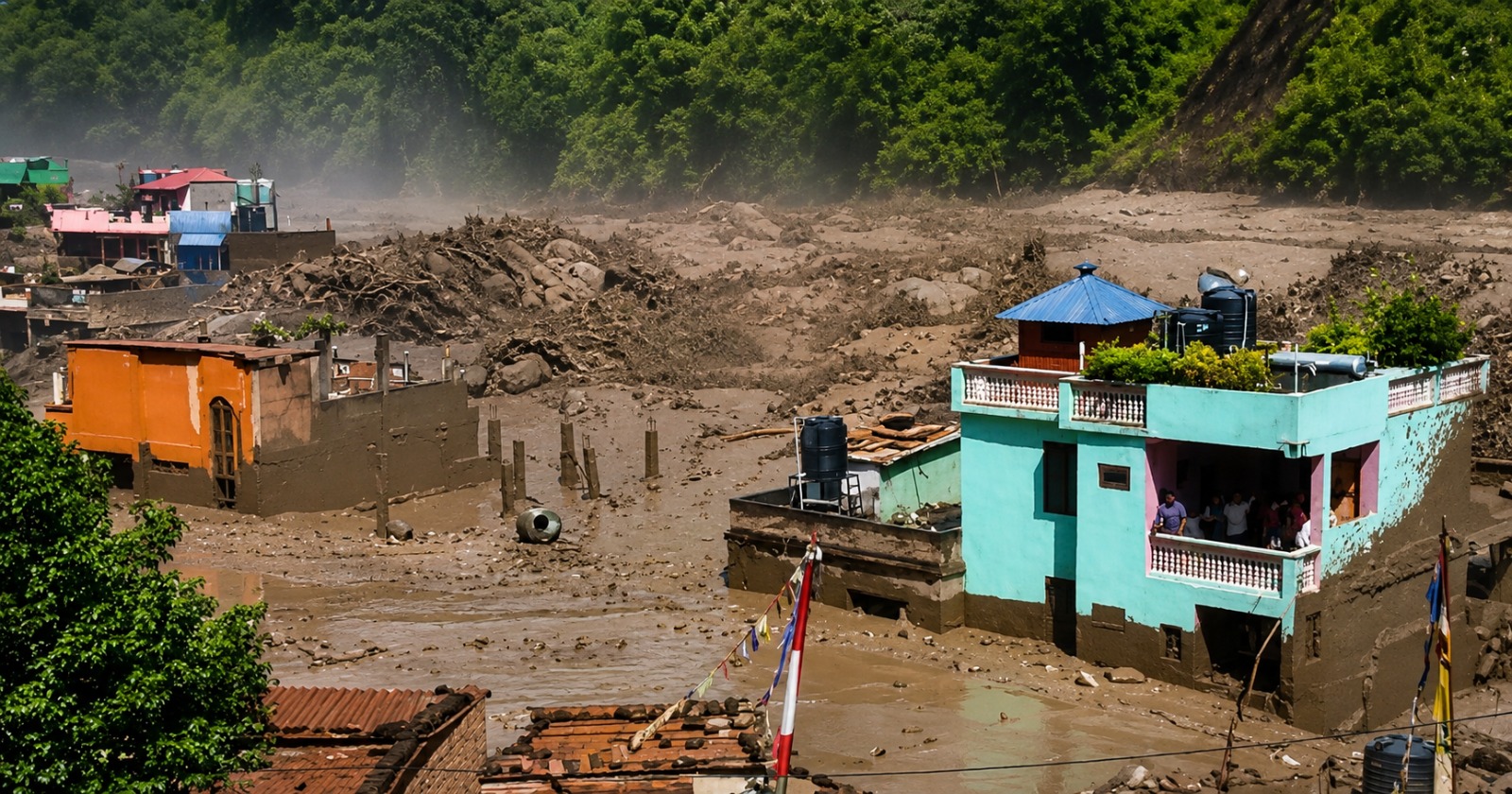
The questions the flash floods raise are not for Nepal alone. India must answer them too. (Photo | Special Arrangement)

Synopsis: A disaster like Nepal’s changes not only the physical landscape. It changes the geography within a person. The distance between home and fear becomes smaller. The distance between the river and death becomes smaller. And memory sits for a very long time at the place where a home once stood.
When I saw the news from Nepal on the morning of August 26 about the tragedy that has by now claimed over 600 lives and left over 2400 people missing, it took me a while to understand what exactly had unsettled me so deeply. There were names in the report: Rasuwa, Timure, Syabrubesi, Bhotekoshi, Trishuli. There were numbers. There were photographs.
Brown water coursing violently between the mountains, carrying pieces of wood, rocks, sheets of metal and perhaps parts of homes that had existed only hours before. A road had disappeared somewhere. In another image, only a fragment of a bridge remained.
A building beside the river stood broken, as if something had hollowed it out from within. The language of the news called it a disaster. But the language of memory called it something else. Perhaps a home. Perhaps an old courtyard. Perhaps a road along which, as a child, I had walked without ever thinking that one day a line on a map would call it a road between two countries.
Floodwater is never merely water. It carries with it the debris of the mountain, rocks, trees, soil, roads and everything built by human beings that believed it could withstand the river. This time too, the sudden surge of the Bhotekoshi altered much of what lay in its path.
Settlements such as Timure and Syabrubesi were affected. Road links were disrupted. Bridges were damaged. Hydropower projects suffered losses. People went missing, and one of the greatest challenges before rescuers was reaching those who were suddenly cut off because the very roads and bridges through which help would have arrived had disappeared into the river.
Perhaps the most terrifying thing about a flood is that it does not merely destroy a home. It can erase the road to that home as well. The bridge from which rescuers would have arrived is no longer there. The road along which an ambulance might have come has become a wall of mud and rock. The mobile tower through which a family might have received news of a missing member falls silent. In the mountains, disaster becomes even more unforgiving because geography itself can stand in the way of rescue.
The full picture of the August 26, 2026, disaster is still emerging.
The US Geological Survey now says that a “glacial collapse”—when a glacier or part of a glacier disintegrates—in Langtang National Park sent a sudden volume of water and debris gushing into the Bhotekoshi. The surge then travelled downstream, joined the Trishuli and moved towards the Narayani river system. Scientific investigation is still underway, and it would be premature to reduce the event to a single cause or two causes. But the images and early reports are enough to remind us how little time a mountain disaster sometimes needs to become a human catastrophe.
A few hours can be enough. For a house. For a road. For a bridge. For a family.
Human beings spend years building a home, and a river can carry it away in minutes. This is not a romantic spectacle of nature’s power. It is a picture of human vulnerability. People who live in the mountains understand this vulnerability better than most of us do. They know that a mountain may appear permanent while constantly changing within. Snow melts. Slopes shift. Rivers alter their courses. Rocks give way. And sometimes something we have imagined to be stable for thousands of years changes its form in a single night.
Yet modern civilisation has increasingly looked at the mountains as resources. Roads. Tunnels. Dams. Hydropower. Tourism. Investment. Development. We must remember that the mountains existed before all of these, and they will remain after them. The question is whether we will learn how to live with them.
I come from Madhubani in north Bihar. That introduction is geographical, but it is also cultural. For me, Mithila has never been merely an administrative region. It is a place made of voices, songs, relationships and journeys that do not possess clear borders.
Nepal, therefore, was never a distant country in my childhood. Travelling towards Nepal never felt like entering another world. Much of the language sounded familiar. The faces seemed known. The voices in the markets carried something of home. The names of the gods were familiar. The emotions in wedding songs were familiar. The seasons were the same. Even the smell of the soil knew nothing about an international boundary.
Perhaps that is when I first understood that a map and the ground beneath our feet are not the same thing. A map has a line. The ground has a river. It has people. It has memories. And sometimes it contains an entire life.
Also Read: A saree that stood between survival and death: Tamil survivors recount horror of Nepal floods
In Mithila, rivers have never been seen merely as water. They are memory. They are fear. They are life. They are death as well. The very name of the Kosi awakens memories in countless villages of north Bihar. The Kamla. The Bagmati. The Gandak. For people living along these rivers, the river is both a message about the weather and a warning about the future.
Perhaps the geography of a flood can best be understood by looking at the farmer who returns to his field after the water has receded. The field is still there, but it is no longer the same field. Seeds may have been washed away with the fertile topsoil. In some places, a thick layer of sand may have settled. Somewhere, the edge of the field has collapsed. And the farmer may stand there for a long time, looking at the place where his crop had stood only days before.
In photographs of disasters, I often notice small things more than large ones. A single slipper. A broken window. A book lying in the mud. A child’s schoolbag. The remaining frame of a door.
These objects are not dead. Life remains inside them.
A slipper tells us that a child was there. A book tells us that someone once imagined a future there. A doorframe tells us that there was once a home, and that people once returned to it.
Statistics tell us how many people were affected. Objects tell us who those people were. That is the difference between news and memory. News says that so many people are missing. Memory asks: what were their names? News says that so many homes have been destroyed. Memory asks: who lived in those homes?
I think the hardest task after a disaster is not clearing the debris. Debris can be removed. Roads can be rebuilt. Bridges can be reconstructed. Houses can be built again. What is much harder is convincing a human being that they are safe again.
For the child who has watched a river swallow a home, the next rain will never be just rain. For the mother who has searched for her child in the rubble, a river will never again be merely a river. For the farmer whose fertile soil has been washed away, a field will never again be just land.
Disaster changes not only the physical landscape. It changes the geography within a person. The distance between home and fear becomes smaller. The distance between the river and death becomes smaller. And memory sits for a very long time at the place where a home once stood.
Perhaps this is why Mithila’s culture contains so many songs of displacement and waiting. The memory of Sita lives within this cultural landscape as well. The relationship between Janakpur and Mithila was not created by a modern border commission. It was created in the memory of the people.
The story of Sita too contains a home. A departure. A forest. A long waiting. And finally, the desire to return.
Perhaps that is why the people of Mithila can instinctively understand the grief of those whose homes are suddenly taken away from them. The true test of a culture does not come during its festivals. It comes when its neighbour is in distress. What has happened in the mountains of Nepal reminds us that shared culture is not merely about sharing a language, rituals or gods. Shared culture also means recognising one another’s grief.
Also Read | ‘We’re finished, Arjun’: The human cost of Nepal’s worst flash flood
But compassion alone is not enough. This is where the harder questions begin.
Are we understanding the Himalaya in its full ecological context? Do we have adequate early-warning systems for sudden floods and landslides? Do we have sufficiently rapid exchange of information across the border about river levels, glaciers, glacial lakes and unstable mountain slopes? Does scientific information reach local communities early enough to save lives? And does our present vocabulary of development give adequate importance to the carrying capacity of the mountains?
These questions are not for Nepal alone. India must answer them too. Bihar, in particular, must. Because there is no space between the Himalaya and Bihar. There are rivers. And the rivers keep filling that space.
I have always felt that to understand a river, one should follow it from its source to its final destination. Only then does one realise that a river is never alone. Mountains travel with it. Forests travel with it. Villages and cities travel with it. Farmers’ fields travel with it. Fish travel with it. Children’s voices travel with it. Temple bells travel with it.
And sometimes, so do bodies.
We have divided rivers into our respective portions. The river itself has never divided. That is perhaps our greatest paradox. Politically, we are separate, but ecologically we depend upon one another. We live in different countries, but we are affected by the same rain. We belong to different administrative systems, but we stand beside the same river.
For now, rescue and relief in the mountains of Nepal are the immediate priority. The missing must be found. The injured must receive help. Displaced families need shelter. Roads and communications must be restored.
But when reconstruction begins, rebuilding exactly what existed before will not be enough. Sometimes a disaster forces us to ask where and how we are living. Where homes should be built. Where roads should not be built. Which slopes must be left alone. Which rivers must be given space to breathe. Which settlements may need to move to safer ground.
Reconstruction cannot mean merely restoring the past. Sometimes it must mean making the future safer.
Cross-border disaster management, therefore, can no longer remain merely a matter of official cooperation. Nepal and India need stronger systems for real-time exchange of river and weather information, better early-warning mechanisms, satellite monitoring and communication that can reach communities before the water arrives. An event in a remote Himalayan valley can become a danger to the plains within hours. In such a situation, even one hour of information can become the difference between life and death.
And yet, while thinking about Nepal’s tragedy, my mind keeps returning to Madhubani.
The soil. The language. The old roads. The relationships. And the rivers whose names a child could recognise without ever opening a geography textbook.
Today, the maps are clearer than ever. But perhaps the geography within us has become blurred. We have learnt the borders very well. We have forgotten the rivers. We have remembered countries. We have forgotten the neighbourhood. We have remembered numbers. We have forgotten names.
Perhaps the deepest lesson of this disaster is that we need to learn again how to read a living landscape in which human beings do not exist alone. A landscape where mountains and plains understand one another’s grief. Where a river has no citizenship. And where a home washed away in Nepal can open a door in the memory of someone in Madhubani.
Behind that door is an old courtyard. A familiar voice. A song. And perhaps a child who once crossed a border without knowing that he was crossing from one country into another. He knew only that people on the other side spoke in a familiar language.
And that the river flowed on both sides.
When the mountains bleed, their cries reach the plains.
The question is whether we will listen only after the disaster, or whether we will learn to hear that voice before the mountains break, before the river leaves its banks, before the water changes its course towards someone’s door.
Because perhaps the most humane way of protecting a river is to protect the people who live beside it.
And the truest way of making a border humane is to ensure that those who live on either side can recognise the other’s suffering as their own.
Also Read:
(Edited by R Rajesh Kumar.)



