

Published Oct 31, 2026 | 9:30 AM ⚊ Updated Oct 31, 2026 | 9:30 AM

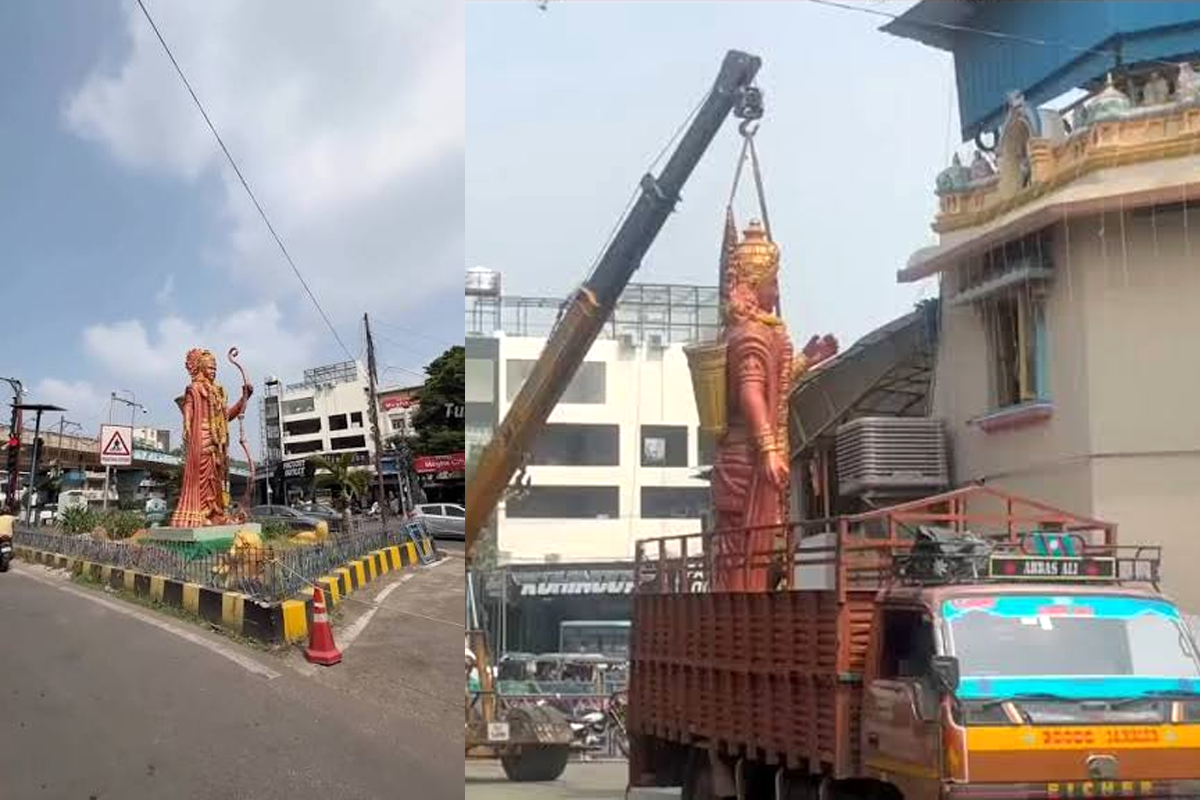
Lord Ram statue removed from Basheer Bagh amid demand to rename junction “Sri Ram Chowk”.

Seeing a news report that someone had called for the renaming of Basheer Bagh Chowrasta as Sri Ram Chowk made me laugh. However, this is not merely an absurd proposition. It is a manoeuvre in a sinister conspiracy to attack history. Within three or four days, the matter became the subject of an intense debate and created an uproar on social media.
Within another two or three days, the police removed the idol of Lord Rama from the spot and brought down the tension. That may have defused the immediate situation, but we must not assume that the venomous snake has now returned to its basket, much less that the danger has ended. Those who want to divide Telangana society along religious lines and set it ablaze in preparation for the forthcoming municipal and Assembly elections have no end to their ambitions.
Forces that believe their political interests can be served only by destroying communal harmony, inciting one community against another, and creating bloodshed are still lying in wait. The machinations of these Hindutva forces will not stop here.
It is therefore necessary to discuss this issue in depth and bring all the relevant facts to the attention of those who do not yet know them. Even innocent devotees of Rama must be told what audacious ventures some political conspirators are undertaking in the name of their own revered deity, and what murderous acts of frenzy they are preparing the ground for.
We must also warn people that, in reaction to the nefarious activities of a handful of Hindu fanatics, another handful of Muslim fanatics are waiting to incite religious fervour among innocent Muslim people. We must explain that the actions of these fanatics on both sides will throw urban life into turmoil, claim the lives of many innocent people, and reduce property to ashes. And after all this, the religious fanatics who have stoked the flames on both sides will ultimately remain safe and sound, on friendly terms with one another, and even as business partners. The public must be made aware of this reality.
The present controversy originated in the words spoken on October 19, as part of the Dasara and Devi Navaratri celebrations, by Dr Ravinutala Shashidhar, national spokesperson of the Vishwa Hindu Parishad and general secretary of the Bhagyanagar Ganesh Utsav Samithi.
A huge idol of Lord Rama had been brought and installed beside the Kanaka Durga temple at Basheer Bagh Crossroads. Standing in front of it, Shashidhar made the statement that has now become the source of the controversy. It was a spark lit to set Hyderabad ablaze.
He declared that the crossroads should henceforth be called Sri Ram Chowk and that the name Basheer Bagh should disappear into the womb of time. Thereafter, many Hindutva supporters and political leaders, possessing mouths but apparently lacking brains, thought and historical awareness, put those mouths to work.
Who the hell is Basheer? Why should the place bear his name? We shall name it after our god; we shall call it Sri Ram Chowk! Such shouting and clamour began in earnest.
In reality, this is not even devotion to Rama. It is blind hostility towards a Muslim name — that of Basheer.
The leaders calculate that this controversy will fetch them a few votes while some innocent people lose themselves in religious frenzy and dance in ecstasy. Just as these provocateurs had anticipated, condemnations began to pour in from prominent figures in Muslim political and religious circles as well. We must acknowledge that the government quickly recognised the confrontation, which was playing out largely on social media, and made efforts to contain it.
Even if we do not expect these ignorant religious fanatics, who wish to erase history, to understand, we must recall for the benefit of historically uninformed but innocent people why the place came to be called Basheer Bagh, and how that name became an inseparable part of Hyderabad’s history.
Asman Jah, who served as Prime Minister of the Hyderabad State for seven years, from 1887 to 1894, was also known as Basheer-ud-Daula. Although he lived for only fifty-five years, he played a crucial role in the history of Hyderabad State for at least thirty years. He held numerous titles: His Excellency, Amir-e-Paigah, Azam-ul-Umra, Amir-e-Akbar, and Sir, among others.
His full name was Muhammad Mazharuddin Khan Bahadur Rifat Jung. He was a Paigah nobleman. In other words, he occupied the second position after the ruler in the hierarchical structure of the princely state’s feudal order. History records that he rose to high positions not merely because he belonged to a noble family but also through his own abilities.
The fifth Nizam, Afzal-ud-Daula, gave his daughter in marriage to Basheer-ud-Daula, thereby making him a member of the royal family. When Afzal-ud-Daula died in 1869, Mahbub Ali Khan, the sixth Nizam, was only three years old. Basheer-ud-Daula therefore became a member of the Council of Regency that administered the State until the young prince came of age.
He began his public career in 1869, at the age of thirty, as Minister for the Judicial Department. In 1887, he became Prime Minister. Although he held numerous offices between 1869 and his death in 1898, it is recorded that he served without drawing even a single paisa in salary from the public treasury.
It was during his premiership that administrative reforms were introduced in several fields, including education. A programme providing free medical assistance from government funds to the public, particularly women, was initiated during his administration. It was also during his tenure that a permanent board was established to regulate the supply of drinking water to Hyderabad city.
When Queen Victoria’s Golden Jubilee celebrations were held in London in 1887, the ruler, Mahbub Ali Khan, sent Basheer-ud-Daula to represent Hyderabad State. Contemporary accounts say that he earned considerable admiration in England as well. Immediately upon his return from London, he assumed the office of Prime Minister.
Basheer-ud-Daula undertook numerous construction projects in the city: Basheer Bagh Palace in 1880, Asman Garh Palace in 1885, Khana Bagh between 1880 and 1885, and the Mahbub Chowk Clock Tower in 1892, among others.
In 1880, he decided to build a private residence at a considerable distance from what was then Hyderabad city, far enough out that Hussain Sagar lake could be seen from the site. He purchased a garden belonging to an Arab Jamadar named Hasan bin Mushin and built an expansive palace there. It was called Basheer Bagh Palace — literally, the palace in Basheer’s garden.
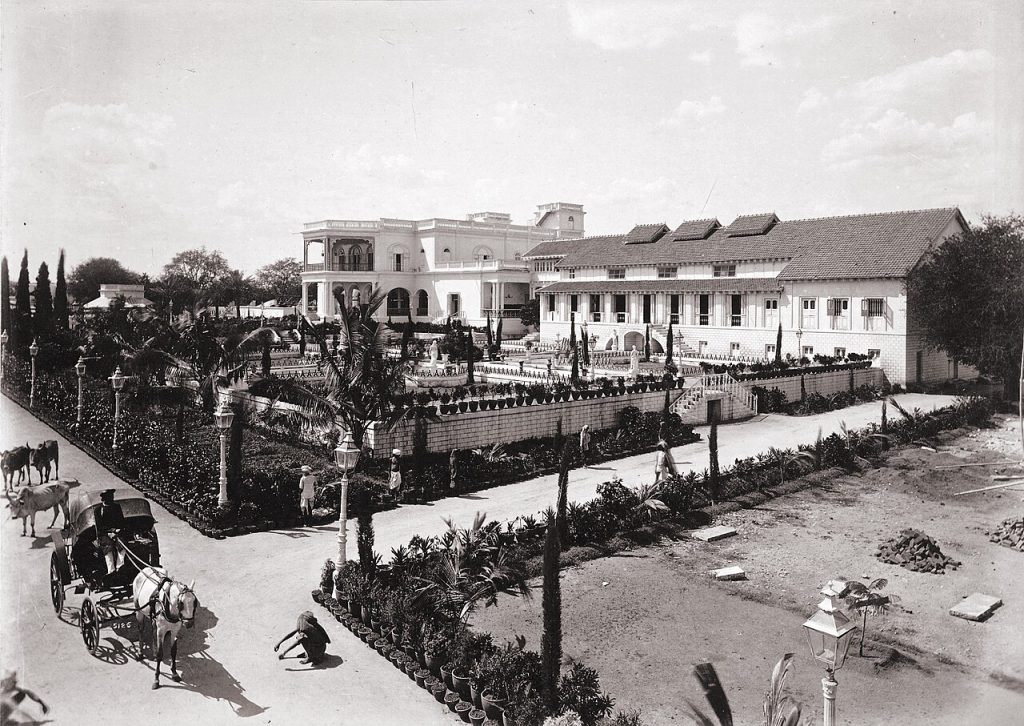
Bashir Bagh Palace, Hyderabad.
The garden probably extended from what is now Basheer Bagh Crossroads to the present-day Liberty Crossroads. Contemporary accounts describe the palace as having a grand entrance gate facing Secunderabad. Inside were extensive flower gardens, a large stone fountain at the centre, marble verandahs, guest rooms, dining rooms with expensive decorations, a special billiards room, and numerous bedrooms. The beautiful view of Hussain Sagar could reportedly be seen from the rooms on the building’s second floor.
The palace also had a home theatre with special arrangements for women, a swimming pool, Turkish baths, tennis courts, and Japanese tea rooms. It was considered one of the most luxurious buildings in the city at the time. The British writer JD Rees described it as an “Italian-style palace,” a description cited by Omar Khalidi in his A Guide to Architecture in Hyderabad Deccan, India.
The palace was reportedly built at a cost of four lakh rupees in 1880. To express that sum in terms of its present value, it would amount to ₹21 crore! Basheer-ud-Daula died in 1898 in Basheer Bagh Palace itself. His mortal remains were buried in the Paigah tombs.
After the so-called Police Action of 1948 and the abolition of jagirs in February 1949, the income of Basheer-ud-Daula’s descendants dwindled. With no money available for repairs, the buildings began to fall into ruin. His grandsons, Zaheer Yar Jung and others, continued to live in the surviving buildings but were unable even to afford their maintenance. From 1963–64 onwards, they began selling the extensive land surrounding the palace.
The celebrated Hindustani classical vocalist Bade Ghulam Ali Khan spent the final days of his life as a guest of Zaheer Yar Jung in this very palace. He died there in April 1968.
By 1970, even the last surviving portion of the palace had been demolished, and its land had been swallowed up by real estate development. A guesthouse that had stood in one corner of the extensive estate was repaired in the 1930s under the supervision of the City Improvement Board and continued as a government building. In the 1950s, it became the office of Andhra Patrika; in 2006, it became the office of the Lokayukta. Another building on the estate became Gandhi Medical College, only to pass into private hands later, thanks to government policies with scant respect towards heritage.
More than 120 years have passed since Basheer-ud-Daula’s death, and fifty years have passed since the magnificent palace he built was razed to the ground. Yet the area has retained the name Basheer Bagh. That is our history. That is our heritage.
Since this entire episode began at the place known as the Kanaka Durga temple at Basheer Bagh, we must also discuss the history of that temple.
Between 1982 and 1984, when I was pursuing my MA at Nizam Postgraduate College, the college wall extended right up to that corner of Basheer Bagh Crossroads. On another corner stood a large Irani restaurant called Embassy Café. At our corner, just inside the college gate, there was a little shelter for the watchman. Beside it stood a small Ellamma shrine, consisting of one stone slab on either side and another placed on top. It was just like the countless Ellamma shrines found throughout the villages of Telangana.
Within ten years, the college wall had been moved back. The Ellamma stones had become a small temple. Ten years later, a flyover came up, and the temple grew larger. Another ten years on, it had become a spacious temple, and the deity worshipped there had also changed: Ellamma had become Kanaka Durga.
Just as many deities in Hyderabad seem to have an intimate relationship with real estate, the place is now on the verge of becoming a piece of real estate for Lord Rama.
Also Read:
Telangana’s looming water crisis: Responsibility and response
Vinayaga! Who will remove these obstacles?
(Edited by R Rajesh Kumar.)



