

Published Oct 01, 2026 | 9:15 AM ⚊ Updated Oct 01, 2026 | 9:15 AM

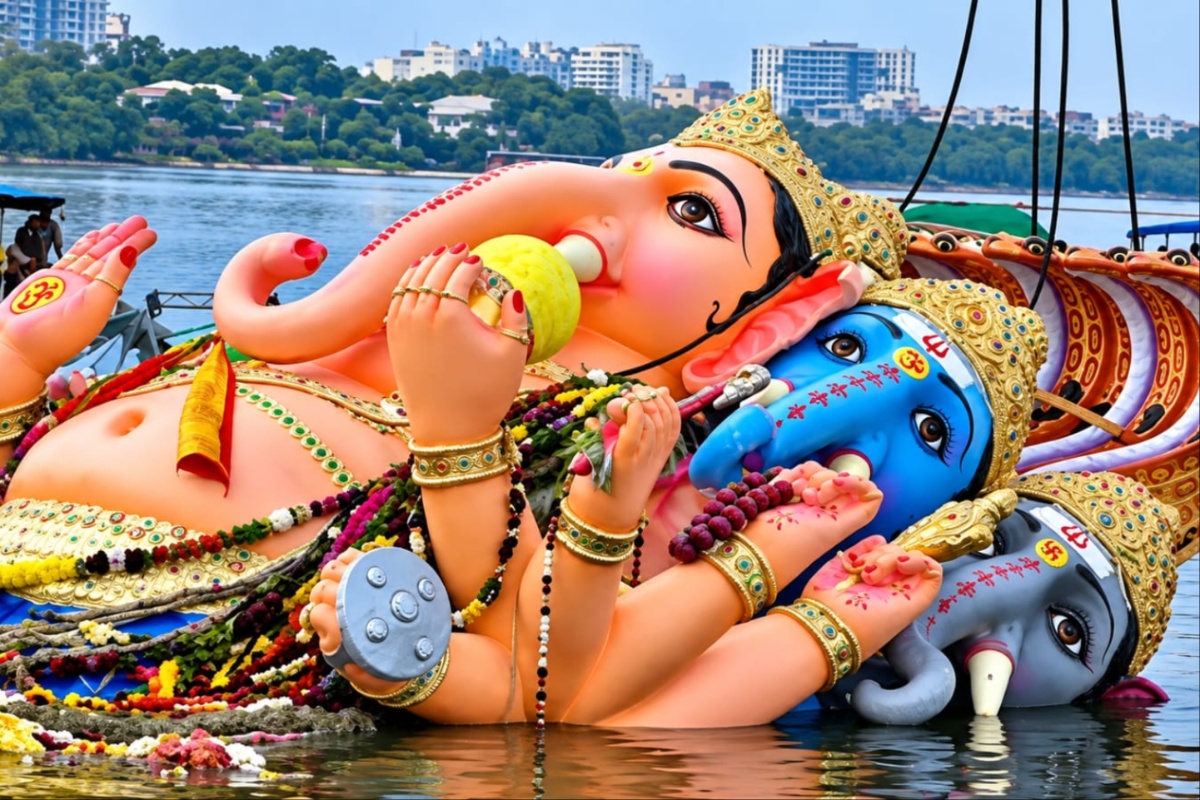
This year 1.5 lakh Ganesh idols were immersed. (Special Arrangement)

Synopsis: If the very worship of Ganesha itself becomes the cause of numerous obstacles for eleven days, who will remove these new obstacles? Politics, caste and competition between streets — and even between two groups within the same street — have entered this festival, occupied it and gradually transformed it into a business worth crores of rupees.
The eleven-day flood that inundates Hyderabad every year and leaves the city gasping for breath ended on Saturday and Sunday.
This flood is no longer drowning just Hyderabad or Telangana; it is now engulfing the entire country. In name, this flood is called devotion to God. But it has become the site of developments that even genuinely devout people cannot approve of.
When one sees the garbage, debris and sewage being swept along in this flood, one really begins to wonder: is this what devotion to God means? Since this spectacle is repeated every year, and since the noise pollution, traffic disruptions, environmental destruction, displays of rowdyism and political manoeuvring carried out in the name of “devotion” are increasing year after year, it is time to pause and ask what this whole affair is really about, and how much devotion to God it actually contains.
In the faith of devotees, Ganesha is Vighneshwara — the remover of obstacles. He protects those who worship him from all obstacles. But if the very worship of Ganesha itself becomes the cause of numerous obstacles for eleven days, who will remove these new obstacles?
According to official figures, this year alone, within Hyderabad city — and not even the entire city, but only within the limits of the Greater Hyderabad Municipal Corporation (GHMC) — 4,527 tonnes of waste accumulated during these eleven days. This included idol debris, plaster of Paris, cement, chemical paints, iron, wood, disposable leaf plates, wet waste, flower garlands, puja materials, plastic bottles and containers, coconut shells, construction waste, discarded cloth, shredded paper, severed internet-cable wires and many other materials.
Of this, 24 tonnes consisted of flower waste alone!
Twenty-four thousand kilograms of flowers — in other words, crores of flowers. Karunasri Jandhyala Papayya Sastry penned the lament of a single flower in his famous poem Pushpa Vilapam; today, there are the laments of crores of flowers lying in the soil!
This waste includes what was collected from roads, what was collected after immersions in large water bodies, and what was collected from nearly a hundred specially created “baby ponds” set up by the GHMC to reduce chemical pollution.
Officials announced that this year 1.5 lakh idols were immersed within the GHMC limits, another 1.2 lakh in the Cyberabad limits, and 80,000 in the Malkajgiri limits. But these figures may actually represent only half, or perhaps three-quarters, of the number of immersions that really took place.
Similarly, the figure of 4,527 tonnes of waste may also be only a fraction of the actual quantity generated. The GHMC estimates that an average of 9,000 tonnes of waste is generated every day within its limits. So perhaps the GHMC is merely announcing, as an approximation, the additional waste generated over and above that normal daily quantity.
Those who want to throw their waste on the road, near a pandal or into a lake simply throw it and walk away. They have no responsibility whatsoever. But hundreds of teams and between 10,000 and 20,000 sanitation workers are required to remove this waste and clean the city.
The existing sanitation workers have to put in additional work. There are garbage-transport vehicles, garbage-lifting vehicles, and supervisory personnel at several levels. Perhaps this additional effort costs several hundred crores of rupees. That, in turn, becomes an additional tax burden on the people.
Even if we assume that the figure for the quantity of waste is accurate, there are some astonishing facts that need to be noted. The 4,527 tonnes of waste said to have accumulated this year are 40 per cent more than last year’s 3,266 tonnes. Compared with the 1,100 tonnes collected three years ago, in 2023, the quantity has increased fourfold. What development! Is this an indication that devotion has increased? Or is it an indication that our civic consciousness has declined?
If the quantity of waste has increased fourfold in three years, it means that the number of idols and pandals has also increased fourfold, or perhaps even more. Earlier, a neighbourhood, a basti or a large locality might have had one or two idols. Now there are four, five or ten idols in a single neighbourhood, a single basti or a single locality. There are even examples of two or three idols being installed on the same street, within a distance of fifty or a hundred feet.
Idols and pandals are being installed based on caste, politics, influence, the possibility of contesting the forthcoming municipal elections, the ability to collect donations, and the opportunity to throw one’s weight around. Everywhere there is a stage; an hour or two of puja; ten or eighteen hours of obscene songs; sometimes vulgar dancing; food or prasad being distributed in front of the stage, while behind it the supply ranges from packets of cheap liquor to expensive bottles. Do even genuine devotees really think all this is devotion?
Why is there such competition between one pandal and another, one local strongman and another, one self-proclaimed paragon of devotion and another, when it comes to installing idols? Is it really competition in devotion?
If those on the other side bring a five-foot idol, we must bring a six-foot one. If they have only a mouse as Ganesha’s vehicle, our Ganesha must rest his hand on a lion and smile smugly! Are these really the forms described in the Vinayaka Vrata Kalpa, which speaks of Ganesha as Vakratunda Mahakaya?
Do these idols really look as though they have been made with devotion and reverence? Or do they look as though they have been designed to appear bizarre as part of a competition, and to intimidate rivals?
Building pandals across streets in a way that even four-wheelers cannot pass, creating traffic obstructions; installing DJs with speakers running into thousands of watts at every pandal and causing noise pollution; children, elderly people, the sick and even domestic animals trembling and cowering at those thunderclaps and explosions. Some people whose lungs had been weakened by COVID have died or ended up in hospitals. The ever-increasing accumulation of waste is causing pollution. Plaster of Paris and chemicals are endangering water bodies and, consequently, groundwater, public health and the environment.
There is no devotion in this. There is only arrogance, ostentation, the display of wealth, the display of power, bullying, creating obstacles to civic life, competing with people of the same faith, or using devotion as a means in the competition between two rivals.
In the old tradition, Ganesha was fond of undrallu — modest rice-and-lentil offerings. Now the Ganesha laddu has entered the publicity arena. These laddus are auctioned, and not merely hundreds or thousands but lakhs of rupees change hands. This year, it is said, the laddu at Bandlaguda Jagir fetched ₹1.01 crore. What is this? Do you still call this devotion?
Above all is the chaos of the final two days. No matter how many environmentalists, scientists and socially conscious civil-society activists have fought these practices for years, appealing again and again and knocking on every possible door, and no matter how firmly the courts have issued directions, these obstacles continue to increase rather than decrease. Even though the government, willingly or unwillingly, says that environmental destruction should not be allowed, the practices continue as usual.
Videos are circulating showing the police, who had announced that polluting idols would not be allowed to be immersed at Tank Bund and had erected iron barricades and barriers, standing by as silent witnesses while Hindutva activists pulled them down. The government itself officially supplied free electricity to the pandals. This year, its value was ₹17.8 crore. Even this may not be the actual figure. The electricity consumed may have been several times greater. The cost of recovering that expenditure also ultimately becomes a burden on consumers to the same extent.
Even devotees need to search their own consciences and ask whether something so ostentatious, aggressive, intrusive, polluting and noisy can really be called devotion. They should quietly ask their gods: “Lord, why does your pure worship need so much pomp, so much expenditure and so much noise?”
Compare all this with the Ganesha worship three or four decades ago. In villages, the puja was performed only by a very small number of families. It had nothing to do with the entire village.
A Ganesha idol, not more than a foot high, made by a potter from the clay of the village tank, would be worshipped. In towns, at one or two places, a small pandal would be put up at a corner of a crossroads, and a somewhat larger Ganesha idol would be worshipped in public. In the evenings, a microphone would be used for songs, speeches and mimicry performances by local artists. It was a natural, peaceful and pure form of devotion. It was not the ostentatious display that it has become today, nor a display intended to serve other purposes.
This was also the land where a tradition of devotion had preached that the relationship between God and the devotee was a personal one, and that nothing else should interfere in it. Since such festivals also contained elements of social interaction and celebration alongside personal devotion, they gradually expanded to the level of families and gatherings of relatives and friends. Even then, devotion and God had not been put so thoroughly on the market.
More particularly, when it comes to public Ganapati festivals, Bal Gangadhar Tilak, during the early period of the national movement, thought that these festivals could be used as a means of bringing people together against colonialism and strengthening a sense of collective connection and solidarity among them. Thus, because of Tilak, Ganesha came out into the public marketplace in Maharashtra. Even if that was considered a social and political necessity at the time, the way it has acquired gigantic and distorted forms through successive transformations and reached its present state means that the justification that it was once started for a good purpose is no longer sufficient.
Because of the Marathi-speaking districts that were part of Hyderabad State, the imitation of this festival also spread to Hyderabad. The imitation went so far that the Marathi slogan “Ganapati Bappa Morya“, including the name of the Marathi saint Morya, began to reverberate throughout Hyderabad even though many people did not know what it meant.
Politics, caste and competition between streets — and even between two groups within the same street — entered this festival, occupied it and gradually transformed it into a business worth crores of rupees. It has become an uninterrupted display of rowdyism, unrestrained bullying, the abandonment of civic consciousness and pollution. Shall we continue to allow all this, innocently believing that it is devotion?
Who will remove this obstacle?
Also Read:
Telangana tangle: When thieves fall out, the truth comes out!
Even a dead worker’s family wasn’t spared: The decline and fall of Telangana’s police
(Edited by R Rajesh Kumar.)



