

Published May 02, 2026 | 12:18 PM ⚊ Updated May 02, 2026 | 12:18 PM

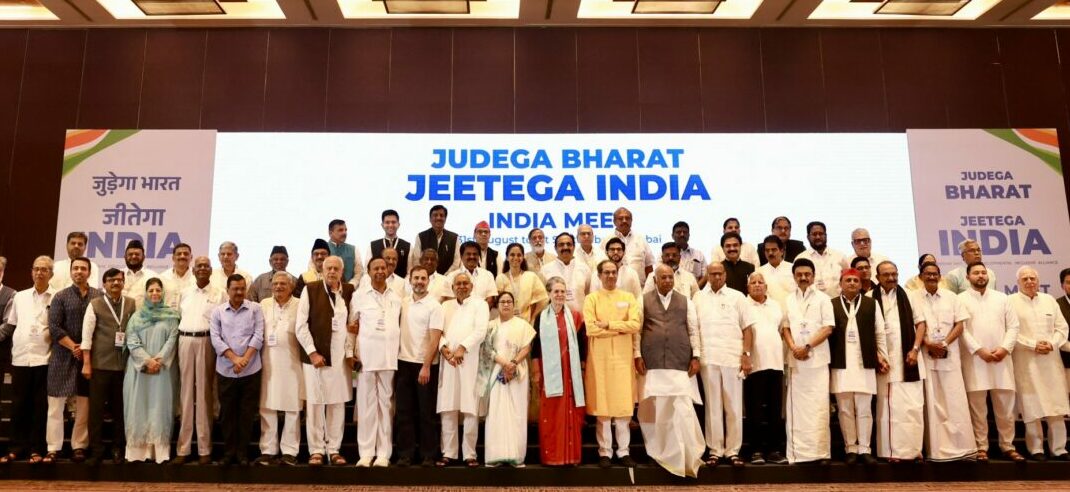
File photo of Opposition bloc INDIA meeting in Mumbai.

Synopsis: The Janata experiment, despite its eventual implosion, initially benefited from towering figures who commanded respect across factions. Today, the INDIA bloc lacks a universally acceptable leader. The Indian National Congress, once the natural pivot of opposition politics, no longer enjoys the dominance required to anchor such a merger.
The question is both timely and uncomfortable: why has the INDIA bloc failed to attempt a serious, Janata Party–style consolidation to counter the formidable electoral machine of the BJP-led NDA? The answer lies not in a single deficiency but in a complex web of structural contradictions, leadership ambiguities, and ideological incoherence that continue to hobble opposition unity in India.
To understand the missed opportunity, one must revisit the historical precedent of the Janata Party experiment of 1977. Forged in the crucible of resistance to the Emergency imposed by Indira Gandhi, disparate political forces subsumed their identities into a single political entity. The urgency of restoring democratic norms overrode ideological and personal differences. The result was not merely an electoral victory but a political moment defined by clarity of purpose and unity of command.
The INDIA bloc, by contrast, appears hesitant to move beyond a loose coalition into a cohesive political formation. One major reason is the absence of a unifying moral or political trigger comparable to the Emergency. While opposition leaders frequently invoke concerns over democratic backsliding under Narendra Modi, these concerns have not translated into a shared sense of existential urgency among constituents. Electoral competition at the state level continues to take precedence over national consolidation.
Also Read: Credibility of exit poll predictions — The West Bengal model
Leadership remains another critical stumbling block. The Janata experiment, despite its eventual implosion, initially benefited from towering figures who commanded respect across factions. Today, the INDIA bloc lacks a universally acceptable leader. The Indian National Congress, once the natural pivot of opposition politics, no longer enjoys the dominance required to anchor such a merger.
Regional satraps—whether in West Bengal, Tamil Nadu, or Telangana—are reluctant to cede space to a central leadership that appears electorally diminished. The result is a coalition of competing ambitions rather than a unified political force.
Ideological divergence further complicates matters. The Janata Party, for all its internal contradictions, was bound together by a singular anti-Congress plank. In contrast, the INDIA bloc encompasses parties with sharply differing ideological orientations—ranging from centrist to socialist to overtly regionalist formations. Reconciling these into a coherent national narrative has proven difficult. Without a shared ideological framework, any attempt at structural merger risks becoming a hollow exercise.
Equally significant is the asymmetry in political incentives. For many regional parties, their primary adversary remains the Congress rather than the BJP. In states like West Bengal and Kerala, opposition parties within the INDIA bloc are direct electoral rivals. A Janata-style merger would require these parties to sacrifice their immediate electoral interests for a long-term national objective—an expectation that runs counter to the logic of competitive politics.
Organisational challenges also loom large. The BJP, backed by the formidable machinery of the Rashtriya Swayamsevak Sangh, operates with a high degree of ideological cohesion and cadre discipline. The NDA benefits from a clear command structure and a well-oiled electioneering apparatus. The INDI alliance, on the other hand, remains an aggregation of parties with varying organisational capacities and campaign styles. Merging these into a single entity would require not just political will but an unprecedented level of coordination and compromise.
Moreover, the political context of contemporary India differs fundamentally from that of the 1970s. The electorate today is more fragmented, media ecosystems are more polarised, and electoral campaigns are increasingly presidential in character. The BJP’s ability to project Narendra Modi as a decisive national leader has reshaped voter expectations. In such a scenario, a fragmented opposition struggles not merely with arithmetic but with optics and narrative.
Also Read: A protest, not a strike — and that made all the difference
Yet, the costs of inaction are becoming increasingly evident. Without deeper coordination—if not outright merger—the INDIA bloc risks being reduced to a reactive formation, united only by opposition to the BJP but lacking a compelling alternative vision. Seat-sharing arrangements, while necessary, are insufficient substitutes for ideological clarity and organisational unity.
The lesson of the Janata Party is not that mergers guarantee success; indeed, that experiment eventually collapsed under the weight of its contradictions. But it does underscore the importance of political imagination and the willingness to transcend narrow interests in moments of national significance. The INDI alliance stands at such a juncture today.
If it continues to function as a loose, transactional coalition, it will struggle to mount a credible challenge to the NDA’s entrenched dominance. A Janata-style consolidation may be fraught with risks, but the greater risk lies in hesitancy. In politics, as in history, moments of opportunity rarely announce themselves twice.
(Views expressed here are personal.)



