

Published Jul 30, 2026 | 4:35 PM ⚊ Updated Jul 30, 2026 | 4:35 PM

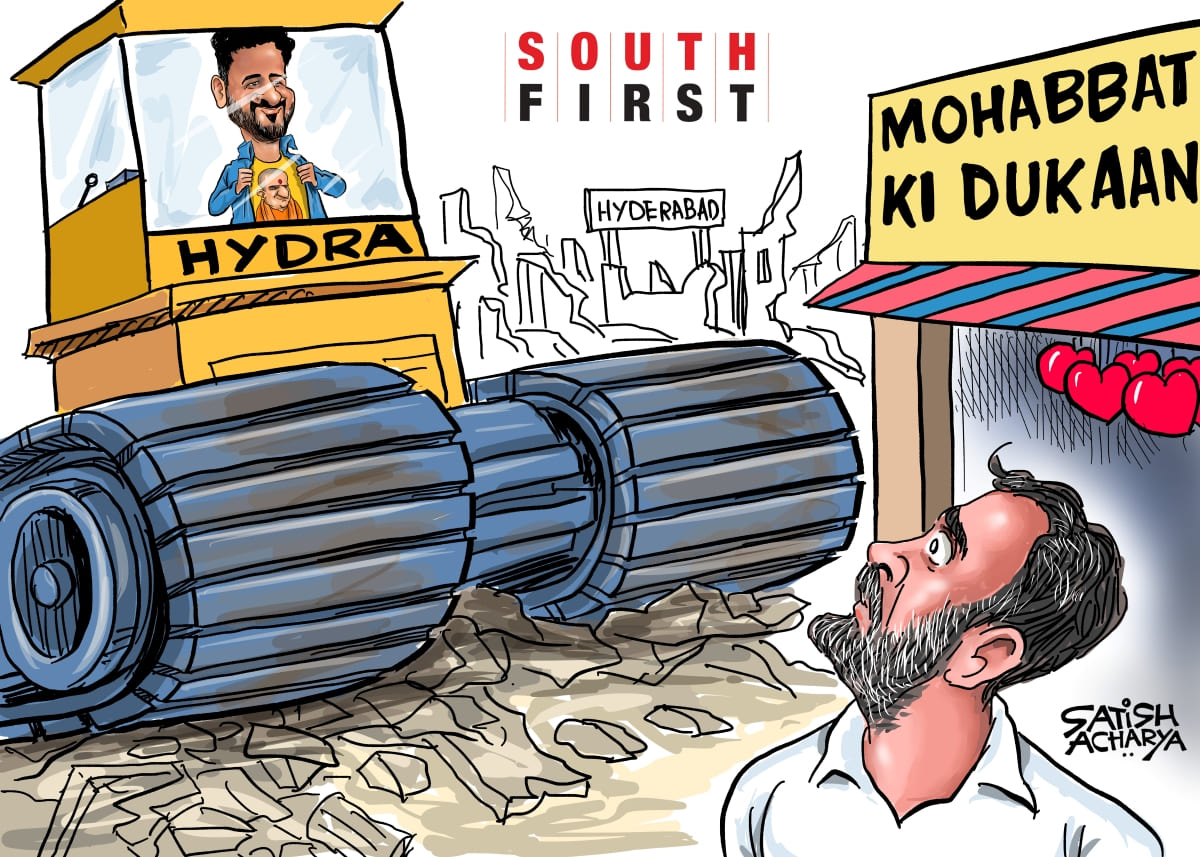
Bulldozing more than buildings

Synopsis: HYDRAA has been controversial from the start. Its first major action against actor Akkineni Nagarjuna earned it praise. It has lost its way since…
This column has previously examined the illegalities being committed in the name of HYDRAA, its excessive abuse of power, and its departure from its declared objectives in pursuit of less visible interests. Since then, matters have escalated considerably. HYDRAA has repeatedly defied the judiciary; the courts have finally lost patience, strongly censuring both the agency and its Commissioner; and, in an effort to shield that Commissioner, the Chief Minister himself appears willing to challenge the authority of the judiciary. A great deal has happened since.
From its inception, the functioning of the Hyderabad Disaster Response and Asset Protection Agency(HYDRAA)—particularly the style of its Commissioner, IPS officer AV Ranganath—has remained controversial. HYDRAA was created to curb the rampant encroachment of land in the city, especially lakes, tanks and other community assets, remove illegal occupiers, and restore such land to government control. Its very name defines its twin objectives: responding to disasters and protecting public assets.
In Hyderabad, “disasters” rarely mean earthquakes or cyclones. The city’s recurring disaster is far more familiar: torrential monsoon flooding. Not only does the Musi overflow, but roads across the city turn into streams. Areas that functioned as lakes and water bodies for centuries, but have since been converted into residential neighbourhoods, seem to reclaim their original identity. Water stagnates for days in many low-lying localities.
These are genuine disasters, and the government has an undeniable responsibility to respond. That was, in fact, HYDRAA’s principal mandate. But any serious response requires asking why these disasters have become so frequent.
The reasons are not difficult to find.
Lakes, ponds, reservoirs and drainage channels have been steadily encroached upon and converted into layouts and housing colonies. Natural waterways that once carried floodwaters have become privately owned properties blocking the flow of water. Hillocks, tree cover and natural depressions that once slowed floods have been flattened, allowing even moderate rainfall to rush unchecked across miles of urban landscape. Almost every patch of land where rainwater once seeped into the ground has now been sealed beneath roads and concrete, forcing every drop of rain to flow elsewhere as floodwater. In short, Hyderabad’s natural ecology has been systematically destroyed. More accurately, it has been destroyed by human intervention. In the city’s 435-year history, this devastation is only about three or four decades old.
Many are responsible for this long-running crime: real-estate developers, corrupt officials who indiscriminately granted permissions, poor and middle-class families desperate to secure a modest home during their lifetime, and the wealthy, the powerful and political elites who, like the mythological Hiranyaksha, sought to possess the earth itself as a playground for their luxury. It may now be impossible to assign precise shares of responsibility, but preventing further destruction is imperative. Society as a whole must commit itself to protecting what remains, and the government must shoulder greater responsibility through effective official action.
That naturally links HYDRAA’s second objective—protecting public assets—to its first. Individuals may defend their private property, but community assets have no such guardians. The government therefore has a legitimate responsibility to establish an institutional mechanism to protect them.
Up to this point, there can be little disagreement. When the Congress government, which assumed office in December 2023, established HYDRAA in July 2024 with these stated objectives, many welcomed the initiative. Its first major action—moving against the illegal structures of N-Convention, owned by actor Akkineni Nagarjuna and located within the Full Tank Level (FTL) limits of Thammidikunta Lake—was widely seen as a necessary assertion of the rule of law. HYDRAA earned considerable public goodwill. Many believed the new institution would finally address Hyderabad’s long-neglected environmental crisis.
But that trajectory soon changed.
The removal of encroachments by politicians, wealthy individuals and other influential interests, who account for the overwhelming share of urban land grabbing, gradually diminished. Critics increasingly alleged that influential encroachers were merely pressured into making unofficial payments, while meaningful action against them became rare. Instead, HYDRAA’s focus shifted toward the poor and the middle classes.
In areas such as Gachibowli, Ameenpur, Ailapur, Nallagandla, Sunnam Cheruvu, Bahadurguda, Lothukunta, Bathukamma Kunta and Narapally, houses were demolished without prior notice or adequate warning. Hundreds of police personnel accompanied dozens of bulldozers. Even structures standing on privately owned land were demolished. Fear itself became HYDRAA’s defining public image.
Commissioner Ranganath claims to have recovered more than 3,000 acres of land valued at ₹1.5 lakh crore from encroachers. Yet even his own statements acknowledge that not all these lands were government property. Meanwhile, large-scale encroachments upon lakes and tanks by influential individuals have largely escaped comparable action.
In many of these demolitions and land seizures, ownership itself remains disputed. Several properties are held under valid private title deeds, while others are pending adjudication before courts. Unsurprisingly, hundreds of affected citizens have approached the judiciary. Reports suggest that nearly a thousand cases have been filed challenging HYDRAA’s actions.
The Telangana High Court has repeatedly criticised the agency and, in several instances, explicitly directed it not to interfere with specified lands or constructions. Yet HYDRAA, under Commissioner Ranganath, has continued demolitions and land seizures despite judicial orders. Aggrieved citizens have therefore returned to court alleging contempt. The fact that at least sixty-three contempt proceedings are reportedly pending against the Commissioner speaks volumes about the agency’s disregard not only for judicial authority but also for the elementary principle that legal disputes must be resolved through lawful processes.
The latest controversy centres on about forty acres at Lothukunta, where a multi-storey residential project was proposed. While the developer maintains that the land is privately owned and not government property, HYDRAA entered the site and demolished ongoing constructions. Even after the High Court issued a stay and restrained the agency from interfering with the property, HYDRAA allegedly continued its operations. Justice Anil Kumar Jukanti reportedly observed that he might have to enlist the support of the army to prevent HYDRAA from entering the site. When the Commissioner’s conduct remained unchanged, the court not only reprimanded him but also directed the Chief Secretary to remove him from office. Chief Minister A Revanth Reddy, however, responded that the executive alone has the authority to decide who occupies official positions, setting the stage for a confrontation between the government and the judiciary. Where this conflict will ultimately lead remains uncertain, but several larger questions deserve attention.
In any class society, governments and state institutions often function in ways that favour wealth and power. That is hardly surprising. Yet when the overwhelming majority of land encroachments are attributable to the rich, the politically connected and the powerful, any credible anti-encroachment programme must visibly concentrate its efforts on them if it is to appear even minimally impartial.
Instead, the reverse seems to have happened. Very few actions have been taken against the wealthy. Critics argue that even these serve more as instruments of intimidation and extraction than as genuine attempts to recover public land. By contrast, the poor and the middle classes have faced a disproportionate share of demolitions.
The distinction is significant. Encroachments by the affluent are typically driven by luxury, speculation and the accumulation of wealth. Even where poor or lower-middle-class families occupy land illegally, they usually do so out of sheer necessity—to secure a place to live—and often with the encouragement or complicity of the very politicians, developers and influential intermediaries who later escape accountability.
Thousands migrate to Hyderabad because rural livelihoods have collapsed, hoping that even irregular daily-wage work will provide survival. With no affordable housing available, many settle wherever vacant land exists, including along the Musi and in informal settlements. These colonies themselves often emerge under the patronage of local politicians and slum leaders, sustained through systematic extortion. HYDRAA’s demolitions have displaced many such vulnerable families.
The story is similar for large sections of the lower and middle sections of the middle class. As employment expanded in the city, thousands purchased modest apartments from small developers who assured them that all statutory approvals had been secured. In some cases, approvals never existed; in others, they were allegedly obtained through corruption. Families mortgaged their futures to purchase these homes. They are now the ones paying the price for a regulatory failure in which they were the least powerful participants.
No precise statistics exist on the total number of houses demolished or families displaced. Yet it is evident that the figures run into the thousands. Ironically, the same HYDRAA that is now being censured by the High Court in a dispute involving a major real-estate developer was widely applauded when thousands of poorer families lost their homes.
Hyderabad urgently needs a serious public debate about illegal land occupation, the city’s chronic housing shortage, the insatiable land hunger of the wealthy, and the housing needs of the poor and the middle classes. Instead, that larger conversation is being swallowed by an unnecessary Bermuda Triangle of conflict involving HYDRAA, the High Court and the state government.
Also Read | Hyderabad’s bullet-train push: Whose sacrifice is it? For whose benefit?
(Edited by R Rajesh Kumar.)



