

Published Apr 17, 2026 | 7:00 AM ⚊ Updated Apr 17, 2026 | 7:00 AM

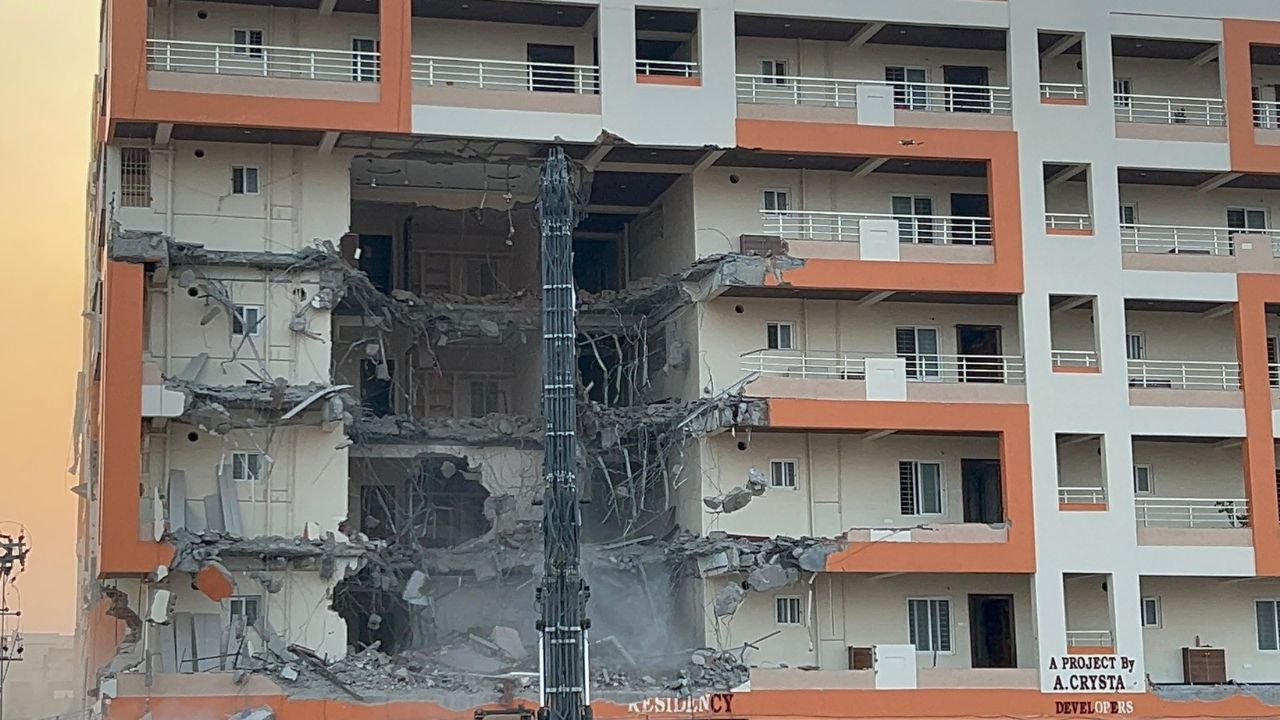
HYDRAA carried out an encroachment drive in Telangana.

Synopsis: The HYDRAA, established to remove illegal encroachments in Hyderabad, is alleged to be functioning without following the proper laws of the nation. Irregularities in its actions have rendered HYDRAA’s functioning deeply questionable. What clearly emerges from the Telangana High Court’s observations is that HYDRAA is not adhering to lawful procedures.
The question of whether the Hyderabad Disaster Response and Asset Protection Agency (HYDRAA) is functioning within the limits of the powers granted to it by law — or indeed, which law has conferred such powers upon it, or whether it is overstepping its jurisdiction and acting excessively — appears to be leaning toward the latter conclusion in the view of the judges of the Telangana High Court.
The agency was established to remove illegal encroachments in Hyderabad, protect government and common properties, and particularly to safeguard lakes and water bodies from encroachments to prevent disasters.
This relatively new government body, set up nearly two years ago, has frequently made sensational headlines by demolishing buildings and erecting fences around lands in various parts of the city under the label of “illegal encroachments.”
HYDRAA claims to have freed over a thousand acres of government land, public parks, and roads from encroachments; to have reclaimed as much as 860 acres of government land in Ameenpur of Sangareddy district alone; to have removed encroachments on nearly 200 acres of lake bed (shikam) lands; and to have demolished illegal constructions in high-value areas such as Banjara Hills (five acres), Kondapur (36 acres), and Gajularamaram (317 acres). By demolishing structures at the N Convention Centre in Madhapur on the grounds that it encroached upon the Full Tank Level (FTL) of Tammidikunta,
Also Read: HYDRAA’s massive crackdown in Ameenpur
HYDRAA presented itself as an agency willing to act even against the powerful.
At the same time, in places such as Kondapur, Golconda Fort, Puppalaguda, Hyder Nagar, Injapur, and Yapral, it has demolished the homes of the poor and middle classes in the name of illegal encroachments and constructions.
The introduction of the much-criticised “bulldozer raj,” notorious in states governed by the BJP across the country, into Congress-ruled Telangana is a distinction that belongs to HYDRAA. In a society where property rights have legal validity, attacks on property inevitably lead not only to disputes over whether that property has legal standing, but also to disputes over whether the very intent behind such actions is justified.
It is therefore not surprising that at least 700 cases have reportedly been filed before the Telangana High Court challenging HYDRAA’s actions.
In and around the city, there exist longstanding disputes over the ownership and transfers of land historically classified as Sarf-e-Khas, Jagir, Waqf, village common lands, and other categories. Over the past seven to eight decades, with direct and indirect encouragement from political and administrative elites, thousands of acres have been encroached upon, resulting in countless illegal layouts and constructions.
It is therefore necessary to prevent such encroachments and, to the extent possible, rectify historical wrongs. At the same time, some migrated to the city in search of livelihood and, with the overt or covert support of political leaders and officials, acquired small parcels of land — whether or not those lands were technically encroachments — and have lived on them for generations.
There are also real estate and construction operators who, in a rapidly expanding market, developed ventures and apartment complexes on disputed lands, obtained approvals through corrupt practices, sold them to poor and middle-class buyers, and then disappeared. In such a complex situation, an agency like HYDRAA is indeed necessary to identify and remove genuine encroachments.
Efforts to bring order to Hyderabad’s land and construction landscape, and to eliminate illegal encroachments, are undoubtedly essential. However, even such necessary work must be carried out in accordance with the law and through acceptable procedures — not in an arbitrary or authoritarian manner.
Yet, in its two-year existence, HYDRA’s functioning has raised serious concerns. The authoritarian conduct of its officials, their harshness toward affected persons, the absence of notices or prior warnings, the practice of descending at dawn with numerous bulldozers to demolish homes, disregarding the pleas of victims, the creation of havoc without any apparent legal sanction — all these irregularities have rendered HYDRAA’s functioning deeply questionable.
An agency established to rectify illegality is itself becoming a source of illegality.
It is for this reason that, on Monday, 13 April, while hearing different cases related to the demolition of “illegal constructions,” Telangana High Court judges — Justice NV Shravan Kumar and Justice B Vijaysen Reddy — made severe observations against HYDRAA.
While hearing a writ petition filed by a petitioner named Jitendra, who complained that HYDRAA had entered his land in Suraram of Medchal-Malkajgiri district, fenced it off, installed boards declaring it government land, and did so without issuing any prior notice or possessing legal authority, Justice Shravan Kumar questioned whether HYDRAA considered itself above the courts or was running a parallel government.
Noting that the land in question was already under judicial dispute and subject to orders to maintain the status quo, the court condemned HYDRAA’s unilateral intrusion. The judge asked who had authorised HYDRAA to enter and fence off the land: Was it the Revenue Department, or the Municipal Administration and Urban Development Department? Observing that HYDRAA appeared overly eager to take possession of disputed lands, the judge remarked that its primary responsibility was to protect water bodies and respond to disasters.
“Why are such swift actions not taken to protect lakes and ponds?” the judge asked, even raising the question of whether HYDRAA had any “vested interests” in intervening in disputed lands. Just two days earlier, on Saturday, in another case involving the fencing of 1.26 acres of land in Khanamet near Serilingampally, Justice Shravan Kumar had similarly criticised HYDRAA’s functioning.
At the same time, while hearing a writ petition filed by a 98-year-old farmer MA Sharif — who alleged that HYDRAA officials entered his land in Ailapur village at 4.30 am on Saturday, demolished his ancestral two-storey house, water tank, compound walls, and cattle sheds, and took away CCTV cameras and other equipment — Justice Vijaysen Reddy ordered that HYDRAA should not undertake any demolitions within the city or municipal areas.
He directed that demolitions should be limited strictly to the removal of encroachments on rivers, streams, canals, and roads.
The judge also criticised HYDRAA for failing to heed earlier court directives and for not having formulated a Standard Operating Procedure (SOP) for demolitions even at this stage. Observing that “hundreds of such cases” were coming before the court, he remarked that demolitions without notice and violations of principles of natural justice were alarming.
Even if undertaken with good intentions, such actions must follow legally prescribed procedures. It was surprising, the judge noted, that despite functioning for over a year, there was still no clarity on the source of HYDRAA’s authority, nor any SOP governing its operations.
He ordered that no demolitions should take place until such an SOP was formulated. “The manner in which HYDRAA officials were deployed at the site, the way the situation was exaggerated… it was akin to a war-like scenario. Such a situation cannot be allowed,” he said.
Also Read: Hyderabad flood affected mostly Musi bank encroachers, says HYDRAA chief
What clearly emerges from the court’s observations is that HYDRAA is not adhering to lawful procedures. It is not respecting the principles of natural justice. It is acting indiscriminately, without any SOP to guide its actions, and without clarity on whether it operates under the GHMC Act or the Municipalities Act, or whether it even possesses the authority to carry out such demolitions.
In such an unregulated “bulldozer regime” devoid of procedural norms, corruption, favouritism, targeting of the voiceless, and selective inaction against the powerful are inevitable. Although the share of the affluent in illegal encroachments and constructions is greater, actions against them are not proportionate.
Instead, the brunt falls on lower-middle-class and poor households who, having already been deceived once by real estate and construction operators, now face destruction under the label of “illegal encroachments.” In fact, many such constructions were carried out with official permissions on paper, with electricity, water, sewerage, and road access duly provided by government agencies — indicating official recognition.
If genuine action were to be taken, it should first be directed against the government officials who granted such permissions and the real estate and builder mafia who developed and sold these properties. Instead, innocent homebuyers are being targeted.
While a token action or two may have been taken against politically influential persons or wealthy individuals who committed far greater violations by constructing buildings and farmhouses, there is no evidence of systematic action against all encroachments.
Despite repeated judicial censure that HYDRAA is not functioning within the law and is behaving as though it itself is the law, its officials have shown no inclination to change their approach. On the contrary, to avoid judicial intervention, demolitions are often carried out between Friday night and Sunday night, in the dead of night or at dawn, to avoid immediate judicial intervention.
In response to criticism that it is not following the law, HYDRAA invokes legal terms such as FTL and buffer zones — but there is no consistency in applying these standards. Its actions differ depending on whether those involved possess financial power, muscle power, or political backing.
Does HYDRAA have no faith in the rule of law?
(Views are personal.)



