
Published Nov 11, 2026 | 1:04 PM ⚊ Updated Nov 11, 2026 | 1:04 PM


In August 2026, I argued in Scroll.in that India’s E20 programme is an ecological distribution conflict in the sense that Professor Joan Martinez-Alier, the originator of ecological economics, described: gains captured by one group and losses pushed onto another with no voice in the decision.
That article traced three hidden ledgers — food diverted from the public distribution system, water and land extracted from stressed regions, and mechanical damage borne by the two-wheeler-riding majority whose vehicles predate the 2023 fuel-injection mandate.
Three months later, the November controversy over ethanol content in Karnataka has added a fourth ledger. It is no longer merely a story of costs being dispersed onto the poor. It is a story of those costs being actively concealed — and of the institutions meant to verify them declining to answer the question.
The 31.2 per cent question
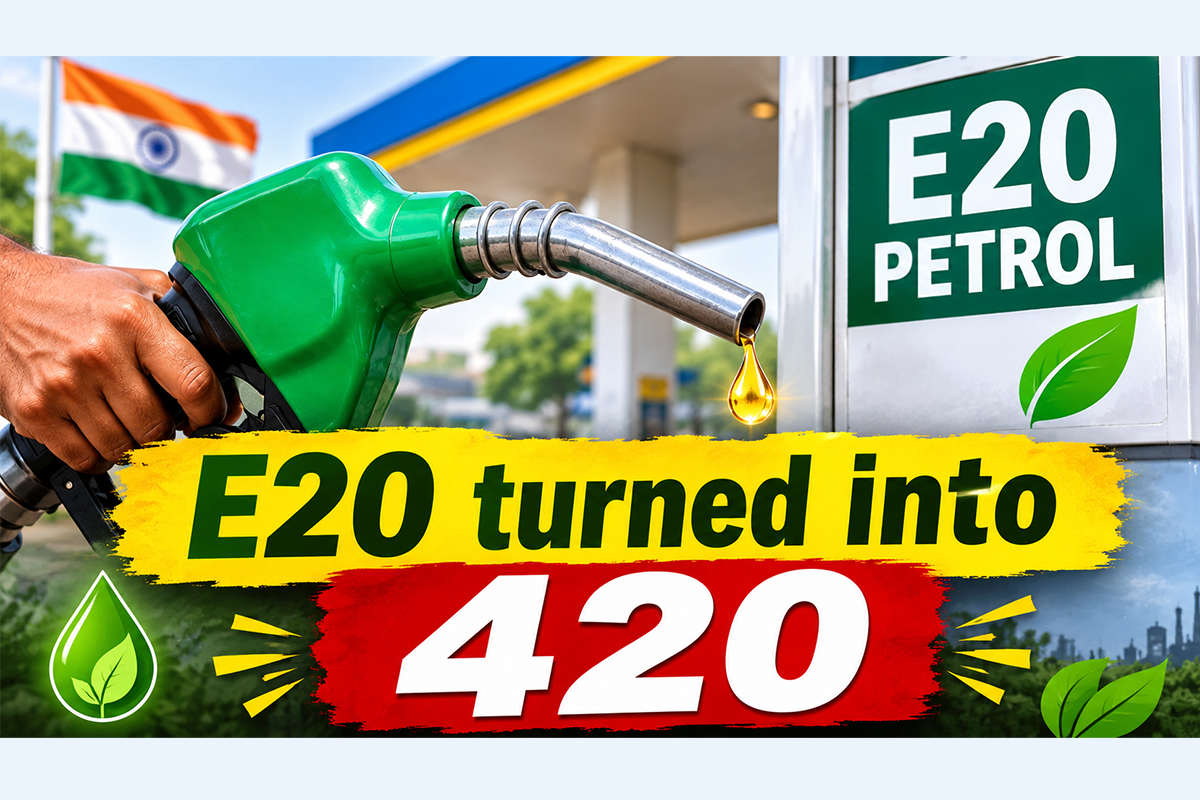
In early November, Karnataka announced that petrol samples collected from seven districts and tested at a NABL-accredited laboratory showed ethanol content as high as 31.2 per cent at Indian Oil, 30.5 per cent at Hindustan Petroleum, and between 25.5 and 26.5 per cent at Bharat Petroleum, Nayara and Shell. Eleven of fourteen samples exceeded the mandated 20 per cent ceiling. Rahul Gandhi rebranded the policy: “E20 turned into 420,” a reference to the penal code provision on cheating.
The oil marketing companies’ response was procedural. Their own 56 samples, they said, averaged 19.3 per cent; the Karnataka samples were not collected or tested in accordance with the prescribed statutory procedure; the third-party laboratory certificates did not disclose sufficient methodological detail to independently verify the findings.
Both sides may be technically correct. That is precisely the problem.
The most damaging allegation was not about the 31.2 per cent figure. It was about what the companies’ own in-house laboratories did not report. When the same samples were first submitted to Indian Oil and BPCL labs, the test reports allegedly omitted ethanol content entirely — despite it being a prescribed testing parameter. If true, this is not a dispute over methodology. It is a dispute over whether the entities responsible for compliance are also the entities responsible for certifying it, and whether they have chosen not to certify.
The Petroleum Ministry has since cited 893 samples across 27 states, all within the 19–21 per cent range. But the public has no independent means of verifying either dataset. There is no mandatory display of ethanol content at fuel stations — a demand Karnataka has formally made. Consumers cannot know what is in their tank. The companies that blend the fuel are the same companies that test it, and when an external government tests it, they dispute the procedure rather than the substance.
The E20 defence has always rested on a dual promise: energy security for the nation, income support for the farmer. The November numbers tell a different story at the farm gate.
As of February 2026, sugarcane arrears owed to farmers nationwide stood at ₹16,087 crore — roughly 32 times the ₹497 crore owed in the same period the previous year. Karnataka, the very state whose tests ignited the current controversy, had the highest pending dues at ₹4,956 crore, after recording zero arrears in the two preceding years. In Maharashtra, arrears climbed from ₹2 crore in 2023-24 to ₹4,252 crore in 2025-26.
The Parliamentary Standing Committee on Consumer Affairs attributed the surge to excess sugar production and mills’ blocked liquidity. The government’s remedy, it said, was to encourage diversion of surplus sugarcane to ethanol. But diversion has not resolved the payment crisis. It has merely changed the destination of the crop while leaving the farmer waiting.
In early November, sugarcane farmers in Maharashtra blockaded the Pune-Bengaluru highway for three days, demanding ₹4,500 per tonne. The government’s mediator offered ₹3,850. Farmers said they would settle for ₹4,200. The protest led to the cancellation of 166 state transport buses and cut Gokul milk cooperative’s sales in Mumbai and Pune by 50–60 per cent. These are not abstract distributional conflicts. They are the visible rupture of a supply chain in which the farmer carries the risk and waits for the payment.
The same chain that leaves the farmer waiting delivers a second bill to the consumer — specifically, the consumer on a two-wheeler.
Seventy to seventy-five per cent of India’s registered vehicles are two-wheelers, with an average working life of 12 to 15 years. The vast majority predate the April 2023 electronic fuel injection mandate. For these vehicles, ethanol’s lower energy density and corrosive properties are not a marginal inconvenience. They mean a 15–20 per cent mileage loss, swollen fuel lines, and corroded carburettors, with no manufacturer retrofit support.
The government’s own admission, via Nitin Gadkari’s July 2026 reply in Parliament, confirms a 2–6 per cent mileage drop even for newer vehicles. For the delivery worker, the small trader, the commuter for whom a two-wheeler is an economic necessity rather than a lifestyle choice, this is a direct tax on already thin margins. And unlike the 7.5 per cent of Indian households that own cars, they cannot absorb it.
Now add the November 2026 dimension. If ethanol content can exceed 20 per cent — whether through error, design, or fraud — the damage is concentrated precisely on the vehicles least able to tolerate it.
Karnataka’s estimate of the hidden consumer loss from mileage reduction alone runs to ₹62,000 crore annually, and the total including damage and repairs to closer to ₹1 lakh crore. These figures are contested by the companies. But the companies have offered no alternative estimate of consumer loss. They have offered only procedural objections.
Meanwhile, the entities in the middle of this chain — the oil marketing companies — are reporting robust earnings. In the September quarter of FY26 alone, Indian Oil, BPCL and HPCL together posted a net profit of ₹30,106 crore, up 68 per cent year-on-year, equivalent to nearly 39 per cent of their entire FY26 profit. Indian Oil alone reported its highest-ever quarterly standalone net profit of ₹21,630 crore.
The OMCs argue these are not windfall gains but normal margins for a capital-intensive commodity business, and that a profit pool of roughly ₹1 lakh crore annually is needed to sustain refinery upgrades and the energy transition. That may be true as a matter of corporate finance. But it is beside the point of the distributional question.
The question is not whether the OMCs are profitable. It is whether their profitability is being underwritten by a policy architecture in which they purchase ethanol at administered prices, blend it under a government mandate, sell the resulting fuel at petrol prices, and then contest external findings about what is actually in the blend — while the farmer waits for payment and the two-wheeler rider pays for a litre that is not entirely petrol.
My August article’s framework still holds: food, water, land, and mechanical wear are the hidden ledgers of E20. What November 2026 has revealed is that these ledgers are not merely hidden by inattention. They are hidden by a regulatory structure that places verification in the hands of the verified.
The Karnataka dispute may be resolved in the courts or by a committee. The 31.2 per cent figure may be confirmed or debunked. But the structural fact will remain: India’s fuel supply chain has no independent, real-time, consumer-facing mechanism for disclosing ethanol content. The companies that blend are the companies that test. The government that mandates is the government that defends. The farmer who grows the feedstock was owed ₹16,087 crore as of February 2026. The rider who burns the fuel cannot read a label that does not exist.
Martinez-Alier called this an ecological distribution conflict. What India now has is something closer to an information asymmetry dressed as an energy transition. The gains are captured upstream and midstream. The losses are pushed downstream — to the farmer waiting for payment and the rider paying petrol prices for a blend he cannot verify.
Until the ethanol content in every tank is independently audited and publicly disclosed, the E20 debate will remain what it has become this November: not a disagreement about policy, but a disagreement about facts that the public has no power to establish.
Also Read:
(Edited by R Rajesh Kumar.)



