

Published Jul 26, 2026 | 8:40 AM ⚊ Updated Jul 26, 2026 | 8:40 AM

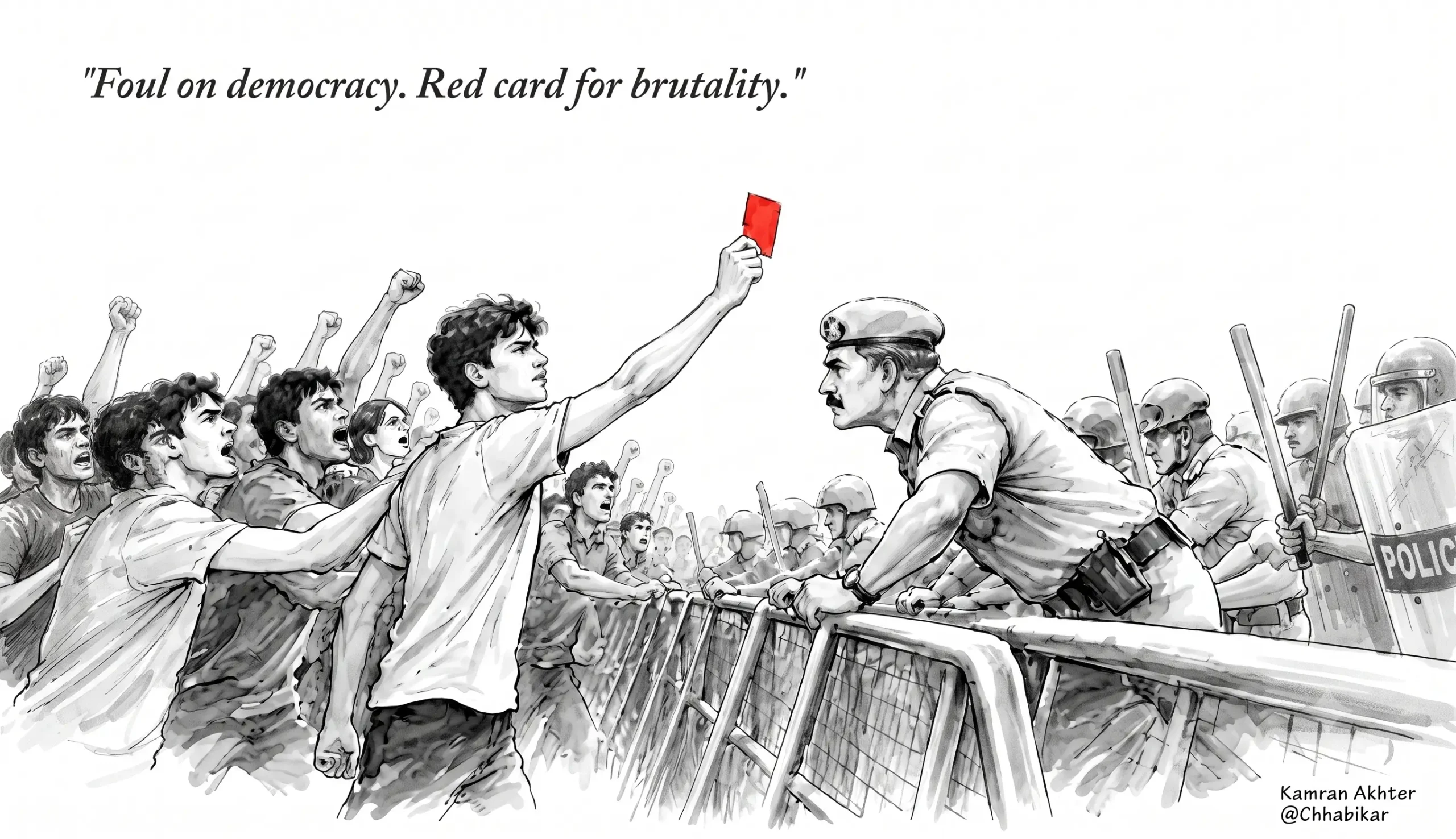

Synopsis: The Jantar Mantar protesters were young. They did not have a proper organisation. They were taking on an establishment that believed it could bring everyone to heel. But in 35 days, a David trumping Goliath tale has played out…
They were the students, taking on a BJP widely seen as the masters at the political messaging game.
But after 35 days of protest, they walked away victorious, with the Cockroach Janta Party, their interlocutors, announcing that the government has accepted “all their demands”.
The first big move from the government’s side came when Dharmendra Pradhan took to X and announced his resignation as Education Minister. Fittingly, a protest that has seen the students trump the government on social media earned one of its prized scalps through an announcement on the platform.
During the 35 days the agitation continued, the protesters turned into their own journalists, writers and content creators, wielding social media and placards with the ease of people who were to the manner born. There are some advantages to spending a significant amount of time online, after all. They told their own story, in their own voice and at the speed of an algorithm.
The reforms in India’s education system that they were demanding are indeed long overdue. Competitive examination paper leaks are not a recent phenomenon; they have plagued recruitment and entrance examinations at both the state and national levels for years. The figures Leader of Opposition Rahul Gandhi shared were striking: 152 paper leaks in 10 years, more than one a month, as he put it.
What makes this agitation different is not merely the issue itself, but the generation confronting it.
Unlike previous generations, who were often accustomed to accepting institutional shortcomings as unavoidable, Generation Z is aspirational, impatient, digitally native, and increasingly politically aware. They expect transparency, fairness, and accountability—and they are willing to demand it.
Many could be heard saying after the government accepted their demands that they will continue to fight for their rights. In a protest that has caught the imagination of the nation with the posters on display, there was a “picture abhi baaki hai” placard to remind everyone of this.
Creativity remained and will remain the movement’s greatest strength, not conventional political messaging.
Gen Z transformed social media into its public square. Instagram feeds, stories, reels, memes, digital illustrations, satire, and short-form videos became powerful instruments of communication.
For today’s youth who doomscroll, social media feeds and stories are the primary source of information. What they see is not random but carefully curated content stitched together by sophisticated recommendation algorithms.
According to Instagram, its feed is built from what it calls signals: the recent posts of accounts they follow, details about each post, and their own patterns of use. The platform weighs these signals to predict how likely they are to engage with a given post by liking, commenting, or sharing, to determine what appears in a user’s feed.
Reels go even further, recommending content largely from accounts users do not already follow based on the likelihood that they will find it engaging.
As a result, the algorithm-driven feeds remained the key messaging tool among the young. In this context, if anyone engaged with even a small amount of content supporting the movement, there was a strong chance their feed would have featured the now-iconic image of a young woman, later identified as Rhiya Ahir, an army man’s daughter, standing defiantly before a police bus carrying detained protesters in Mumbai.
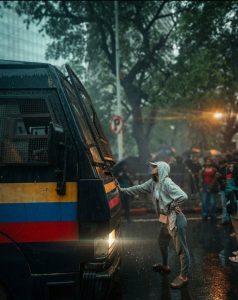
A woman, 27-year-old model Rhiya Ahir, preventing a police van from taking away protesters at Mumbai’s Shivaji Park. (SudhirSuryawanshi/X)
Images and posts like this have travelled farther, faster, and more powerfully than many television news broadcasts.
While many mainstream media outlets were seen giving limited coverage to the protests, Independent digital journalists like Samdish Bhatia, Kavya Karnatac, Priyanshi Sharma, Vedanta Agarwal, Abhniav Pandey, Harsh Yadav, Sarthak Goswami, and many others, often working with limited resources amid jammed internet connectivity, documented events in real time, providing raw, unfiltered reporting directly from the ground.
They played a crucial role in fact-checking, verifying claims, and countering misinformation. Their work became an alternative source of information for millions of young viewers over mainstream media. Public appreciation poured in all over social media, crediting their work.
Artists, designers, and content creators across the country also played a pivotal role. Their digital illustrations, animations, and visual storytelling gave the movement a distinct identity that resonated across linguistic, regional, and political boundaries. In the digital age, art was no longer merely an expression—it became a vehicle for mobilisation.
Rarely has a movement of this scale received comparatively modest mainstream television coverage while flourishing so extensively across digital platforms. But then this was more a slap on traditional media than the protestors.
Among other things, the CJP protest then was a demonstration of how algorithms, creativity, and decentralised storytelling can reshape public discourse. The Prime Minister, the BJP and their social media cell were beaten at their own game, as platforms they have relied on to build narratives were turned against them by young men and women who knew how to wield them.
Also Read:
Jantar Mantar protests mark the birth of fear among Modi and his men
No country for the young: The grim numbers fuelling the angst among India’s youth
Gen Z protest is not ‘unserious’, it is civil disobedience dismantling Modi’s crafted image
(Edited by R Rajesh Kumar.)



