

Published Jul 15, 2026 | 4:55 PM ⚊ Updated Jul 15, 2026 | 4:55 PM

Hoodwinking

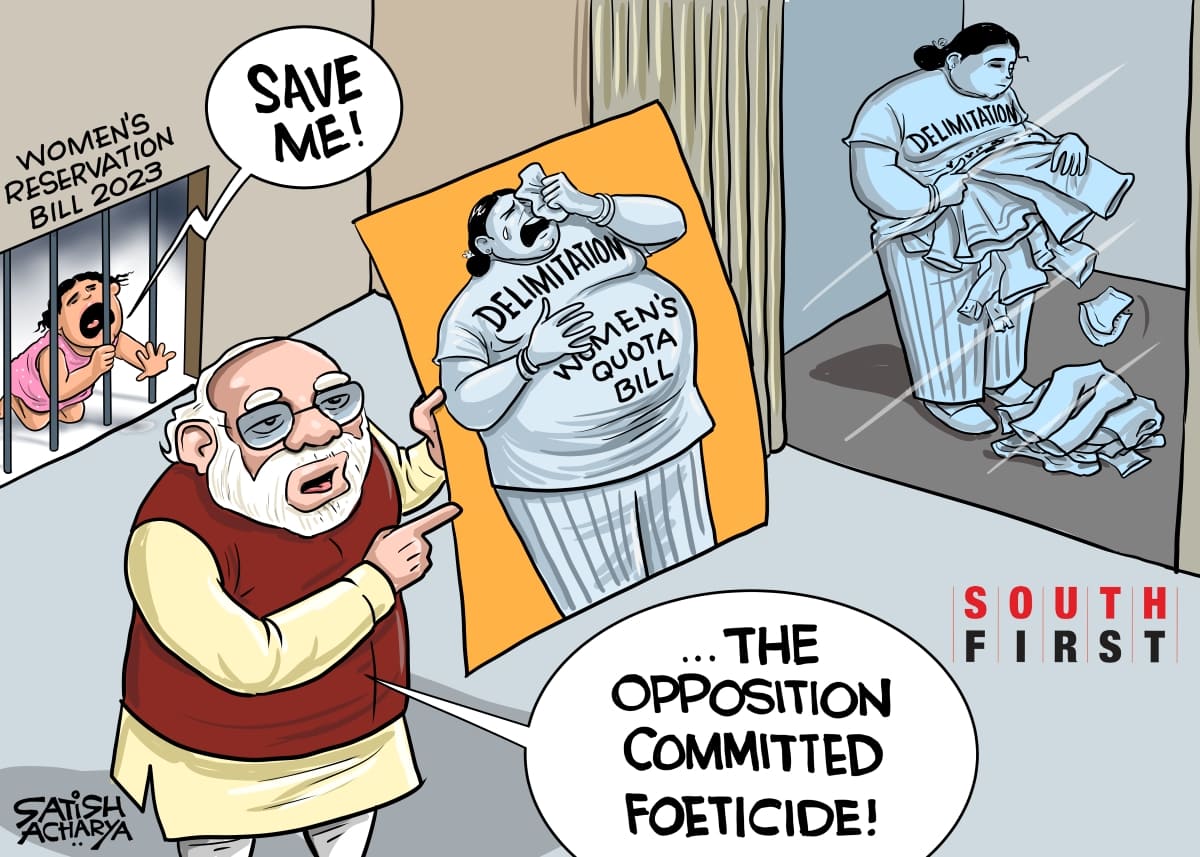
Synopsis: P Chidambaram is worried that the women’s reservation bill could be brought back and serve as a trojan horse for the introduction of the delimitation bill. The former Home Minister also believes that other Opposition parties could be wooed and targeted. Here’s analysing what the BJP is trying to engineer…
In his Lok Sabha address on the Women’s Reservation Bill, Prime Minister Narendra Modi had remarked, ‘Sansad main numbers ka game kya hai woh toh samay tay karega’ (Time will decide the fate of numbers in Parliament).
Having bolstered its Rajya Sabha count, where it is creeping closer to a two-thirds majority needed for constitutional amendments, is the NDA coalition poised to overcome its current ayes deficit in the Lok Sabha too?
The question is pertinent at a time when Congress stalwart P Chidambaram has warned on X that the BJP is planning to bring back the 131st Constitution Amendment Bill, whose main aim purportedly is to reserve one-third of the seats for women in the Lok Sabha and the State Assemblies. According to the former Home Minister (and Opposition leaders), though, the real aim is to seal “delimitation and, possibly, gerrymandering of constituencies”.
Chidambaram went on to add that “after splitting the TMC, the BJP is reportedly wooing the NCP(SP) and the DMK” to get the votes needed to pass the new version of the Bill, but said both the parties are “clear-headed” and “it is expected that they will stand firm in the future too”.
The ground reality is that even with potential support from regional satraps and expected gains in impending bypolls, the Lok Sabha presents a tougher challenge for the BJP-led NDA, which is precariously short of a supermajority.
A series of defections from multiple opposition parties, however, has fueled confidence among BJP apparatchiks about gaining the coveted strength.
Such has been the pace of the political realignments that even BJP acolytes have been left dazed. The Aam Aadmi Party (AAP) rebellion has been followed by a spate of Trinamool Congress defections. There is also the split in Uddhav Thackeray’s Shiv Sena that is likely to see six MPs merge with the Eknath Shinde faction. But the NDA is still well short of reaching the two-thirds majority of 362 MPs in the Lok Sabha.
This is the state of play in the Lok Sabha. 293 MPs support the NDA. If the ruling front gains the support of 20 rebel Trinamool MPs and also of the six Uddhav Thackeray Sena MPs, their tally rises to 319. They are also likely to get support from the YSRCP’s four MPs. If they manage to get issue-based support from the 22 DMK MPs, they still reach only 345.
But as Chidambaram noted, DMK, which has 22 MPs, and NCP (SP), which has eight MPs, should be expected to hold strong in their opposition to the delimitation bill and also other contentious bills. Hence, the moot question is whether other Opposition parties, notably the Samajwadi Party, are going to feel the sting of rebellion next?
As mentioned earlier, the NDA is already within sniffing distance of the two-thirds figure in the 245-strong Rajya Sabha. Its current tally, bolstered by defections from AAP’s Upper House members, victories in the recent bypolls and Trinamool members’ defections, all points towards the attainment of the goal. Moreover, vacancies created by the Trinamool quitters are likely to be filled by the BJP, given its overwhelming majority in the West Bengal Assembly.
Also Read | Governors vs state governments: Can this 36-hour “constitutional fiction” from Brussels help?
Why is it so critical for the saffron ecosystem to ensure delimitation and a one-nation-one-poll modus operandi? Many observers speculate that the ambitious project is an electoral insurance to prolong the dispensation’s hold over the nation beyond the 2029 Lok Sabha polls.
Does the thought process underline that the party is not confident about its second line of leadership having Narendra Modi’s mass charisma and chutzpah? If it is so —and there are very good reasons to believe so — the delimitation of pan-India constituencies could well be an equity-linked insurance with future annuity benefits in store. Prominent opposition leaders have also objected to the fact that redrawing fresh constituencies can hand the BJP a longevity gain on a platter.
At a state level, the formula has already worked to the BJP’s demographic advantage. In 2023, delimitation in Assam restructured constituency profiles in the state’s eastern and central districts to redistribute the Bengali-origin Muslim populace and reduce the number of Muslim-majority seats. The national delimitation roadmap that the BJP desperately aspires to implement ahead of the 2029 General Elections may follow this model.
The BJP is helped by the fact that the objective for some regional satraps and their chieftains is to remain electorally relevant and draw comfort from supporting the NDA. For the others, there is a whole bag of tricks that is being pressed into service. No avenues are being left unexplored.
As the Centre seeks to push through major reforms such as delimitation, women’s reservation and One Nation-One Poll, the alliance blitzkrieg and quid pro quo have begun on a war footing. The plan to stack up numbers is to either garner more ayes or ensure further abstentions in the monsoon session of Parliament. With attrition of federal power and systemic weariness of regional satraps, the BJP is doubling down on its aim to replace India’s highly fragmented, multi-party coalition with a centralised party system, say critics.
The slogan Congress-mukt Bharat in 2014 was coined to purge India of dynastic democracy, but the latest move aims at finishing regional political power blocs too. It must be remembered that the BJP has often critiqued decentralisation, harping on its message that regional parties prioritise caste-based, ethnic interests over national development.
The anti-defection law of 1985 and the 10th Schedule were a response to rampant party hopping. But such has been the flight of MPs that even these safeguards have been rendered toothless.
In the past, every ruling party has tried covertly to weaken its opponents. The BJP cannot then cop all the blame on that score, but the sophistication and brazenness of the latest exercise have shocked many and sundry.
India may well be foreseeing an increasingly transactional Indian polity marked by clandestine political auctioneering and frenetic backstabbing. Here, victory alone is not enough; it must be a victory where the opposition is decimated.
As Indian politics gears up for these tectonic shifts, we only need to think of Priyanka Gandhi’s witty compliment to Home Minister Amit Shah during the debate on the Women’s Reservation Bill, who was left smiling too: ‘If Chanakya had been alive, he would have been shocked…’
The other far-reaching impact: a one-nation-one-poll agenda has been a pet theme for the BJP. It believes that simultaneous polls in states and at the Centre would help national issues such as security and threats to sovereignty gain traction over state issues during assembly polls. They also believe that such an election would maximise the pull PM Modi generates.
Passing and ratifying landmark legislation to reshape the country’s political landscape is what the much-coveted BJP’s legacy has always been. Implementing changes considered implausible, impermissible and beyond the purview since the British left our shores could well be the final nail in the Nehruvian socialist coffin.
Also Read | India in 2050: The world’s second-largest economy—and its hundredth-poorest nation
(Views are personal. Edited by R Rajesh Kumar.)



