
Published Aug 08, 2026 | 4:52 PM ⚊ Updated Aug 08, 2026 | 9:26 PM


Tamil Nadu CM Vijay and Finance Minister N Marie Wilson with their government's maiden budget. (Special Arrangement)

Synopsis: When compared to 20 years ago or even ten years ago, the TN budget numbers reveal that the government is playing an increasingly smaller role in the state’s development. Support from the Centre too has been slipping. So, how achievable is the dream of making the state a $1.5 trillion economy in 10 years?
Tamil Nadu has set itself an ambitious target of becoming a USD 1.5 trillion economy by FY 2036, which requires the economy to grow at about 17% in nominal terms. How achievable is it?
We assume that INR will depreciate at an annual rate of about 2%. The Tamil Nadu government’s own growth rate projection for the next couple of years is 14%, with post-COVID growth being 14.4%. While the state has grown at a nominal rate faster than 14% in the past, what a deep dive into the Tamil Nadu budget reveals is that it is not easy to consistently grow at that pace in the current operating environment and for the next ten years.
The government as well as the private sector will need to mobilise and allocate resources in a way that accelerates growth in capital as well as labour productivity at a much faster rate if this is to be achieved. Importantly, the observed correlation between government expenditure and nominal Gross State Domestic Product (GSDP) has been quite low (0.13) during the last two decades. While the correlation is positive in the pre-COVID period, it was negative during the post-COVID period. The expenditure-growth relationship suggests that some effects of the COVID disruption may still be impacting Tamil Nadu’s ability to grow.
In such a situation, the state needs to redefine its economic role and mobilise the required resources so that the economy can achieve low-risk, high growth. If the proposed long-term goal is to be realised, Tamil Nadu’s resource mobilisation and allocation strategy will need redefining, and the state must also work with the private sector to see how public spending can create a greater multiplier effect.
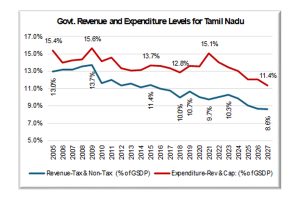
The state has limited its ability to accelerate growth by not mobilising the resources (tax and non-tax revenue) at the same level as in the past.
It peaked at 13.7% of GSDP in FY 2009 and has not crossed 10.7% since FY 2019 – a decade of decline post the GFC (Global Financial Crisis), followed by another eight years of the post-COVID period (Chart 1).
Chart 1: Revenue and Expenditure Level (% of GSDP)
Consequently, the state government’s ability to borrow too is compromised, given the restrictions that the fiscal responsibility framework imposes on the state.
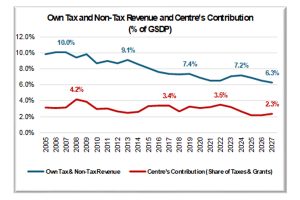
If we break up the state’s revenue receipts, we see a secular decline in its own revenue as well as the resources that it receives from the union government. The average level of support from the central government has been just 3% for the last two decades. Tamil Nadu’s own revenue generation has declined from a peak of 10% to 6.3% of GSDP (Chart 2). Consequently, it has had no choice but to borrow to the extent the fiscal responsibility framework has allowed over the years.
Chart 2: Revenue Receipts – Own and the Centre’s Contribution
While the biggest increase in borrowing was for dealing with COVID, the state was borrowing significant amounts of money even earlier—largely to deal with the post-Global Financial Crisis slowdown. Consequently, the biggest increase in interest cost was not during the COVID period, but between 2012 and 2018—going up from 1.2% to 1.8% of Gross State Domestic Product (Chart 3).
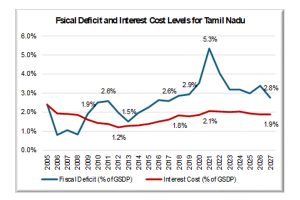
Tamil Nadu’s challenge is not that its interest costs are at an extreme level, but it is that it has not been mobilising adequate tax and non-tax revenue to service its debt. Consequently, it now runs the risk of borrowing an increasing amount for paying interest.
Chart 3: Fiscal Deficit and Interest Cost
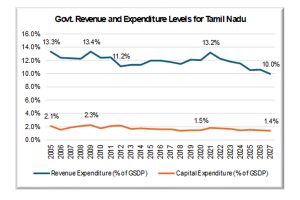
Since the state has limited its ability to mobilise resources, it is constrained from investing too. In a way, it is neither investing nor spending on welfare or other services (Chart 4).
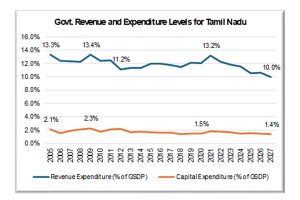
The state’s capital expenditure is down from 2.3% of Gross State Domestic Product (FY 2009) to 1.4% in the budget for FY 2027. Its revenue expenditure too is at its lowest level since FY 2005.
Chart 4: Expenditure Level – Revenue and Capital (% of Gross State Domestic Product)
A decline in expenditure implies that the government is playing an increasingly smaller role in the state’s development. Given that the post-COVID growth rates were lower than in the earlier period, the state needs a strategy that allows it to invest wisely and help accelerate growth.
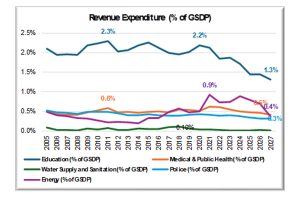
A review of revenue expenditure by service suggests that there is a decline across all services (Chart 5). Even the cost of administrative services and pensions is at historically low levels. We do know that the level of government employment has not been going up.
We also know that the governments, at the state and the union level, have been leaving citizens to fend for themselves even when it comes to basic services like education (private schools, colleges and universities), healthcare (insurance or out of pocket), sanitation (clean your own community and buildings and set up STPs), water (installing ROs at home or buying bottled water), security (private services) and electricity (DGs and now solar).
Chart 5: Revenue Expenditure by Service
Even a review of welfare expenditure does not change the conclusion in any significant way, as the welfare expenditure too has been stagnant at similar levels all these years (Chart 6).
Chart 6: Revenue Expenditure by Basic Services
The aggregate expenditure on these three broad heads of welfare services was 2.6% of GDP in FY 2009 and remains at the same level now (Chart 7).
One change, of course, is that some of the expenditure is seen as election-cycle transfers, as was the case with PM-KISAN during 2019. That is, the government expenditure has become an election-cycle gift or a promise to be made during elections and fulfilled through direct benefit transfers.
Chart 7: Revenue Expenditure by Welfare Service
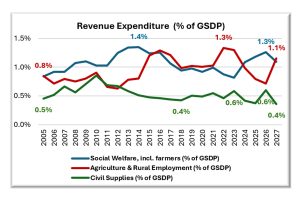
Given that economic growth has been slowing, employment levels and the quality of employment are not what we need, and aggregate household savings rates have fallen, we do need to support household expenditure. However, the same spend reallocated to education, training, healthcare, water, and sanitation may better serve the citizens than election-timed payments as handouts.
In summary, Tamil Nadu’s budget reflects India’s current reality. Tamil Nadu is an industrially advanced state, and, therefore, has a much higher ability to raise resources. It has, however, chosen the path of fiscal consolidation like the Union government and many other states. Consequently, the government now has a much smaller role in the economy, and its ability to provide welfare support and economic and social services too is compromised.
One area where Tamil Nadu has significant untapped revenue potential is property taxation. As one of India’s most urbanised states, the economy benefits from a sustained increase in urban land values, much of which has accrued as private gains. However, the fiscal capacity of the state and urban local bodies has not kept pace with this expansion of the property base. The result is a growing mismatch between the demand for urban infrastructure and the resources available to finance it.
A more effective system of annual property taxation and property-related charges can help address this imbalance while also improving the quality of urban services. However, revenue augmentation must be accompanied by institutional reforms that minimise valuation disputes, reduce incentives for cash transactions, and improve transparency in property records. If designed carefully, property taxation can become an important instrument for financing urban development without imposing excessive distortions on economic activity.
We do believe that the government has a significant role to play at this stage of Tamil Nadu and India’s development. Therefore, we need policies that use public resources in areas where either private capital will not come or demand much higher returns. A misallocation of resources at this stage will make it difficult for the government to fulfil its promises and its role.
Also Read:
First budget of the TVK government: Continuity over consolidation
(Edited by R Rajesh Kumar.)



