
Published Nov 19, 2026 | 9:30 AM ⚊ Updated Nov 19, 2026 | 9:30 AM

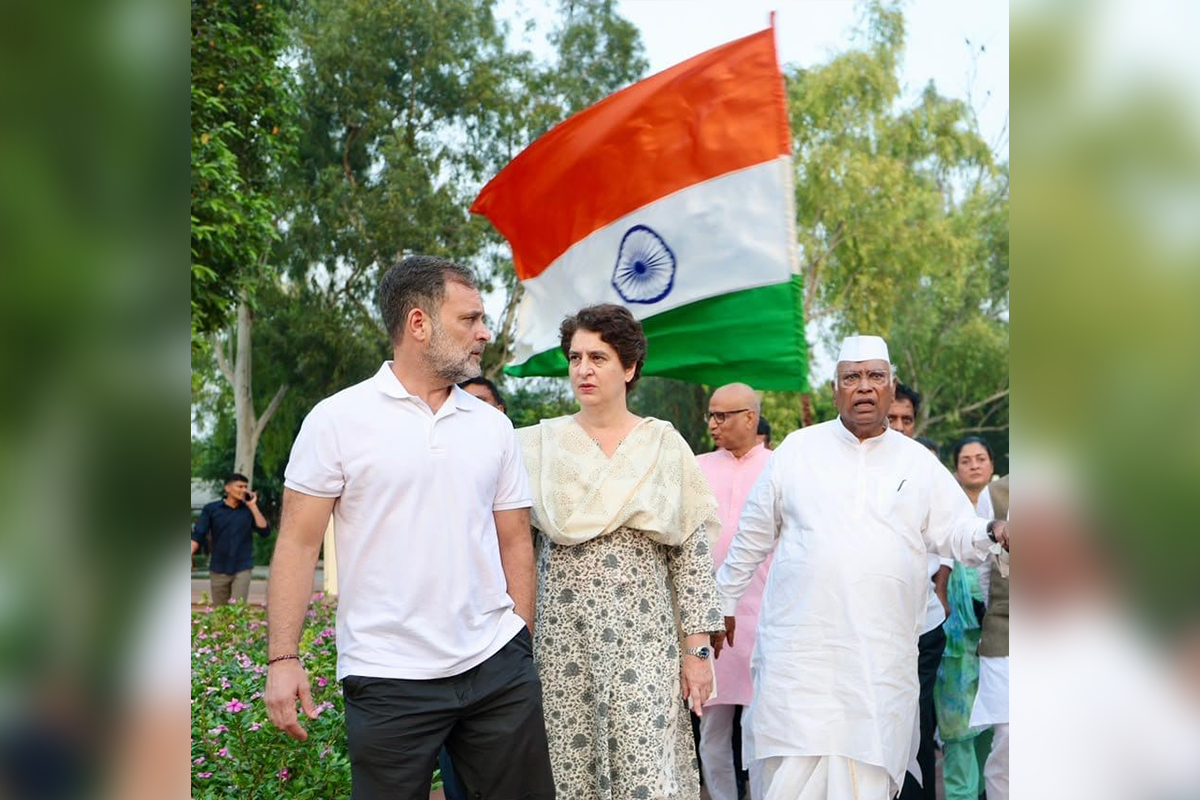
Rahul Gandhi along with Priyanka Gandhi and Mallikarjun Kharge.

The Indian National Congress is attempting to redefine its political identity under Rahul Gandhi’s leadership.
For a party with a long institutional history, this requires more than electoral strategy or leadership changes. It involves rethinking its political language, reconnecting with under-represented social groups and responding to younger generations.
Rahul Gandhi has increasingly placed social justice, constitutional values, gender equality, representation of marginalised communities and youth participation at the centre of his politics.
“Ninety per cent of the population representing Dalits, Adivasis, OBCs and minorities are unrepresented across different fields and there are two different sets of rules although the Constitution is a document of equality,” he famously said at the Samvidhan Samman Sammelan (Conference in Honour of the Constitution) in Panchkula on May 22, 2024.
His approach seeks to move the Congress beyond electoral calculations towards a broader conversation about power, dignity and democratic participation.
Whether it transforms the party’s internal structures remains an open question. But his demand for a nationwide caste census and the slogan ‘Jitni Abadi, Utna Haq‘ have brought representation, institutional power and resource distribution into mainstream political debate.
The issue is not merely about counting communities but understanding who occupies positions of authority, who has access to economic opportunities and who remains excluded from influential institutions. The under-representation of marginalised communities in higher education, bureaucracy, the judiciary and corporate institutions raises fundamental questions about equality in a constitutional democracy.
This emphasis creates an opportunity to engage with Jyotirao Phule, Periyar and Dr Ambedkar, whose intellectual traditions challenged social hierarchies and exclusion. Their contributions remind us that political democracy cannot become meaningful without addressing unequal social and economic power. However, the Congress must demonstrate this commitment through organisational leadership, candidate selection and decision-making rather than limiting social justice to speeches and election manifestos.
Another important dimension of Rahul Gandhi’s political language is his invocation of Dr BR Ambedkar and the Constitution.
By placing constitutional values at the centre of political debate, he connects contemporary struggles with equality, liberty, fraternity and justice. Initiatives such as Run for Ambedkar and Run for Constitution have contributed to this engagement.
However, Dr Ambedkar’s intellectual legacy cannot be reduced to commemorative events or political symbolism. It demands engagement with caste, social exclusion, economic inequality and institutional discrimination. For Dr Ambedkar, constitutional democracy was inseparable from social democracy.
The Constitution provides a framework for political equality, but society must also transform so individuals can exercise their rights with dignity and self-respect. Rahul Gandhi’s emphasis on constitutional protection and representation creates space for these questions. The challenge is to translate this language into institutional equality and social transformation.
Gender equality has also become part of this emerging political vocabulary. The special women’s edition of Chhatron Ki Goonj in Pune, organised in August 2026, addressed women’s freedom, safety, harassment and patriarchy. Its message, “Smash the Patriarchy, Break the Cage”, placed women’s autonomy and agency at the centre of discussion.
Gender inequality is embedded in social institutions, family structures, educational spaces and public life. Moreover, women experience discrimination differently.
Caste, class, religion and location shape their access to education, employment, safety and political representation. Inclusive gender politics must therefore recognise the specific experiences of women from marginalised communities rather than treating women as a homogeneous category.
Chhatron Ki Goonj represents another significant aspect of Rahul Gandhi’s political outreach.
Beginning in Kota in June 2026, the programme has engaged students on examination irregularities, paper leaks, rising educational costs, unemployment and the gap between educational qualifications and employment opportunities. Its relevance extends beyond electoral mobilisation.
Young people increasingly face uncertainty despite investing years in education and professional preparation. Examination disruptions, recruitment delays and unequal access to quality education have weakened confidence in public institutions.
By creating spaces for students to express their concerns, the initiative recognises them not merely as future voters but as citizens with immediate demands. Its lasting value will depend on whether these interactions lead to sustained engagement, policy interventions and opportunities for young people to influence political priorities.
Rahul Gandhi’s Bharat Jodo Yatra and Bharat Jodo Nyay Yatra similarly reflect an effort to reconnect politics with ordinary citizens. Walking across regions, meeting people and listening to their experiences offered an alternative to conventional rallies and televised speeches. These journeys created opportunities to discuss unemployment, inequality, social divisions and justice.
The Bharat Jodo Yatra that saw Rahul cover almost 7,000 kms might have had tangible benefits. Economists Utkarsh Choudhary and Sumit Mishra analysed Election Commission of India data from the 2024 general elections and found that the Congress’ “vote share for constituencies covered by the Bharat Jodo Yatra was higher by roughly six percentage points than other constituencies”.
At a time when political communication is increasingly shaped by spectacle and digital messaging, direct engagement can help rebuild public trust. However, these interactions must translate into the party’s everyday political work.
Rahul Gandhi’s white T-shirt has also become part of his public political identity.
“I am often asked why I always wear a ‘white T-shirt’ — this T-shirt symbolises transparency, solidity and simplicity for me,” he had explained two years ago.
During and after the Bharat Jodo Yatra, it became a recognisable feature of his public presence. Political appearance contributes to how a leader is perceived. Clothing and public conduct can communicate a particular political identity. However, a recognisable image cannot substitute for ideological clarity, organisational credibility or sustained public work.
Rahul Gandhi’s evolving political approach suggests an attempt to establish a new political grammar for the Congress, bringing social justice, constitutionalism, gender equality, youth participation and public engagement into a common framework. Its significance lies in creating space for questions central to India’s democratic future.
The task ahead is more difficult than articulating a new vocabulary. The Congress must demonstrate that its commitment to representation extends to its organisational structures, that its engagement with Dr Ambedkar goes beyond symbolism, and that its outreach to women and young people produces meaningful participation.
Political transformation is measured not only by the language leaders adopt but also by the institutions they build and the power they are willing to share. Rahul Gandhi’s efforts have opened an important conversation about the Congress’s direction. Whether this becomes a durable political transformation will depend on the party’s ability to turn these interventions into consistent democratic practice.
Also Read:
Forget NDA vs INDIA, Modi vs Rahul: The real battle is between universal and limited franchise
(Akhilesh Kumar is a PhD Research Scholar at Jamia Millia Islamia, New Delhi, and an independent writer. Edited by R Rajesh Kumar.)



