


Published Sep 17, 2026 | 2:05 PM ⚊ Updated Sep 17, 2026 | 3:58 PM

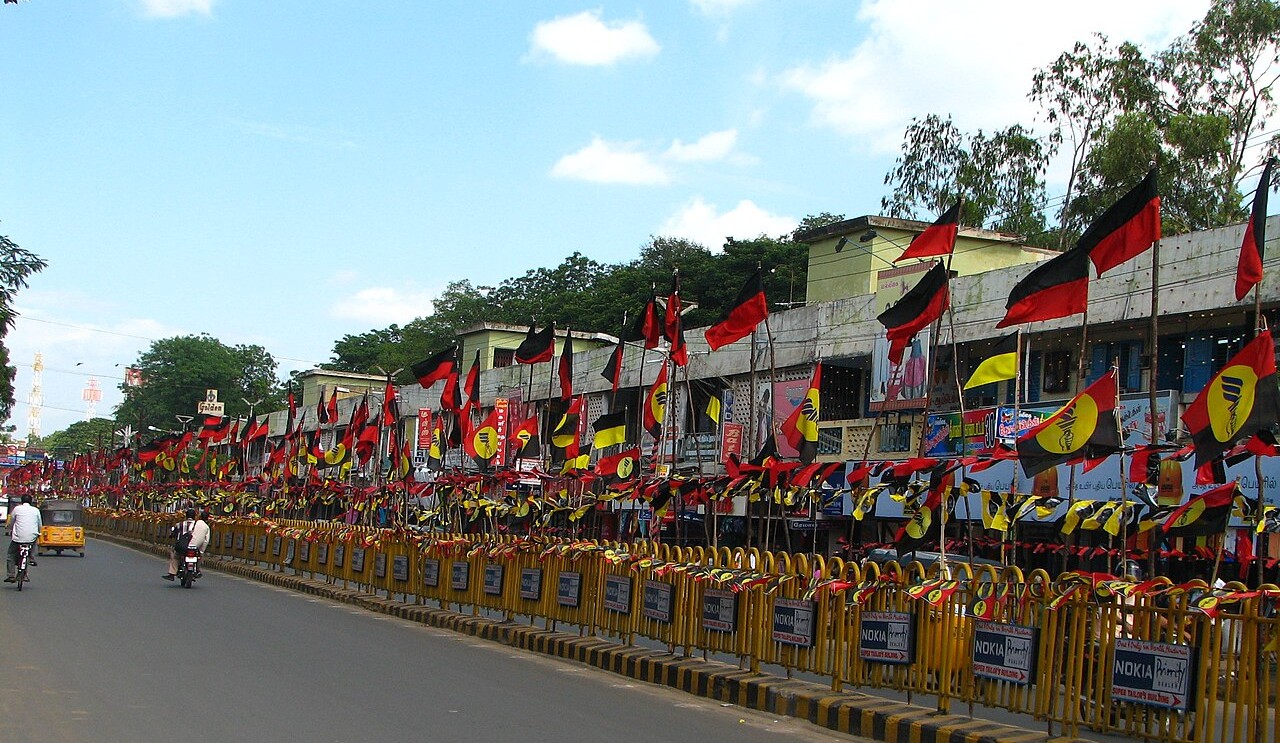
The DMK faces the twin challenge of remaining an electoral war machine without compromising its ideologically rooted social-movement character.

Synopsis: DMK must listen to changes and address emerging issues. It should represent a diverse society and make a positive impact. It needs to accommodate a new set of cadres, identify their potential, and provide them with a platform to grow within the party. It must maintain its ideologically rooted base while becoming a pluralist party to advance its social justice agenda and deliver electoral results.
Tamil Nadu celebrates September as the Dravidian month. The birth anniversaries of iconic Dravidian leaders Periyar and Anna and the founding day of the DMK (17 September) fall in the same month.
The Dravida Munnetra Kazhagam (DMK) calls it ‘Moopperum Vizha’ (three grant celebrations). Its celebrations this year, however, lacked sheen.
The 23 April elections to the state Assembly have upset the DMK, as it lost power to the new entrant Tamilaga Vettri Kazhagam (TVK). The TVK, which emerged as the single-largest party, assumed power with the backing of once DMK allies.
Beyond the overall electoral defeat, the DMK was shocked as its key seniors, including its President and General Secretary, lost the race. The party hoped to retain power, banking on its numerous welfare schemes, formidable alliance formation, multi-contested battles, and extensive campaign and digital advertising.
The unexpected results exposed the dire need for party restructuring and a top-to-bottom revamp; with this realisation, MK Stalin has kick-started systemic organisational reforms.
This article analyses the changing reality of electoral politics confronting the party, the obstacles it faces in winning over Gen-Z, the scope of reforms, and the organisational challenges of transforming a grand old regional party like the DMK.
Also Read: DMK set for major overhaul
DMK has many firsts to its credit. It is the first regional party to win power with a full majority, has retained its electoral symbol for over 75 years, and has had uninterrupted representation in Parliament (at least in the Rajya Sabha).
The party is known for its ideologically rooted commitment to state autonomy, secularism, and linguistic plurality, and it became a model for integrating social justice and welfare objectives with a liberal economy.
Indira Gandhi famously called “Gujarat and Tamil Nadu as two islands of defiance”. The South Indian state effectively prevented the Emergency from being used against dissent. The party paid for it heavily: the government it headed was dissolved, and senior leaders, including MK Stalin, son of the then Chief Minister M Karunanidhi, became targets and were tortured under the Maintenance of Internal Security Act (MISA).
The DMK was among the first to oppose and pass a resolution against the Emergency promulgated in June 1975. In many domains, the party has set standards for others to follow. These include empowering women with property rights, reserving government posts, vertically widening and horizontally sub-categorising reservations to accommodate the marginalised, and identifying and tapping the information technology boom by creating adequate infrastructure to sustain its growth.
Despite flaunting the ‘saviour’ of democracy and ‘victim’ of Emergency tags, the DMK lost the 1977 elections to a new entrant, the All India Anna Dravida Munnetra Kazhagam (AIADMK), led by actor-turned-politician MG Ramachandran. (The ADMK had earlier prefixed “All India” in 1976 to its name to protect the party from any possible persecution of state parties.)
The DMK remained out of power for a long time. AIADMK under MGR governed the state from 1977 until he died in 1987. The DMK suffered another major setback following the assassination of Rajiv Gandhi at Sriperumbudur on 21 May 1991. The party was accused of complicity in the assassination.
This led to severe retaliation: The party’s mouthpiece, Murasoli, was set on fire, party flags were torn down, local functionaries’ homes were looted, and cadres were brutally beaten. Since then, the party has lost every alternate election and faced persistent, unproven allegations—most notably the 2G scam that dominated national headlines, though the eventual acquittals received a fraction of the coverage.
For decades, its leaders have endured calculated charges, with malicious personal attacks hardening into generational folklore.
Notably, when Anna founded the DMK, the party was exceptionally young: Anna was just 40, while first-rung leaders like Nedunchezhiyan were 29, Anbazhagan 27, Kalaignar Karunanidhi and Aasai Thambi 25, and Mathiyazhagan 23.
With many cadres in their late teens and early 20s, most were not even old enough to contest in the country’s first general election. But in the 1952 election, they actively campaigned for candidates and parties that championed the demand for ‘Dravida Nadu’ in the Assembly and Parliament.
In their first electoral battle in 1957, the young party faced the grand old, deeply entrenched Indian National Congress and Communists and secured 15 seats. In 1962, it emerged as the main opposition with 50 MLAs, and came to power in 1967.
Until then, the party had not faced any structural or organisational challenges as it welcomed new members and assigned roles as it grew vertically and horizontally.
The first major challenge came after the death of its founder, CN Annadurai, in 1969. The party was divided over whether M Karunanidhi or VR Neduchezhiyan should be the successor. However, the party reached a compromise by creating a leader’s post and appointing Neduchezhiyan as the general secretary.
The real physical divide came in the next decade. Ramachandran (popularly known as MGR) split the party and managed to keep a significant number of key organisers and cadres with him.
The prolonged period in the opposition forced the DMK to reform. By then, second-rung leaders had reached their 40s and 50s, and the party launched a statewide membership drive to attract the next generation.
MK Stalin was assigned the task. The party appointed him the secretary of the newly-formed youth wing. He toured the entire state, identified large potential cadres at the district level, and nurtured them. Later, these same youth-wing leaders emerged as the party’s icons at the state and national level.
The party’s auxiliary wings contributed immensely to its growth. However, it began solely with a student wing—the Dravida Maanavar Munnetra Kazhagam— and the DMK progressively established specialised fronts, including the Women’s Wing, the Labour Wing (Thozhilalar Munnetra Sangam), and the Legal Wing to defend the party in courts.
To represent diverse demographics and carry its message deeper into society, the DMK eventually formed over 20 such affiliated wings. However, in practice, their operational scope often remained constrained, remaining largely dependent on the backing and autonomy of the district units.
Also Read: Inside the quiet downsizing of DMK’s digital empire
Since its inception, the DMK largely relied on its district units, which have a decentralised power structure. Initially, the party aligned its structure with the Tamil Nadu administrative district map, and 20 district secretaries handled all functions.
The secretaries enjoyed undisputed power in their administrative zone as they handled the party’s day-to-day affairs. Beyond regular functions, they had significant influence over selecting candidates for Assembly and Parliament and local body elections, and managing campaigns responsible for electoral outcomes.
Whenever the DMK is in power, the district secretaries are the preferred choice for ministerial posts, and they were elevated to key state-level positions. However, in the long run, this strength became the party’s weakness, as district secretaries retained their posts for long periods and increasingly became a curse for the party. Their unfriendly attitude distanced people, their accumulated wealth sparked corruption charges, and their inner circle prevented natural power transfer.
Instead of serving as a bridge between district-level cadres and party headquarters, district secretaries became a barrier, blocking cadres from reaching leadership to voice grievances. Though the DMK conducts periodic party elections, the sitting district secretaries effectively blocked career growth within the party and expelled dissenters.
Disillusioned cadres found hope in a handful of parties that gradually emerged. These parties recruited cadres from disappointed DMK functionaries. In recent years, the DMK has had fewer members from the new generation than the Naam Tamilar Katchi (NTK) or TVK.
However, over the years, DMK increased its district units from 20 to 77. Now, it intends to increase the number further to 110, with about two assembly constituencies per party district. It may seem logical to raise the number of district units to strengthen a decentralised party across the state, but the recent poll results told a different story.
TVK emerged as the single largest party in the Assembly. The outfit comes across as an amateur party with no credible organisational structure. Even its cadres don’t seem to be in a position to recognise their district secretaries, and the secretaries wield little influence over their district units. Its leader, actor-turned-politician C Joseph Vijay, has not even visited every district. Nor did he unleash an effective campaign against the DMK. But he secured 108 seats in the 2026 Assembly Elections.
Also Read: Fair Delimitation, not ‘No Delimitation’: Has the DMK really changed its stand?
The law of diminishing returns, an economic theory, can be used to analyse political parties’ performance in the electoral cycle and voters’ behaviour. When a political party reaches its saturation point, additional efforts won’t yield expected results; it starts to decline despite extra spending on finance, campaigns, schemes, etc.
The influx of a new generation of voters in every election further accelerates diminishing returns. A party like the DMK still cannot comprehend Gen Z or similar groups, born into a neo-liberal, globalised world, without any natural understanding of the role of government in poverty alleviation, necessities, and the struggle to implement affirmative action or welfare schemes that uplift millions of people.
DMK under Karunanidhi initiated 30% reservation for women in government jobs, which benefited thousands. Similarly, Arundathiyar or Muslim internal reservation and property rights for women won’t influence the current generation. They have never needed such schemes. They care only about contemporary problems and priorities that align with their views.
If it doesn’t create awareness of the situation and rationale, DMK’s campaign promoting such schemes among the new generation is counterproductive. The emergence of the Cockroach Janta Party (CJP) and its supporter base is a new reality for political parties. They need to revamp their structure by attracting more young people and creating an environment for them to grow.
Shifting public speeches to Instagram won’t completely alter youth voting patterns, but accommodating them more in party representation will pay dividends. Another major change is fair representation. DMK is known for social justice advocacy, and unfortunately became an OBC trap as it successfully ended the Brahminical dominance in the Madras Presidency, without sharing power with the marginalised.
Currently, DMK has only three district secretaries from Scheduled Caste communities. It needs to increase their strength proportionately and at all levels. Local communities must fill the bottom of the ladder. Twenty per cent of the population belongs to SC, but the party has only three SC district secretaries. It is not fair representation.
DMK needs to develop a formula to ensure fair representation of women, SC, ST, and minorities at all levels of the organisation. Merely increasing the number of district secretaries will not fulfil the party’s objectives. It needs to shift its public image and strengthen outreach to win over voters, including Gen Z.
In this regard, announcing intra-party elections, introducing age limits, and capping tenure limits for key positions—including district and union secretaries—are welcome reforms. These structural changes will create avenues for fresh faces to step into leadership and foster healthy competition within internal party dynamics.
Unlike previous generations, Gen-Z and first-time voters consume a lot of content but retain little. They judge century-long protests by reading paid or propagated AI-generated memes without questioning their credibility or verifying their authenticity.
DMK, like old parties, still cannot fully transform itself for new voters. Its long speeches and multi-page articles do not resonate with its audience on the electoral ground. DMK is regarded as a party that perfectly used theatre and cinema to its advantage, but it now lacks strategies to attract and retain new audiences.
In recent days, NTK Saattai Duraimurugan videos were largely viewed and circulated more by hardcore DMK cadres. This reflected the DMK’s content deficit and its difficulty in presenting its views to the current generation.
The Assembly elections showed how TVK used a professional digital team to attract and consolidate an influencer network, generate anti-incumbency, and build support for Vijay. Numerous influencers were on its payroll. However, the DMK’s IT wing, apparently unaware of such developments, did not initiate countermeasures. These failures need urgent fixes and the induction of professionals.
Unlike the AIADMK or other parties, the DMK faces the twin challenge of remaining an electoral war machine without compromising its ideologically rooted social-movement character. It must overcome these challenges to retain power and stay relevant.
The party was neither formed nor did it earn votes along caste lines or religious identity. Nor did it develop its cadres solely on personality. It gradually built its foundation by consolidating the inclusiveness of various suppressed and marginalised communities and uniting them through a robust party structure, using secular social justice as the binding force. Despite a limited and disrupted tenure in power, the DMK achieved key successes by preserving the state’s Tamil identity and initiating various welfare and development steps.
The post-neo-liberal international order has its own challenges, and South India is not insulated from its impact. The globalised market hits whenever its supply chains fracture and unilateral sanctions affect millions worldwide.
DMK must listen to these changes and address emerging issues. It should represent a diverse society and make a positive impact. It needs to accommodate a new set of cadres, identify their potential, and provide them with a platform to grow within the party. It must maintain its ideologically rooted base while becoming a pluralist party to advance its social justice agenda and deliver electoral results.
(Views are those of the authors. Edited by Majnu Babu).



