

Published Sep 16, 2026 | 1:15 PM ⚊ Updated Sep 16, 2026 | 1:15 PM

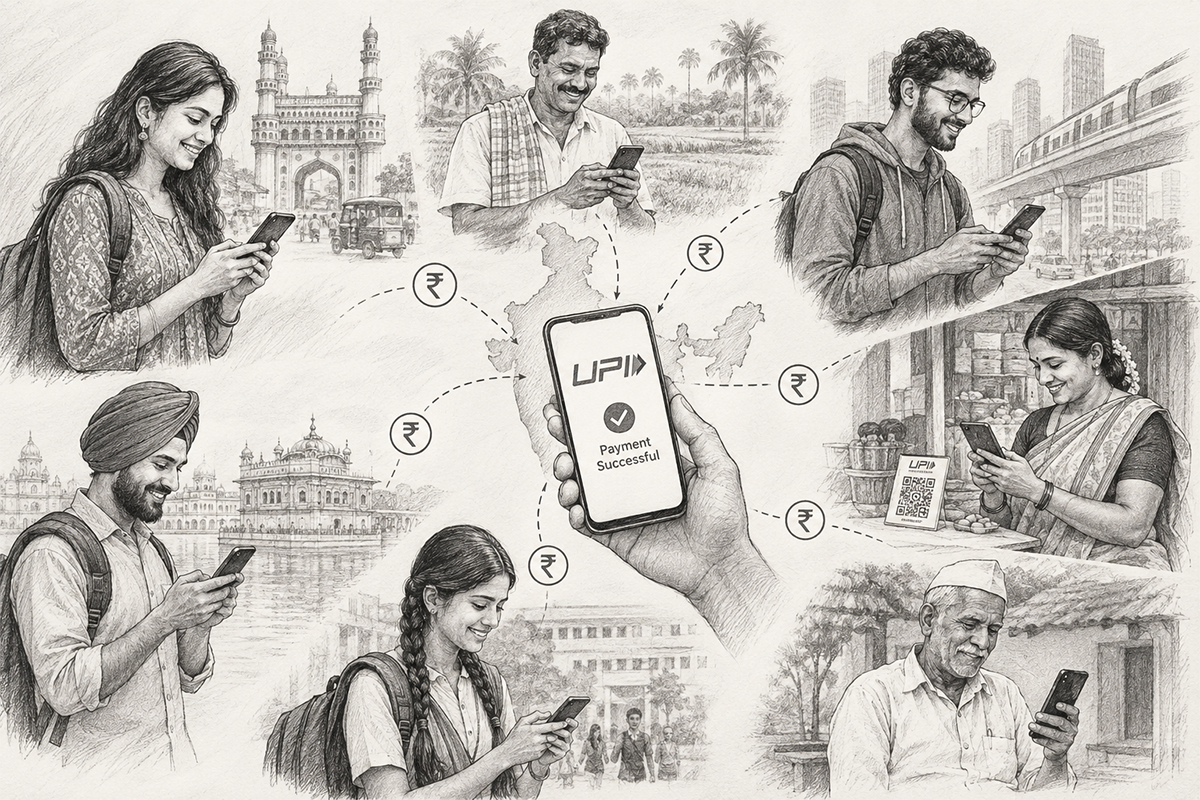
More than 55.49 crore Indians have been onboarded on the UPI platform. (AI generated image)

Synopsis: The more important question as UPI enters the paid-service era is this: who are the Indians behind the crores of transactions daily? Numbers such as 2,365.8 crore transactions valued at ₹29.87 lakh crore in July 2026 establish scale. They do not, however, establish inclusion.
September 15 has thrown the spotlight back on India’s digital-payment revolution as the government announced a new Merchant Discount Rate (MDR) on specific merchant transactions above Rs 2,000. Now is a good time to reflect on UPI’s success that is often measured in crores of transactions. This is the easiest number to celebrate—and perhaps the least revealing. The more important question is this: who are the Indians behind those transactions?
The answer tells a far more consequential story. UPI is no longer a payment facility used mainly by the urban middle class with smartphones and bank accounts. It has penetrated the informal economy, reached small merchants and made the mobile phone a de facto extension of the bank account. The QR code at a roadside tea stall may say more about India’s economic transformation than the payment terminal at a five-star hotel. The fact that 96% of the transactions on the platform are below Rs 2000 is telling.
It shows how UPI has grown from a digital banking innovation into a piece of everyday economic infrastructure. More than 55.49 crore Indians have been onboarded on the UPI platform, while an enormous merchant network accepts it. In July 2026, UPI saw 2,365.8 crore transactions valued at ₹29.87 lakh crore. Such numbers establish scale. They do not, however, establish inclusion.
That distinction is important.
A transaction is not a person. One individual can operate multiple bank accounts, UPI IDs and payment applications. Nor does India have a single definitive public database that neatly divides UPI users by income, age, gender and geography. Consequently, claims about the “typical UPI user” need caution.
Yet the direction of travel is unmistakable. UPI began with a strong urban and digitally literate constituency: students, salaried employees, online shoppers and smartphone users. It has since moved into a much larger universe of small traders, street vendors, drivers, artisans, neighbourhood retailers and rural businesses.
This is where UPI’s economic significance lies.
For a customer, scanning a QR code instead of handing over cash may appear trivial. For a small merchant, it can mean no change to maintain, no cash to count and a direct connection between daily business and the banking system. A ₹30 vegetable purchase, a ₹100 auto fare and a ₹500 grocery bill can all enter the digital financial trail.
The distinction UPI has blurred
UPI has consequently blurred an old distinction in Indian finance: the distinction between the formal and informal economy.
But another concentration has emerged. The infrastructure is interoperable; the applications through which people access it are not equally distributed. PhonePe has accounted for roughly 46 per cent of UPI transaction volume, while Google Pay has occupied the low-to-mid 30 per cent range. Paytm has remained in single digits. The two leading platforms together still account for around four-fifths of transaction volume, although their combined share has been gradually declining.
These numbers should not be confused with user penetration. If PhonePe processes 46 per cent of transactions, it does not mean 46 per cent of Indians use PhonePe. It indicates the application’s share of the relevant UPI transaction market.
That distinction also reveals an important feature of India’s digital architecture. UPI itself is not owned by any one consumer-facing application. It functions as an interoperable payment rail on which competing applications operate. The public infrastructure and the private interfaces are therefore two different layers of the same revolution.
UPI’s dominance within retail digital payments is even more significant. It now accounts for more than three-fourths of India’s retail digital-payment transactions. Internationally, India has become the largest adopter of real-time payments, with UPI accounting for nearly half of worldwide real-time payment transaction volume.
The next UPI revolution
But triumphalism carries its own danger.
The existence of a QR code does not prove universal digital inclusion. Millions of Indians continue to face barriers involving smartphones, connectivity, digital literacy, banking access, language, age and trust. Elderly citizens and sections of poorer households cannot be assumed to have entered the digital economy merely because UPI is available to them.
There is also a less visible question of dependence. As everyday payments migrate from cash to digital systems, reliability, cybersecurity, privacy and consumer protection become economic necessities rather than technological luxuries. A payment system that becomes indispensable must be judged not only by how many transactions it processes but also by how resilient and accessible it remains when something goes wrong.
The next UPI revolution, therefore, cannot simply be another increase in transaction volumes. It must be an expansion in the quality and breadth of participation.
Voice-based payments, vernacular interfaces, feature-phone access, stronger fraud protection and simpler grievance mechanisms could determine whether UPI becomes genuinely universal. The objective should not be to eliminate cash by administrative enthusiasm, but to ensure that digital payments are accessible enough that people can choose them without being excluded when they cannot.
The greatest achievement of UPI is that digital payment has ceased to look digital. It has become mundane. People scan, pay and move on. Will it continue now that the first set of charges have been brought in? It remains a question for another day.
What India has already demonstrated is that hundreds of millions can be brought onto a common digital payment network. The unfinished task is to ensure that the farmer and the financier, the street vendor and the corporate executive, the pensioner and the student are not merely counted as transactions, but are equally capable participants in the financial system.
The real measure of UPI’s success will not be another record month. It will be whether India can turn its extraordinary digital-payment scale into equally extraordinary financial inclusion.
From our archives:
Towards a sustainable UPI: How India’s digital payment revolution can reinvent itself
(Edited by R Rajesh Kumar.)



