

Published Sep 15, 2026 | 12:59 PM ⚊ Updated Sep 15, 2026 | 3:13 PM

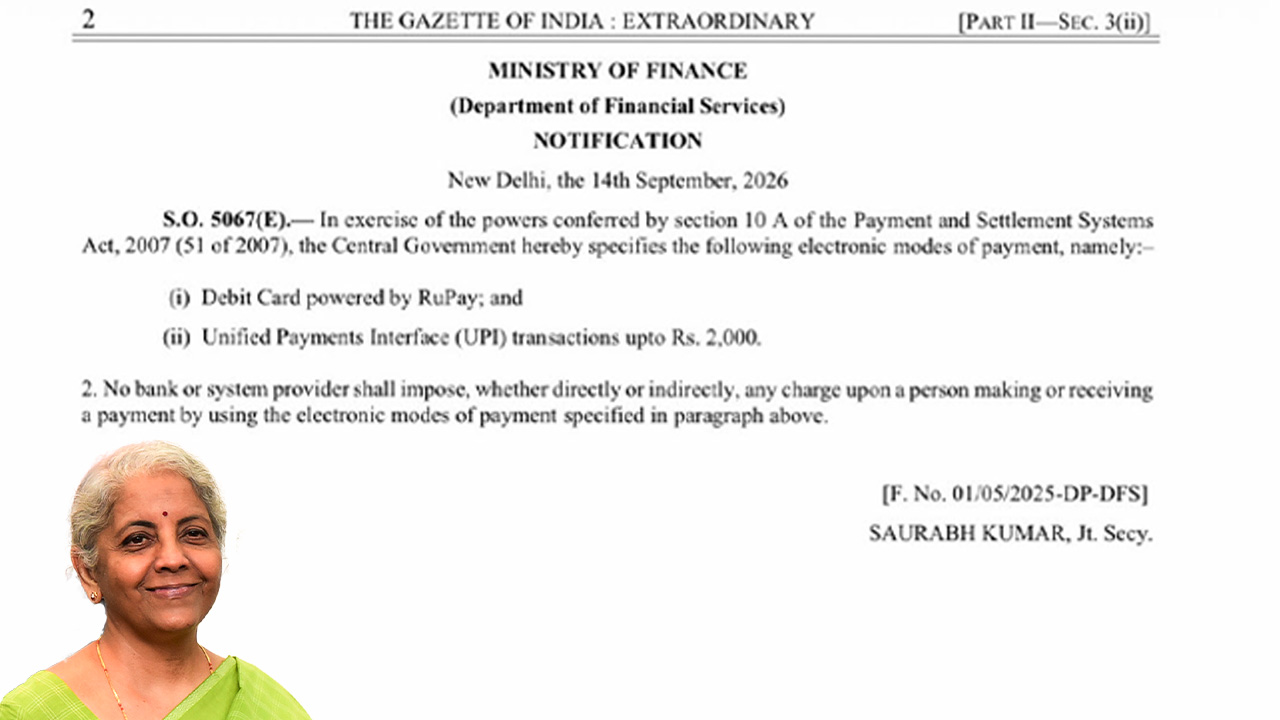
UPI notification with Finance minister Nirmala Sitharaman inset.

Synopsis: Professor Anil Sood, a financial expert, said the new notification could lead to
“pricing for profitability” emerging as a choice for service providers like GPay, PhonePe and banks. The UPI is the world’s largest real-time payment network, with 241.6 billion transactions in FY 26. Over 550 million Indians use it.
The Ministry of Finance’s notification that banks must not impose any charges on payments up to Rs 2,000 through RuPay-powered debit cards and UPI transactions has triggered speculation about charges being imposed on payments above that threshold.
“No bank or system provider shall impose, whether directly or indirectly, any charge upon a person making or receiving a payment by using the electronic modes of payment — ‘Debit card powered by RuPay’ and ‘Unified Payments Interface’ transactions up to Rs 2000,” the notification issued on Monday, September 14, said.
Transactions below Rs 2,000 account for 96% of the UPI transaction volume.
Currently, UPI transactions attract no charges.
Professor Anil Sood, a financial expert, saw it as the first step towards making UPI commercially attractive for service providers.
“With the current set of enabling provisions, the digital payment system is evolving toward implementing a commercial service structure. Consequently, pricing for profitability is likely to emerge as the choice for service providers. I see the move to charge for high-value transactions as the first step in this direction. The government’s move to not allow fees to be charged for transactions less than ₹2,000 will mean that either the government support will continue or the service providers will cross-subsidise small-value transactions through earnings from high-value transactions,” he said.
He also flagged the risk of escalating costs.
“Digital payments will be preferred in the long run, given their cost efficiency. We will have to, however, assess the impact on transaction volume once the banks start charging a margin over the system cost for digital transactions. Over time, banks and other payment service providers are likely to view digital payment systems as a potential source of revenue and profit. Given that it is a retail consumer-based business, the pricing power will always be with banks and digital payment service providers like Google Pay and PhonePe,” he said.
Many critics had pointed to the possibility of UPI transactions becoming chargeable when the Union government amended the Taxation and Other Laws (Amendment) Bill, 2026, on August 6, 2026. The amendment removed the statutory guarantee that had kept UPI transactions free until now.
The Reuters news agency was quick to headline the possibility of “fees on large payments made via UPI system“.
Business channel CNBC-TV18 quoted sources as saying that “guidelines may be issued” as early as next week.
Congress spokesperson and former Union Minister Jairam Ramesh was quick to slam the move.
“Just as we warned on August 6, 2026, to which the Hon’ble FM herself had deemed it fit to respond, the Modi Govt is now using new laws bulldozed through Parliament to start the process of charging for UPI.
“A notification has just been issued under the amended Payment and Settlement Systems Act, 2007, that prohibits banks and providers from charging only for UPI transactions under ₹2,000. But there is NO explicit protection for any transaction above this cap.
“The stage is clearly being set for all of us to pay a fee for UPI transactions. Tomorrow the cap itself might be changed with another such notification—there is no longer a guarantee in the law. For all we know, the govt can introduce a charge for daily person-to-person transactions as well.
“The Modi government has yet again shown a complete lack of honesty and transparency and has broken the trust of users. Is all of this being done to open digital payments for American companies to appease President Trump?” he asked on X (formerly Twitter).
Ramesh was referring to his earlier point about the move being driven by the US Trade Representative’s 2026 report, which criticised UPI and RuPay for being free and accused them of driving out American payment platforms like Visa and Mastercard.
Ramesh had previously accused the Prime Minister of bowing to pressure from US President Donald Trump and diluting UPI when the bill was passed.
A former Minister of State for Commerce, Ramesh maintained that “the RBI has the financial capacity to sustainably fund the UPI ecosystem without imposing charges on merchants or consumers. In 2025-26, the RBI transferred Rs 2.86 lakh crore to the Modi Government. It would take only a small fraction of this surplus transfer to support this critical digital public infrastructure.”
The official Congress handle, meanwhile, predicted a 0.5% charge on every payment above Rs 2,000 while criticising the government for its “loot the public as much as possible and fill your friends’ coffers” mentality.
Journalist Suhasini Haidar asked why the government could not reduce or end income tax if it planned to levy so much expenditure tax on salaried taxpayers.
Moneycontrol’s Chandra R Srikanth tweeted that the UPI committee was likely to meet this week to decide the Merchant Discount Rates (MDR) on transactions above Rs 2,000. MDR is the fee banks and payment gateways charge merchants for processing a payment. As is the norm, merchants are expected to pass on the extra cost to customers once these charges are imposed.
UPI is the world’s largest real-time payment network. In July 2026, UPI saw 23.6 billion transactions valued at ₹29.87 trillion. More than 55.49 crore Indians use it. The financial year that ended (FY 26) saw 241.6 billion transactions valued at ₹314 trillion. UPI payments are also active in 11 countries besides India. Google Pay and PhonePe are the biggest UPI platforms.
Also Read:
Towards a sustainable UPI: How India’s digital payment revolution can reinvent itself
(Edited by R Rajesh Kumar.)



