

Published Sep 14, 2026 | 3:30 PM ⚊ Updated Sep 14, 2026 | 3:30 PM

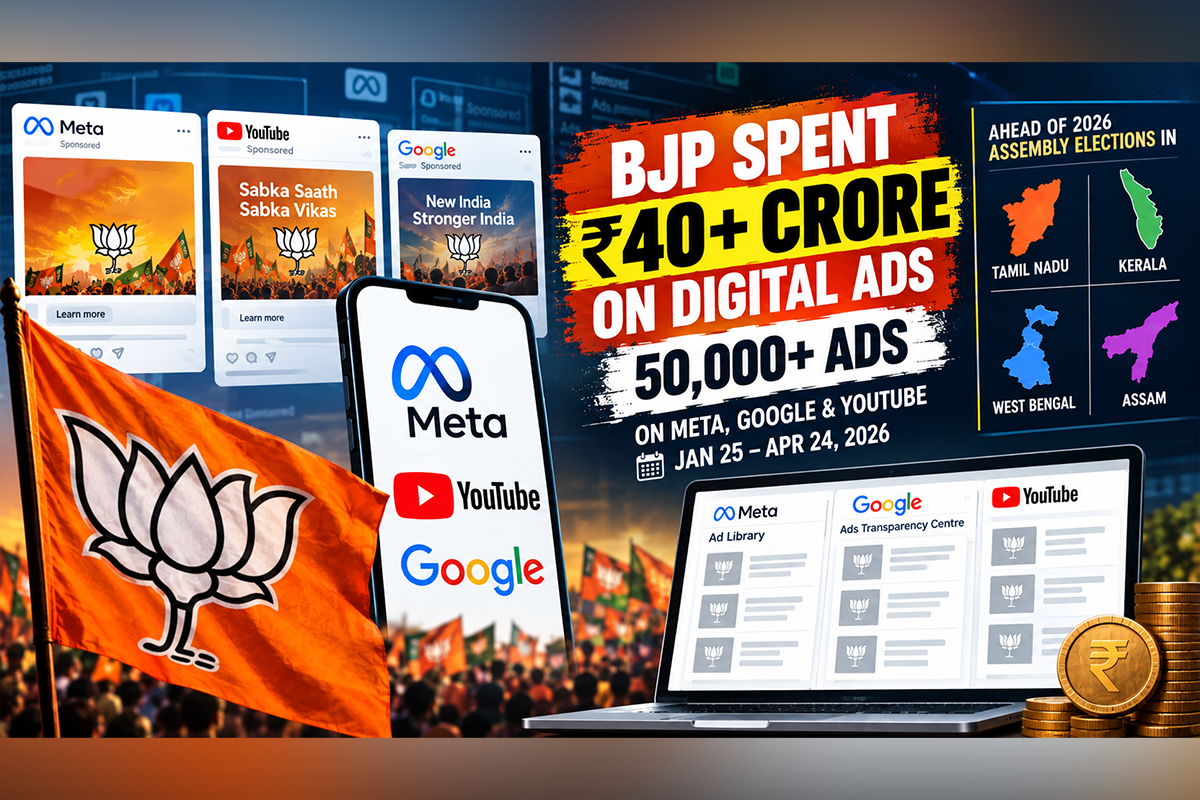
Image used for representational purpose. (AI generated image)

Synopsis: Social media enables micro-targeting of swing demographics, rapid counter-messaging, livestreaming of rallies and continuous internal coordination. Yet India, which Nobel laureate VS Naipaul once called the land of a million mutinies, remains too vast, diverse and grounded for any single medium to dominate permanently.
Indian political parties are increasingly mistaking the volume of social media for the substance of political power.
Over the past decade, digital platforms have moved from the margins of campaigning to its core. WhatsApp groups, X timelines, Instagram reels, YouTube shorts and Facebook pages now shape narratives, mobilise cadres and target voters with a degree of precision once unimaginable.
The 2024 Lok Sabha elections, widely viewed as a digital contest, and subsequent state polls in Bihar, Uttar Pradesh and Assam have only deepened this dependence. The critical question is whether the reliance has become excessive and whether social media strategies have proven more productive for parties’ long-term prospects than the traditional architecture of organisation, welfare delivery and ground-level engagement.
Empirical evidence shows the scale of investment.
The Bharatiya Janata Party deployed tens of thousands of advertisements on Meta platforms and dominated Google and YouTube spending by wide margins. Ahead of the 2026 Assembly elections in Tamil Nadu, Kerala, West Bengal and Assam, data from Google’s Ads Transparency Centre and Meta’s Ad Library show that the party spent more than Rs 40 crore on fifty thousand digital ads between January 25 and April 24.
The Congress was far more restrained, spending just under Rs 5 crore during this period. The party often records higher engagement rates through issue-based and humour-driven content.
Regional outfits—from AAP in Delhi to DMK in Tamil Nadu and surrogate pages in Bihar—have built parallel ecosystems of AI-generated videos, influencer collaborations and unofficial narrative machines. Post-election surveys indicate that nearly half of voters access WhatsApp daily, while significant sections rely on YouTube and Instagram for political information. Parties now treat follower counts, reel views and hashtag trends as proxies for organisational vitality.
These tools deliver clear advantages. They enable micro-targeting of swing demographics, rapid counter-messaging, livestreaming of rallies and continuous internal coordination. Youth and first-time voters, who form a substantial share of the electorate, are more easily reached through short-form video than through conventional meetings. Digital infrastructure has also allowed parties to bypass traditional media filters and maintain narrative control even between election cycles. In this limited sense, social media strategy has been productive: it has professionalised communication, lowered entry barriers for smaller players and created data-driven feedback loops that earlier generations of politicians lacked.
Yet productivity measured solely by digital metrics remains incomplete and potentially misleading. High engagement does not automatically convert into votes. Multiple analyses of the 2024 results and later state polls underline that welfare schemes, candidate credibility, caste and community arithmetic, and sustained door-to-door work remain decisive, especially in rural and semi-urban constituencies. Social media often reinforces existing supporters rather than persuading the undecided. Algorithms reward polarisation, outrage and simplification, fostering echo chambers that harden identities while eroding the space for deliberation. Misinformation, deepfakes, coordinated trolling and opaque surrogate pages further complicate accountability and public trust.
There is also an organisational cost. When leaders prefer to communicate directly with their followers through social media, intermediate party structures and local feedback mechanisms can weaken. Cadres may prioritise online amplification over patient groundwork. Authenticity, particularly among younger voters, becomes harder to manufacture; polished or paternalistic content frequently invites ridicule rather than loyalty. Parties that treat digital saturation as a complete substitute rather than a complement risk hollowing out the very organisational depth that sustains them between elections.
Objectively, social media has expanded the repertoire of Indian political communication and forced greater professionalism. It has been productive in specific domains—reach, speed and targeted messaging. It has not, however, rendered traditional methods obsolete or proven itself superior for durable electoral success. The parties that have managed the transition most effectively are those that integrate digital tools with robust grassroots presence, credible policy delivery and continuous offline engagement. Excessive reliance—evident when budgets, attention and strategy tilt disproportionately toward screens at the expense of streets—carries diminishing returns and systemic risks of polarisation and organisational atrophy.
Indian democracy remains too vast, diverse and grounded for any single medium to dominate permanently. Social media will continue to shape the contest, but its true value lies in amplification, not replacement. Parties that recognise this distinction, calibrating digital energy with institutional depth and substantive performance, are better positioned for the elections that lie ahead. Those that mistake online volume for political capital may find that the mirror of social media eventually reflects an incomplete and fragile image of power.
Also Read:
Reels, narratives, and governance: Is Tamil Nadu’s new government being run through social media?
Aggressive social media and its impact on polity
A party of “firsts”? How pro-TVK social media is cooking up political myths
(Edited by R Rajesh Kumar.)



