

Published Aug 09, 2026 | 7:00 AM ⚊ Updated Aug 09, 2026 | 7:00 AM

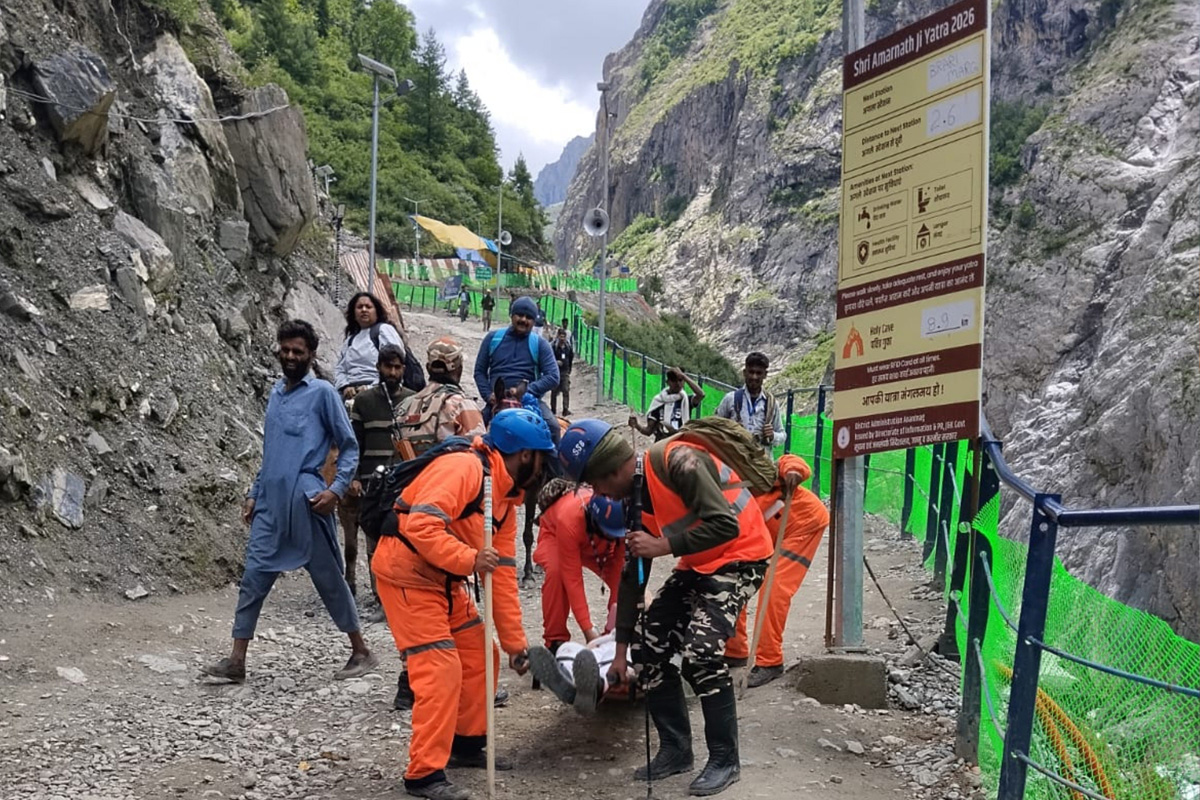
SSB personnel, alongside J&K police, ensure a safe and secure pilgrimage for thousands of devotees undertaking the Amarnath yatra. (Photo | X.com)

Synopsis: Many narratives talk up the Amarnath Yatra, among them that it gives a Rs 2,000-3,000 crore boost to the economy of Kashmir. But the truth is that the influx of pilgrims in worryingly large numbers to this ecologically sensitive region is becoming increasingly difficult to justify.
First came the viral video of men bathing and women shampooing their hair in the once pristine Lidder waters at the picturesque valley of shepherds, Pahalgam.
Then came the disturbing footage of an ambulance halted to let the buses carrying Amarnath pilgrims pass.
It was followed by unrelenting traffic across Srinagar, and the reported 90 per cent melting of the ice stalagmite (lingam) by the sixth day of the Yatra, among other incidents.
All of these warrant a reflection on how a pious religious and cultural event has been reduced to “virtue signalling” for the wider Indian body politic, with little regard for the logical, ecological, and theological realities of Kashmir.
Compared to the 1980s, the number of Amarnath pilgrims has increased nearly fiftyfold, with more than half a million now entering this ecologically fragile valley. While allowing such an expansion in the scale of the Yatra may serve political ends, it is also accelerating environmental degradation. A recent report noted that Kashmir’s glaciers are melting faster than those across the rest of the Himalayas, attributing the accelerated retreat of glaciers such as Thajwas to excessive transportation, mass tourism, and overcrowding in these fragile ecosystems.
Baltal has become a ‘tent city’, generating enormous quantities of waste without any scientific disposal mechanism. The direct discharge of human waste and sewage into the Lidder and Sindh rivers has severely polluted vital freshwater sources, increasing toxic contamination and reducing dissolved oxygen levels. Open-air cooking and diesel generators further contribute to localised warming and black carbon deposition, thus accelerating the melting of nearby glaciers and permanent snow beds.
Kashmiris have a tradition of removing their footwear before dipping their feet in the Sindh and Lidder. These waters are considered sacred in our culture. Therefore, the indifference to their degradation is deeply troubling. The State Pollution Control Board and the Department of Science and Technology have repeatedly highlighted these concerns, but to little effect. If pilgrimages to high-altitude sites such as Kedarnath, Badrinath, Vaishno Devi, and even the Hajj are subject to regulatory limits, why have the Nitish Sengupta Committee’s recommendations and repeated Supreme Court directives on regulating the Amarnath Yatra remained unimplemented? To make matters worse, the administration is often praised for accommodating thousands of unregistered pilgrims, creating a perverse incentive for the assembly of even larger crowds in subsequent years.
Worryingly, the proposed opening of a new route to the cave via Minamarg in Ladakh’s Drass region would only intensify the environmental burden. These are not ideological objections but ecological and practical concerns. Yet, no comprehensive environmental impact assessment has been undertaken. In the process, the spiritual ethos of pilgrimage, which should be inseparable from respect for nature, has increasingly been overshadowed by its projection as a patriotic enterprise and a nationalistic pilgrimage.
The Amarnath Yatra is as much a Kashmiri endeavour as it is an annual spiritual event for the Hindus. Kashmir is the host, yet many Kashmiris experience it as mute and often muted spectators. The problem isn’t just the occasional video of a few politically charged individuals shouting ‘Jai Shri Ram’ or ‘Bham Bham Bhole’ slogans at Kashmiri women. Those incidents are disturbing, but they also point to a much deeper issue: the feeling of becoming strangers in your own homeland during one of the biggest events.
Every year, the Valley undergoes a massive security transformation. Around the Bhavans and Yatra camps, fresh rolls of concertina and barbed wire appear. Every tent is fenced off, and when there aren’t enough personnel, even Station House Officers reportedly help lay the concertina themselves. The entire pilgrimage route is lined with heavily armed security forces personnel. Roads are frequently closed for civilian traffic to let the Yatra convoys pass, and common Kashmiris, including patients in ambulances, often have to wait until the cavalcade passes. This is apart from the usual halts to let the Army convoys pass. These daily disruptions leave many residents with a sense of being reduced to second-class citizens during the Yatra.
The impact isn’t limited to security alone. For almost two months, teachers, doctors, and other government employees are pulled away from their regular work and assigned Yatra duties. In several places, Tehsildar and BDO offices are converted into shelters for pilgrims. Everyday governance takes a back seat while the entire administrative machinery is reorganised around the pilgrimage.
Then there is the magnitude of the security deployment itself. Nearly 400 companies, comprising approximately 40,000 armed personnel, are stationed across the Kashmir Valley to ensure a smooth and incident-free Yatra. Whether one sees it as necessary or not, such an extraordinary deployment inevitably shapes how people experience the event. It is difficult to describe a festival as joyous when it unfolds behind layers of concertina wire and under the watch of tens of thousands of armed personnel.
There have also been videos of pony handlers being beaten up and of pilgrims verbally abusing Kashmir Police personnel despite their efforts to manage huge, often unregistered crowds. These incidents don’t define the Yatra, but they certainly leave a lasting impression.
Kashmir has always opened its doors to pilgrims. In fact, a Kashmiri Muslim family from South Kashmir’s Batkoot discovered the Amarnath cave. People want the Amarnath pilgrimage to be remembered as a celebration of faith, hospitality, and shared humanity. But when politics, hyper-nationalism, and overwhelming securitisation begin to dominate the experience, the warmth of that hospitality gets buried. Perhaps the saddest part is that many Kashmiris no longer feel like participants in it.
The Farooq Abdullah-led National Conference government, which assumed power in 1996, passed the legislation creating the Shri Amarnath Shrine Board (SASB) through an Act in 2000. Until then, the Yatra was managed directly by the state. Since its formation, the SASB, headed by the Governor, has managed the pilgrimage with considerable autonomy. While its primary focus has understandably been ensuring security for the pilgrims, ecological concerns and local sentiment have increasingly taken a back seat.
The BJP projects the Yatra as a national affair and benefits politically by presenting it as an extension of its broader temple politics and a conquest. But it would be inaccurate to suggest that this process is a post-2019 phenomenon. The expansion of state patronage started in the late 1990s, when successive governments promoted the Yatra as a way to quell ‘separatism’ and to reinforce the state’s presence in Kashmir. Whatever the motivations then or now, it is time to move beyond this competitive communalism and have a rational conversation about the pilgrimage’s ecological impact on the fragile ecology, which witnesses frequent flashfloods, cloudbursts, landslides and shooting stones.
Equally questionable is the claim that every pilgrim spends around ₹35,000 and that the Yatra generates ₹2,000–3,000 crore for Kashmir’s economy. The reality is far more complicated. Much of the Yatra is organised and controlled by the SASB. Accommodation, food, langars, and even many stalls selling Kashmiri products are outsourced to non-local operators. As a result, a significant portion of the money never really circulates within the local economy.
Even the everyday experience challenges the economic narrative. One need only observe the transport counters to understand how inflated these estimates are. It is common to see passengers insist on getting ₹3 back because the fare for the Pantha Chowk–Baltal route is ₹197. While there is nothing wrong with asking for the correct change, such interactions challenge the claim that the average pilgrim spends lavishly and contributes tens of thousands of rupees to the Kashmir economy.
The Amarnath pilgrims are always welcome. But the assumption that the Yatra, in its current form, substantially uplifts Kashmir’s economy is difficult to sustain. If pilgrims travel from one SASB-managed camp to another, stay in SASB-sponsored tents, eat at designated langars, and move according to fixed schedules, where exactly is the opportunity for meaningful local spending?
By gradually stripping the pilgrimage of its distinctly Kashmiri and spiritual character and turning it into an increasingly ideological affair, we have done a disservice to everyone involved. The ecology has suffered, and so have local sentiments. Many Kashmiris increasingly view it not as a shared spiritual tradition but as a political and ideological exercise, a feeling reinforced when they see their own vehicles held back while Yatra convoys are given preference and uninterrupted passage. If the annual pilgrimage is to remain meaningful, it must be viewed not merely through the lens of politics and security but also through ecology, local participation, and mutual respect.
Also Read:
Who is a Kashmiri? The contradictions in Pakistan’s Kashmir discourse
Dachigam: Legacy, power and the question of renewal as Omar decides to march to Jantar Mantar
(Zuhaib Yousf Mir holds a Master’s degree in Economics from the University of Edinburgh and writes regularly on politics, economics, ecology and youth affairs. He tweets @ZuhaibYousf and can be reached at zuhaibyousfmir@gmail.com.)
(Edited by R Rajesh Kumar.)



