

Published Nov 12, 2026 | 3:55 PM ⚊ Updated Nov 12, 2026 | 3:55 PM

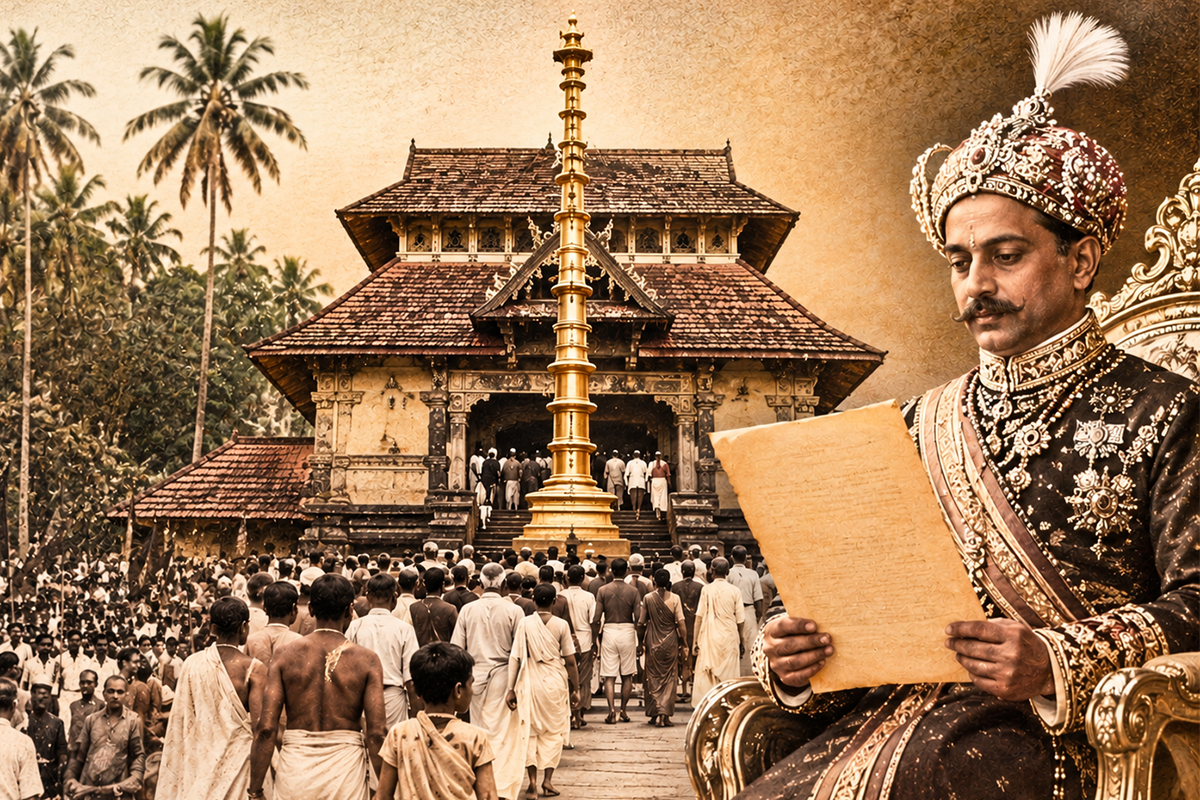
The Proclamation did not emerge overnight, nor was it the outcome of a single movement or leader.

Synopsis: The historic Temple Entry Proclamation of 12 November 1936, which opened Travancore’s temples to all Hindus, was the culmination of nearly two decades of sustained social reform and public pressure. From the early interventions of a retired High Court judge and Ezhava leaders to the Vaikom and Guruvayur satyagrahas, the growing support of Savarna organisations and the influence of social reformers, campaigns and political developments – all paved the way for one of the most significant turning points in Keralam’s social history.
The historic Temple Entry Proclamation of 12 November 1936 in Travancore was not a sudden act of royal benevolence. It was the culmination of nearly two decades of social reform efforts, political representations, public campaigns and sustained pressure from both oppressed communities and sections of upper-caste Hindus.
The Proclamation did not emerge overnight, nor was it the outcome of a single movement or leader. Its roots can be traced to events that began nearly two decades earlier, when a retired High Court judge set the ball rolling, an Ezhava legislator took the fight to the pages of a weekly and the Sree Moolam Popular Assembly.
The influence of Western ideas, Christian missionaries, Mahatma Gandhi, Sree Narayana Guru and powerful community movements at Vaikom and Guruvayur all contributed to changing public opinion and compelled the Travancore administration to reconsider its position on caste-based exclusion.
As Keralam marks 90 years of the historic proclamation, the lesser-known stories behind the momentous decision offer a fascinating glimpse into how a deeply entrenched social order was finally challenged.
The demand for opening temples to all Hindus had surfaced in Travancore well before the major satyagrahas of the 1920s.
Mahadev Desai, Mahatma Gandhi’s personal secretary, in his work The Epic of Travancore, stated that C. Raman Pillai, a retired High Court judge, was the first person in Travancore to publicly call for opening all state temples to Avarnas (some 30 castes were categorized as Avarnas then).
He made the demand at a public meeting in Quilon (Kollam) in 1917.
However, Desai identified the intervention of T.K. Madhavan, a prominent Ezhava leader and editor of the Malayalam weekly Deshabhimani, as the first major organised effort to take the demand to the government.
T K Madhavan
At the 15th session of the Sree Moolam Popular Assembly in 1919, Madhavan submitted a representation seeking the removal of untouchability and the admission of Avarnas to temples traditionally reserved for Savarnas. The government declined to intervene, maintaining that the issue concerned religion and was therefore beyond its jurisdiction.
Desai questioned the reasoning, pointing out that a Hindu government could not simply rely on the argument traditionally advanced by the British administration when it had a responsibility to protect the interests of all its Hindu subjects, including the most disadvantaged.
The issue resurfaced in the Assembly in 1920, when another Ezhava member, Kunju Panicker, raised the hardships faced by Ezhavas in social and political life and asserted their right, as Hindus, to enter all Hindu temples. The government merely took note of his representation.
Madhavan raised the demand again in 1921, but the Dewan reiterated the earlier position, ruling that a religious matter could not be discussed in the Assembly.
The repeated rejection of these representations did not end the campaign. Instead, it strengthened the resolve of reformers and community organisations to take the issue beyond the legislature.
The Temple Entry Enquiry Committee’s report of 1934 identified the Ezhava community as a major force behind the early agitation.
It noted that Ezhavas were the largest and most influential among the Avarna communities in Travancore, with a relatively higher level of education and economic standing.
According to the census figures cited in the report, Ezhavas numbered 869,863, marginally more than the Nairs, whose population stood at 868,411.
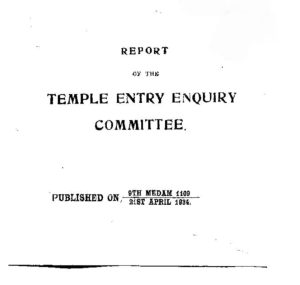
The Report
Unlike the Pulayas and Parayas, who were largely dependent on agricultural labour, Ezhavas were engaged in industry, trade and agriculture. Their comparatively stronger economic position had also provided them with greater access to education.
The committee observed that the community’s growing awareness of its social position made it particularly conscious of the indignities imposed by caste restrictions. Ezhavas had begun organising themselves to improve their social standing, and the demand for access to Hindu temples emerged as a natural extension of that struggle.
The Sree Narayana Dharma Paripalana (SNDP) Yogam, with Sree Narayana Guru as its guiding force, repeatedly passed resolutions demanding temple entry at its meetings. The organisation helped turn the demand into a sustained community campaign rather than an isolated political representation.
The committee also pointed to the influence of Western ideas as an important factor in changing the attitudes of Savarnas.
Christian missionary activity, it noted, had challenged caste-based discrimination by drawing attention to the inequalities and social humiliation associated with untouchability. Missionaries contrasted these practices with Christian teachings and questioned the justification for treating people as belonging to higher and lower castes.
According to the report, such criticism gradually encouraged Avarnas to question traditional social hierarchies. It also contributed to a decline in faith in certain established social and religious practices among sections of the Savarna population.
The resulting change in outlook helped create a climate in which support for temple entry could grow.
The campaign gradually moved beyond the Ezhava community, drawing support from several influential Hindu organisations and leaders.
Desai records that the Kerala Hindu Sabha, the Nair Service Society, the Yogakshema Sabha representing Malayali Brahmins (Namboodiris), and the Kshatriya Mahasabha extended their support to the agitation.
The Nair Service Society and its local units, the Nair Samajams, took up the issue actively, conducting extensive propaganda across Travancore and creating a considerable awakening among Savarnas. The support extended by the Namboodiri community was also significant. The Yogakshema Sabha passed resolutions favouring the opening of temples to Avarnas at its annual conferences.
C.K. Parameshwaran Pillai, who served for several years as president of the Nair Service Society, emerged as an important voice among Savarna reformers. At a major protest meeting in Thiruvananthapuram, he articulated the sentiments of upper-caste Hindus who supported the removal of caste-based restrictions.
Mannath K. Padmanabha Pillai, who later led the Savarna Jatha from Vaikom to Thiruvananthapuram, was also associated with the Nair Service Society as its general secretary. The participation of such leaders helped widen the movement’s social base and challenged the notion that temple entry was exclusively a demand of the oppressed communities.
The developments in Travancore received a major impetus from the national campaign against untouchability.
At the Cocanada (now Kakinada) session of the Indian National Congress in 1923, the Kerala Untouchability Committee was constituted to coordinate efforts for the removal of untouchability. The initiative brought fresh momentum to the campaign in Travancore.
In March 1924, the Vaikom Satyagraha began with the objective of securing the right of Avarnas to use the public roads surrounding the Vaikom Mahadeva Temple. Dravidian ideologue Periyar and Mahatma Gandhi played important and distinct roles in the movement.
During his meeting with T.K. Madhavan in 1921, Gandhi agreed that Keralam was ready for a temple-entry agitation. Deeply concerned about the limited response of temples in South India to reform efforts, he maintained that a properly conducted satyagraha was the most effective way to address the issue, while insisting on peaceful methods.
Periyar, hailed as “Vaikom Veerar (the hero of Vaikom)” for his contributions to the movement, was instrumental in reshaping the narrative of the agitation from an internal issue of Hindu religion to a basic right of the citizen to use public roads.
The agitation was called off in November 1925, after a compromise was reached with Regent Sethu Lakshmi Bayi, who agreed to open the north, south, and west public roads leading to the temple, while the eastern road remained reserved for the upper castes.
Though the compromise was criticised by Periyar and other lower caste leaders, the over a year-long struggle became a landmark in Keralam’s social reform history.
It demonstrated the power of sustained, non-violent protest and brought the question of caste discrimination into wider public discussion.
Following Vaikom, similar efforts were made in other parts of the state to secure access for lower caste people to roads around temples. The agitation gradually moved from the right to use public roads to demand the right to worship inside temples.
A formal temple-entry campaign was launched in Thiruvananthapuram on 3 April, 1926. However, the movement soon received another major impetus from the Guruvayur Satyagraha.
On 1 November, 1931, large numbers of Dalits and Savarna Hindus assembled at Guruvayur to demand the right of Avarnas to enter the Sree Krishna Temple. The agitation, which continued for nearly 10 months, attracted considerable public attention.
K. Kelappan, popularly known as Kerala Gandhi, undertook a fast as part of the campaign. He eventually called it off on 2 October, 1932, following Gandhi’s advice. Although the satyagraha did not immediately secure temple entry, it intensified public pressure and gave the wider movement renewed national visibility.
The repeated agitations, growing support from different sections of Hindu society and the increasing prominence of the temple-entry demand eventually prompted the Travancore Government to examine the issue officially.
In November 1932, the government appointed a Temple Entry Enquiry Committee to study the question. Its report, submitted in 1934, offers an important account of the social and political developments that shaped the movement.
Apart from recording the role of Ezhava organisations and reformers, the committee highlighted the changing outlook among Savarnas, the influence of Western thought and missionary criticism of caste discrimination.
Its observation that the agitation was being driven substantially by Savarna sympathisers reflected the extent to which the campaign had moved beyond its original social base.
Also Read: 80th anniversary special of Punnapra-Vayalar struggle turns contentious, reopens old wounds in Left
By 1936, the demand for temple entry had acquired considerable strength across Travancore.
On 9 May that year, an All Kerala Temple Entry Conference was held at New Theatre Hall near the Thiruvananthapuram Central Railway Station.
The conference decided to intensify the campaign and convert the widespread goodwill for reform into a strong, collective demand. Speakers pointed out that nearly 20 lakh of the approximately 30 lakh Hindus in Travancore were being denied entry into temples.
A committee was also appointed to take up the matter directly with the Maharaja.
The conference marked another important stage in the movement.
The Travancore Government’s decision followed within months.
On 12 November, 1936, the Maharaja of Travancore issued the historic Temple Entry Proclamation through a Gazette Extraordinary.
An excerpt from it reads, “…..there should henceforth be no restriction placed on any Hindu by birth or religion on entering or worshipping at temples controlled by us and our Government.”
The Temple Entry Proclamation was thus not merely a royal decree. It was the outcome of a prolonged social struggle that gradually made the exclusion of a large section of Hindus from places of worship increasingly difficult to defend.
(Edited by Fayisa CA)



