

Published Nov 11, 2026 | 6:00 PM ⚊ Updated Nov 11, 2026 | 6:00 PM

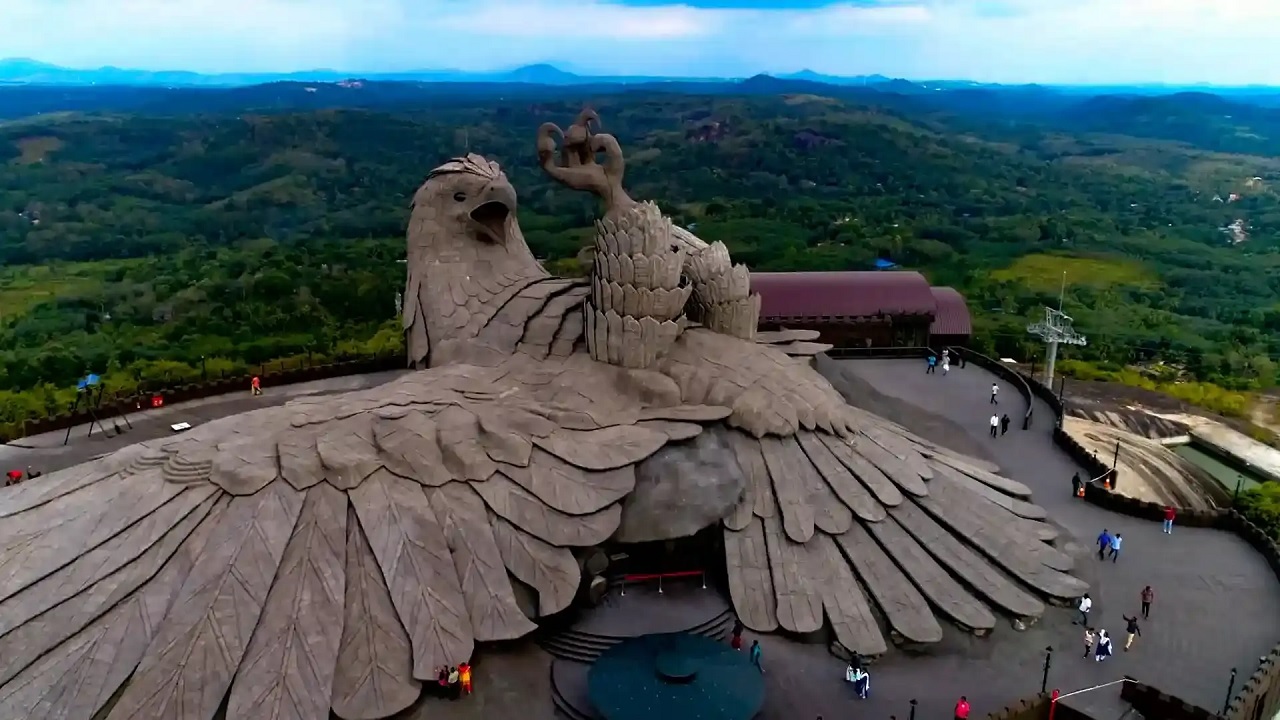
Jatayu Earth's Center/keralatourism photo gallery

Synopsis: The Jatayu Earth’s Center in Chadayamangalam, Kollam district, Keralam, has evoked renewed attention following the cinematic depiction of the battle between Ravana and Jatayu in Nitesh Tiwari’s Ramayana: Part 1. Historian Rajeev Pallikkonam says the origins of the place name have more to do with the Pandya ruler Maran Chadayan than the Valmiki Ramayana, while its association with Jatayu is believed to have emerged only in the 1970s. Moreover, Chadayamangalam is not the only place that claims to be where the legendary Jatayu fell.
The first glimpse of Chadayamangalam’s towering rocky hill is difficult to forget. Rising dramatically above the landscape of Kollam district in Keralam, the massive rock formation has long been a landmark for travellers on the Kottarakkara–Thiruvananthapuram route.
Today, perched atop the hill is a gigantic sculpture of a fallen bird, its wings spread across the rocky terrain, its beak open as though letting out a final cry for help.
The Jatayu Earth’s Center, built around the sculpture, has become one of Keralam’s most recognisable tourism destinations. Its popularity has received a fresh boost following the cinematic depiction of the battle between Ravana and Jatayu in filmmaker Nitesh Tiwari’s Ramayana: Part 1.
The film’s elaborate aerial battle sequence, which reportedly took six and a half years to complete, has drawn renewed attention to the legendary bird and the place associated with its death, largely through social media reels, travel vlogs and discussions comparing the cinematic portrayal with the real-life sculpture.
A brainchild of internationally acclaimed sculptor and filmmaker Rajiv Anchal, the 200-foot-long structure is promoted as the world’s largest bird sculpture. Its striking scale, panoramic views, cable car ride and adventure tourism facilities have helped transform what was once a relatively quiet hill into a major tourist attraction.
The Jatayu Earth’s Center was a dream project of Rajiv Anchal, whose vision was to create a monumental work of art while preserving the natural character of the rocky landscape. The sculpture took nearly a decade of painstaking work to complete.
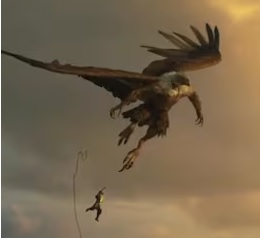
A still from Ramayana: Part 1
(Photo: X/@baxnall)
Ramayana: Part 1’s depiction of the battle between Ravana and Jatayu has prompted an influx of tourist footfall at the Jatayu Earth’s Center.
The response is already visible at the destination. Manu, an executive at the Center, told South First that the centre currently receives around 3,200 to 4,000 visitors a day.
“We are expecting the numbers to increase in the coming days, possibly to around 5,000 visitors daily. We have the facilities to accommodate them. Renovation work is also progressing,” he said.
According to him, most visitors are from Andhra Pradesh, Tamil Nadu and Karnataka. Visitors from North India also arrive in larger numbers during certain seasons, while the number of Malayali visitors remains comparatively low.
The centre currently offers a cable car ride and a walkway, while renovation work is under way on other adventure activities. The entry ticket, priced at ₹640 per person, is scheduled to be reduced to ₹555 from 15 November.
Also Read: Keralam auto, taxi unions call off strike; government agrees in principle to fare revision
Historian Rajeev Pallikkonam says the origin of the name Chadayamangalam has a historical connection with a Pandya ruler rather than with the Ramayana’s Jatayu.
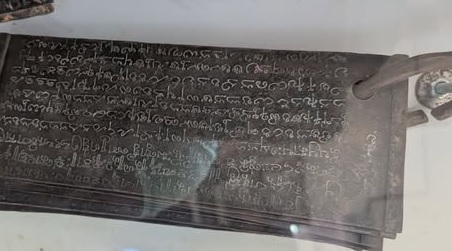
The copper plate kept in the Government Museum, Egmore
Rajeev told South First that the region was associated with Jatila Parantaka Nedunjadayan, also known as Maran Chadayan and Varagunavarman I, a Pandya ruler who reigned from Madurai between AD 765 and 815.
Historical records indicate that Nedunjadayan conquered the Ay kingdom, which extended from Kannetti in Kollam to Kanyakumari in Tamil Nadu, and maintained Pandya supremacy over the region for nearly a century.
“During the Pandya military expedition from Madurai towards Vizhinjam, the area around present-day Chadayamangalam served as a military encampment. Following the establishment of control over the territory, the forested landscape was gradually cleared for human settlement, and a temple was established. The settlement came to be known as Chadayamangalam in memory of the ruler,” he said.
Rajeev also referred to the Parthivapuram copper plates of Ay ruler Karunandadakkan, dated between AD 865 and 869, which portray him as an independent ruler. This suggests that Pandya control over the Ay territory had weakened by then.
The Jatayu association, according to Rajeev, became prominent much later.
He traces its popularisation to the 1970s, when a proposal to blast the massive rock for road construction material triggered resistance from local residents.
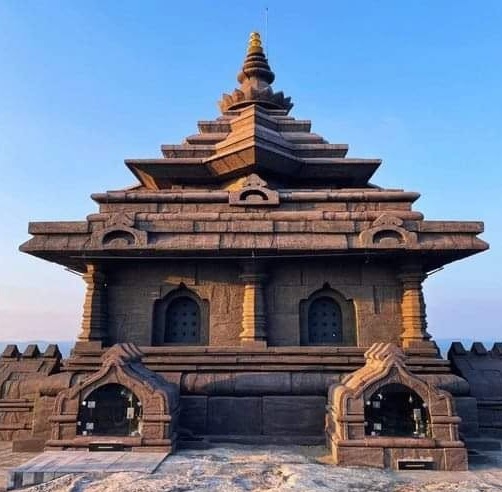
Sree Kodanda Rama Temple
The community reportedly popularised the narrative that the hill was where Jatayu fell after being attacked by Ravana. The name Jatayumangalam was introduced as part of this account, with the claim that it gradually evolved into Chadayamangalam.
The intervention of Swami Sathyananda Saraswathi and the installation of a Sree Kodanda Rama idol atop the rock on 8 February 1974 helped bring the proposed quarrying activity to an end. The Jatayu narrative subsequently gained wider acceptance.
“What we have to understand is that the Jatayu story and the original history of the place are two different things. The name Chadayamangalam existed in connection with Maran Chadayan. The later narrative gradually pushed that historical association into the background,” Rajeev said.
Also Read: ‘Breakdown in collective responsibility’: Adoor Prakash renews attack on CM Satheesan
There is another aspect of the sculpture that differs from the Ramayana: Jatayu is described in the epic as a Griddharaja, or king of vultures, but the bird represented in the sculpture resembles an eagle or a raptor.
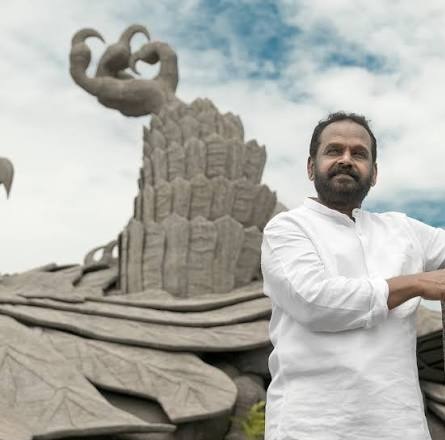
Rajiv Anchal
Rajeev recounted to South First how the idea for the sculpture emerged.
Around 2000, Rajiv Anchal’s son, who was then a school student, created a digital illustration of Jatayu using software such as Adobe Illustrator or Photoshop. The image, which depicted the bird falling at Chadayamangalam, reportedly attracted attention for its artistic quality and was featured in a Mathrubhumi newspaper report.
“The boy may not have been familiar with the distinction between an eagle and a vulture at that age. The illustration subsequently became the basis for the larger sculpture project. Rajiv Anchal approached the government with the proposal to create the monumental structure. In 2004, the then Chadayamangalam MLA, Prayaar Gopalakrishnan, took steps to transfer around 65 acres of revenue land, including the rocky hill, to the Tourism Department, considering the project’s potential to generate economic and cultural development in the constituency,” Rajeev said.
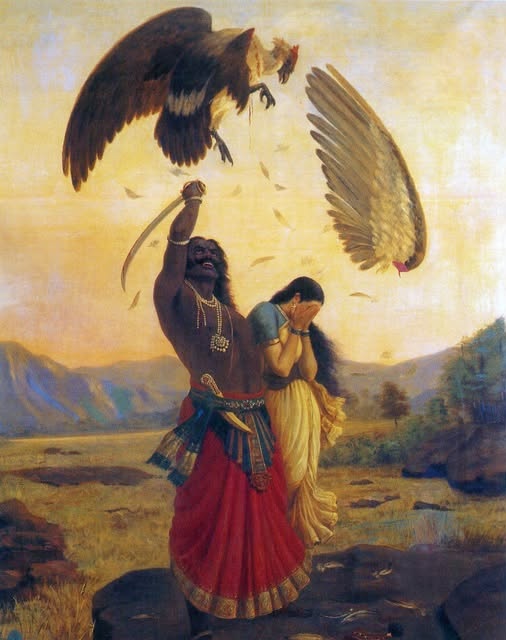
Raja Ravi Varma’s ‘Jatayu Vadham’ depicts the noble vulture Jatayu valiantly trying to save Sita from Ravana.
The project eventually took shape over the following years.
Rajeev also noted inconsistencies between the Ramayana’s narrative and the geographical plausibility of Chadayamangalam as the place where Jatayu fell. In the Ramayana, Ravana abducts Sita from Panchavati, near the Godavari, and travels towards Lanka.
“The route to Lanka would not naturally require Ravana to cross the Western Ghats and reach southern Kerala,” he said.
Moreover, Chadayamangalam is not the only place that claims to be where the legendary Jatayu fell. Lepakshi, in Andhra Pradesh, near the Karnataka border, also lays claim to the honour. The location, associated with the famous Veerabhadra Temple, built during the Vijayanagara period, is also geographically more consistent with the route from Panchavati towards Lanka, Rajeev said.
Nevertheless, for now, the Jatayu sculpture has undoubtedly given Chadayamangalam a place on the tourism map.
(Edited by Dese Gowda)



